

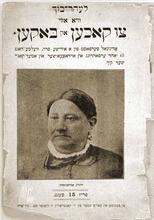
Lizzie Black Kander

Courtesy of the Wisconsin Historical Society.
Lizzie Black Kander turned the recipe book she made for a cooking class for new immigrants into a two-million-copy bestseller. Kander founded the Milwaukee Jewish Mission, called “the Settlement,” in 1896 as a base for vocational training, education, and entertainment for the poor and for new immigrants, serving as president for two decades. In 1901, denied the funds she needed to print recipes for a cooking class, Kander got funding from local businesses and printed a thousand copies of The Settlement Cook Book: The Way to a Man’s Heart, selling the extra copies off for fifty cents each. The book went through twenty-three editions, and Kander used the profits to fund two new community centers. In 1939, Wisconsin honored her as one of the state’s outstanding women.
“The way to a man’s heart is through his stomach.” In 1901, Lizzie Kander and Mrs. Henry Schoenfeld used this adage in the title of a cookbook produced for the benefit of the first settlement house in Milwaukee, Wisconsin. By 1984, nearly two million copies of The Settlement Cook Book: The Way to a Man’s Heart had been sold. Its success can be attributed to the determination and ingenuity of a woman known as the “Jane Addams of Milwaukee.”
Early Life and Service
Lizzie Black Kander, born in Milwaukee on May 28, 1858, was the third of John and Mary (Pereles) Black’s five children. Siblings included Annie Wetzler, Flora Gottachalk, and Herman, a newspaper publisher. She graduated in 1878 from Milwaukee High School and married Simon Kander, a salesman from Baltimore, on May 17, 1881. They were married for fifty years.
Kander began her service to the Jewish community in 1878 as a volunteer in the Ladies Relief Sewing Society, an organization that evolved into the Milwaukee Jewish Mission formed in 1896 under her leadership. As president of “The Settlement” (1900–1918), Kander took a pragmatic and practical approach to problems and programs. In one project, excess steam from a local brewery was used to heat water for community bathing facilities. Along with other volunteers, Kander developed popular cooking classes for young immigrants and supervised educational, social, and recreational programs for neighborhood residents.
In 1901, the Settlement’s board denied Kander’s request to underwrite the cost of printing recipe booklets for her classes. Undaunted, Kander approached the Milwaukee business community, secured outside funding, and had one thousand copies printed. Excess copies were sold through a local department store for fifty cents each. An expanded 1903 edition, supported by sixty-five local sponsors, included 180 pages of household hints, kitchen-tested recipes, and reliable instructions for preparing traditional and German Jewish foods. Kander became head of the Settlement Cook Book Company in 1914 and subsequently supervised the publication of twenty-three editions. Profits from this successful business venture funded newer and larger facilities, the Abraham Lincoln House, built in 1911, and the Jewish Community Center, opened in 1931.
Career and Legacy
field_section_text_value
Crocker, Ruth Hutchinson. Social Work and Social Order: The Settlement Movement in Two Industrial Cities, 1889–1930 (1992).
Obituary. NYTimes, July 26, 1940, 17:6.
NAW; Scott, Anne Firor. Natural Allies: Women’s Associations in American History (1991).
Trolander, Judith A. Professionalism and Social Change: From the Settlement House Movement to Neighborhood Centers, 1886 to the Present (1987).


Double your impact to amplify Jewish women’s stories—
All gifts matched up to $35,000
Before you close this article, please consider supporting the Jewish Women’s Archive and uplifting Jewish women’s voices.
At JWA, we preserve the voices of Jewish women and gender-expansive people past and present, share them freely with millions online, and empower a new generation of Jewish feminists to lead with courage, creativity, and conviction.
But none of this happens without you. JWA is an independent nonprofit— we rely on people, like you, who believe that history belongs to all of us and that the voices of Jewish women must remain powerful, and heard.
This month, a generous JWA board member will match every gift dollar for dollar—up to $35,000—through June 30. Your contribution goes twice as far right now.
Every contribution—no matter the size—helps us document, teach, and inspire through Jewish women’s stories.
It takes less than a minute to make a difference.
Thank you for being a part of the JWA community,


Judith Rosenbaum, CEO

