

Food in the United States

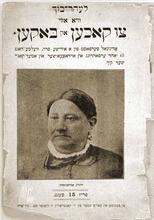
Hinde Amchanitzki's Lehr-bukh vi azoy tsu kokhen un baken (Textbook on How to Cook and Bake), published in New York, circa 1901, was one of the first Yiddish cookbooks published in the United States. Using her forty-five years of experience in European and American kitchens, Hinde Amchanitzki provided thousands of newly arrived Eastern European immigrants with an introduction to American cuisine, as well as recipes for traditional Jewish fare, in a language they could understand. In her introduction, the author (pictured on the cover) promises that using her recipes will prevent stomach aches and other food-related maladies in children.
Institution: U.S. Library of Congress, Hebraic Section.
Food and foodways—the cultural actions and processes that surround food, including not only what we eat, but when, where, why, how, and with whom—are a critically important area of documenting and deciphering the evolving experience of American Jewish women from the earliest days of immigration to the present. Food is a lens onto American Jewish women’s worlds of family, religion, identity, work, political action, entrepreneurship, and more as they have encountered the forces of assimilation, anti-Semitism, systemic racism, sexism, changing consumer economies, and the long women’s movement. By examining food “moments” throughout American history, we see Jewish women not only shaping their own Jewish lives and that of their communities, but actively impacting and changing American life and culture.
Foodways of the Early Ashkenazi Immigrants
While the earliest Jews in North America were Western Descendants of the Jews who lived in Spain and Portugal before the explusion of 1492; primarily Jews of N. Africa, Italy, the Middle East and the Balkans.Sephardic Jewish immigrants who came to early America by the 1650s from Brazil, Spain, and Portugal, as part of a long Jewish migration forced by the expulsion of Jews from the Iberian Peninsula, the first sizable American Jewish community consisted of Ashkenazi Jewish immigrants who came from Central Europe between the mid-1700s and the first decades of the 1800s. During this period, many single immigrant men became peddlers, selling goods from town to town until they could open stores of their own—a nearly universal Jewish experience. While on the road, observant Jewish peddlers carried Term used for ritually untainted food according to the laws of Kashrut (Jewish dietary laws).kosher food with them, such as hard-boiled eggs, and honored the Sabbath whether they returned home or stayed at a farmer’s home for the duration of the holiday. By taking in Jewish peddlers and clerks as boarders, middle-class Jewish women in cities from Savannah, Georgia, to Newport, Rhode Island, developed food-related businesses that provided familiar tastes, language, and a religious atmosphere for newly arrived immigrants who were separated from their families in Europe.
Mercantile trade was central to Jewish life and buying and selling food was critical to this economy. From the eighteenth century through the early twentieth century, America Jewish women worked alongside their husbands, as widows, and as sole proprietors, as dry good merchants, grocers, innkeepers, food vendors, and entrepreneurs. Jewish women were also the keepers of the religious and culinary lives of their families. Mobility, adaptation, and pragmatism influenced their choices and their expressions of “domestic Judaism.” In the 1870s, Lavinia Minis of Savannah advised her family to “keep the Sabbath Holy,” to follow the laws of kashrut, and to participate in the rituals of A seven-day festival to commemorate the Exodus from Egypt (eight days outside Israel) beginning on the 15th day of the Hebrew month of Nissan. Also called the "Festival of Mazzot"; the "Festival of Spring"; Pesah.Passover and other Jewish holidays. Lavinia wrote her husband Abram when he was away on business and traveling on the Sabbath, “I do not think that you will ever regret having kept the Sabbath holy, Abram dear, although it is not more than a right-minded man should do” (Ferris, 40.)
As merchants, traders, slave-owners, and even a small number of planters, American Jews in the South, but also in Northeastern trading sectors, largely supported slavery and the economy it made possible. White-generated wealth from rice and cotton contributed to the affluence of Jewish communities, too. In South Carolina, a traditional silver rice spoon owned by the Lazarus family served the grain that became known locally as Carolina Gold. The family’s cake knife and silver kiddush cup—for making a special blessing over wine—was likely used each Sabbath and on Jewish holidays. In the spring of 1862, when Union forces occupied New Orleans during the Civil War, Clara Solomon, the teenage daughter of a Confederate Jewish family wrote in her diary, “Our [Passover] motzoes are so miserably sour that I don’t think I have eaten a whole one…I expect before long we shall all starve” (Ashkenazi, 334). Across the country, Jewish women participated in war-time efforts, including “sanitary fairs” and the publication of synagogue and community cookbooks as fundraisers to support both Union and Confederate troops.
Eastern European Jewish Immigrants and Food
field_section_text_value
The Development of Kosher Certification
To combat these changes and the rise of Reform Judaism in America, many Orthodox Jews clung to their old traditions, including kashrut. (The first kosher cookbook published in America, Jewish Cookery by Esther Levy, appeared in 1871.) It was not always easy. In 1881 in Denver, for example, Jews were unable to acquire kosher meat, so they either had to practice ritual slaughtering for themselves or eat no meat. Later, many of them would become Conservative Jews.
One Orthodox Jew, Rabbi Hyman Sharfman, went from Kennebunkport, Maine, to Corpus Christi, Texas, in a gearless cycle car, sometimes on horseback, kashering meat and teaching people in the community how to do it themselves. Another, Dov Behr Manischewitz, hearing of the huge center of Reform Judaism in Cincinnati, decided to settle there as a shohet. He later made his fortune in the Unleavened bread traditionally eaten on Passover.mazzah industry.
The diverse Orthodox immigrant groups lacked unified Jewish leadership. In a small town in Russia, for example, the rabbi was the leader, and everyone went to the same shohet. In New York, with millions of people and thousands of kosher butchers, not to mention the importance of the separation between church and state, there was no central authority to whom to turn for validation of the religious laws. In 1888, eighteen Orthodox synagogues in New York, Philadelphia, and Baltimore organized themselves and brought over Jacob Joseph, the chief rabbi of Vilna, as their head. Among his other duties, he was supposed to organize the kosher meat business. Not surprisingly, considering what he was up against, he failed miserably. By 1917, at the height of Orthodoxy in America, there were a million Jews eating 156 million pounds of kosher meat annually—or at least meat they believed to be kosher. With no central authority, individual rabbis were putting hekhsher (kosher) stamps on the meat. Some was kosher, some was not. It was not until 1944 that a food inspection bureau to authenticate kosher meats was formed in New York State. It remains in operation to this day, and its inspectors regularly spot-check all kosher meat markets across the state—yet there are still occasional problems.
Because of escalating prices, kosher meat and bread riots broke out at the turn of the century with women leading the lines. One boycott was dubbed the “war of the women against the butchers.” The battle cry became “twelve cents instead of eighteen cents a pound.” Eastern European Jewish women oversaw the domestic consumption of their families and, as daily consumers in the marketplace, also controlled the pace of their families’ acculturation. Historian Andrew Heinze argues that Jewish women’s purchasing power of new mass-produced American food products and home goods—many designed specifically for a Jewish market and Jewish holidays—symbolized their changing status and place in the United States.
At the turn of the twentieth century, the Union of Orthodox Jewish Congregations of America, the umbrella organization for Orthodox Jews, was established as a means of bringing cohesion to the fragmented immigrant Jewish populations. In 1923, the year it created its women’s branch and four years after women won the right to vote, the union’s official kashrut supervision and certification program was introduced.
At about that time, a New York advertising genius named Joseph Jacobs encouraged big companies to advertise their mainstream packaged products in the Yiddish press. Jacobs’s mission was to change the way Americans thought about Jewish dietary practices. The chains and the big food companies did not know how to promote to a Yiddish-speaking population, since they employed no Jews. Jacobs encouraged the Maxwell House coffee company to write a Haggadah and helped Crisco and Pillsbury to produce Yiddish-English cookbooks to teach the immigrant women, who would salivate over the illustrations in the Ladies’ Home Journal but could not read English. Now they could use Crisco to make an “American” apple or lemon meringue pie; better yet, they could serve their children southern fried chicken.
When canned products like H.J. Heinz Company’s baked beans and pork came on the market, an inventive man named Joshua C. Epstein, an Orthodox Jew, had a thought: What if Heinz made kosher vegetarian baked beans? Company officials liked Epstein’s suggestions, but they balked at the idea of writing “kosher” in Hebrew or English on the package. “Heinz wanted something identifiable, but not too Jewish: they didn’t want to antagonize the non-Jewish population,” recalls Abraham Butler, the son of Frank Butler, Heinz’s first mashgiah. With Jacobs and Rabbi Herbert Goldstein, one of the founders of the Union of Orthodox Hebrew Congregations of America, the three devised the Orthodox Union OU symbol, today the best-recognized trademark of the some 120 symbols of kosher certification.
Sephardi and Mizrahi Cooking in America
field_section_text_value
Jewish Cooking in the South
In the Jewish South, skilled African American cooks and domestic workers, enslaved then free, deeply shaped evolving regional Jewish American cuisine. Black and Jewish culinary historian Michael Twitty argues that the first “kosher soul cookery” flourished in the coastal colonial South, where a culinary syncretism emerged between Black women cooks and Jewish women at the center of mercantile families. The dynamics of this labor and its racial interactions was complex, both exploitative and intimate.
In Greenville, Mississippi, where the nearest delicatessen is over 150 miles to the north in Memphis, Tennessee, the sisterhood members of Hebrew Union Congregation have organized a deli-style community meal for decades. The event raises funds for the historic congregation and allows non-Jewish neighbors to enjoy corned beef shipped in from Chicago piled high on rye bread for sandwiches. The annual deli lunch also reflects the Jewish self-sufficiency of places with small Jewish populations and little in the way of Jewish infrastructure other than a place of worship. Philip Graitcer shared this story through the voices of Hebrew Union’s resilient congregants in his 2017 radio documentary for the Southern Foodways Alliance, “Corned Beef Sandwiches in the Delta.”
Negotiating the rules of kashrut versus fitting into a largely non-Jewish community was clearly felt in Natchez, Mississippi, at Temple B’nai, founded in the 1840s. By the 1990s, the congregation had declined to just a few members due to the changing agricultural economy of the region. When the congregation celebrated its long history at a “homecoming” event in 1994, the tension of religion versus region still prevailed. Producer and journalist Robin Amer documented her grandmother Elaine Lehmann’s powerful voice—and presence—in this historic congregation in “The Last Jews of Natchez,” where listeners can learn about the “ham biscuit incident.”
Creating “Jewishness” Through Food
field_section_text_value
Twentieth-Century Transformations
field_section_text_value
Into the Twenty-First Century
field_section_text_value
Admony, Einot and Janna Gur. Shuk: From Market to Table, the Heart of Israeli Home Cooking. New York: Artisan, 2019.
Alpern, Liz, and Jeffrey Yoskowitz. The Gefilte Manifesto: New Recipes for Old World Jewish Foods. New York: Flatiron Books, 2016.
Amer, Robin. “The Last Jews of Natchez.” Southern Foodways Alliance Gravy Podcast, May 21, 2015. https://www.southernfoodways.org/gravy/the-last-jews-of-natchez-gravy-ep-14/
Ashkenazi, Elliot. The Civil War Diary of Clara Solomon: Growing Up in New Orleans, 1861-1862. Baron Rouge: Louisiana State University Press, 1995, 334.
Braunstein, Susan L. and Jenna Weissman Joselit, eds. Getting Comfortable in New York: The American Jewish Home, 1880-1950. New York: The Jewish Museum, 1990.
Capelouto, Susannah. “Pie by Another Name: The Burekas of Or VeShalom.” Southern Foodways Alliance Gravy Podcast, August 24, 2017. https://www.southernfoodways.org/gravy/pie-by-another-name-the-burekas-of-or-ve-shalom/
Cohen, Jake. Jew-ish: Reinvented Recipes from a Modern Mensch. New York: Houghton Mifflin Harcourt, 2021.
Deutsch, Jonathan and Rachel D. Saks. Jewish American Food Culture. Westport, CT: Greenwood Press, 2008.
Diner, Hasia R. Hungering for America: Italian, Irish, & Jewish Foodways in the Age of Migration. Cambridge: Harvard University Press, 2001.
Diner, Hasia R. and Simone Cinotto, eds. Global Jewish Foodways: A History. Lincoln, NE: University of Nebraska Press, 2018.
Diner, Hasia R. Roads Taken: The Great Jewish Migrations to the New World and the Peddlers Who Forged the Way. New Haven: Yale University Press, 2015.
Ferris, Marcie Cohen. Matzoh Ball Gumbo: Culinary Tales of the Jewish South. Chapel Hill: University of North Carolina Press, 2005.
Graitcer, Philip. “Corned Beef Sandwiches in the Delta.” Southern Foodways Alliance Podcast, April 6, 2017. https://www.southernfoodways.org/gravy/corned-beef-sandwiches-in-the-delta/
Green, Edith. Oral interview with Joan Nathan, July 1991.
Gross, Aaron S., Jody Myers, and Jordan D. Rosenblum, eds. Feasting and Fasting: The History and Ethics of Jewish Food. New York: NYU Press, 2019.
Gross, Rachel B. “Jews, Schmaltz, and Crisco in the Age of Industrial Food.” In Feasting and Fasting: The History and Ethics of Jewish Food, eds. Aaron S. Gross, Jody Myers, and Jordan D. Rosenblum. New York: NYU Press, 2019.
Heinze, Andrew R. Adapting to Abundance. New York: Columbia University Press, 1990.
Jacobs, Richard. Oral interview with Joan Nathan, 1991.
Joselit, Jenna Weissman. The Wonders of America: Reinventing Jewish Culture, 1880-1950. New York: Hill and Wang, 1994.
Joselit, Jenna Weissman, Barbara Kirshenblatt-Gimblett, Irving Howe, and Susan Braustein. Getting Comfortable in New York: The American Jewish Home, 1880-1950. New York: The Jewish Museum, 1990.
Kander, Lizzie Black. Microfilm material. American Jewish Archives, Cincinnati.
Katchor, Ben. The Dairy Restaurant. New York: Nextbook/Schocken, 2020.
Kempner, Aviva. “Yoo-Hoo, Mrs. Goldberg.” Documentary, 2009.
Koenig, Leah. Modern Jewish Cooking: Recipes & Customs for Today’s Kitchen. San Francisco, CA: Chronicle Books LLC, 2015.
Koenig, Leah. The Jewish Cookbook. London: Phaidon Press Limited, 2019.
Krone, Adrienne. “Ecological Ethics in the Jewish Community Farming Movement.” In Feasting and Fasting: The History and Ethics of Jewish Food, eds. Aaron S. Gross, Jody Myers, and Jordan D. Rosenblum. New York: NYU Press, 2019.
Levy, David. "The orange on the seder plate and Miriam's Cup: Foregrounding women at your seder." 12 March 2012. Jewish Women's Archive. <https://jwa.org/blog/he-orange-on-seder-plate-and-miriams-cup-foregrounding-women-at-your-seder>.
Marcus, Jacob Rader. Memoirs of American Jews, 1775–1865. Philadelphia: Jewish Publication Society of America, 1955.
Merwin, Ted. Pastrami on Rye: An Overstuffed History of the Jewish Deli. New York: NYU Press, 2015.
Lipman, Steve. “Crashing the Kosher Party.” The Jewish Week, October 29, 2004.
Nathan, Joan. The Foods of Israel Today. New York: Knopf, 2001.
Nathan, Joan. Jewish Cooking in America. New York: Knopf, 1994.
Nathan, Joan. The Jewish Holiday Kitchen New York: Schocken Books, 1979.
Nathan, Joan. “Lights of Life, Food of Memory.” The New York Times, December 1, 2004.
Nathan, Joan. “A Social History of Jewish Food in America.” In Food & Judaism, ed. Leonard J. Greenspoon, Ronald A. Simkins, and Gerald Shapiro. Omaha, NE: Creighton University Press, 2005.
Nathan, Joan. King Solomon’s Table: A Culinary Exploration of Jewish Cooking from Around the World. New York: Alfred A. Knopf, 2017.
Newhouse, Alana, ed. The 100 Most Jewish Foods: A Highly Debatable List. New York: Artisan, 2019.
Orlovsky-Schnitzler, Justine. "The Politics of Holiday Preparation." 4 March 2021. Jewish Women's Archive <https://jwa.org/blog/politics-holiday-preparation>.
Ottolenghi, Yotam and Sami Tamimi. Ottolenghi: The Cookbook. New York: Ten Speed Press, 2013.
Rao, Tejal. New York Times, March 10, 2021.
Roden, Claudia. The Book of Jewish Food: An Odyssey from Samarkand to New York. New York: Knopf, 1996.
Schleifer, Yigal. “Kashrut Goes Global.” The Jerusalem Report, December 13, 2004.
Sharfman, I. Harold. Jews on the Frontier. Malibu, CA: Joseph Simon Pangloss Press, 1977.
Shaya, Alon. An Odyssey of Food, My Journey Back to Israel. New York: Knopf, 2018.
Sussman, Adeena. Sababa: Fresh. Sunny Flavors from My Israeli Kitchen. New York: Avery, 2019.
Twitty, Michael. The Cooking Gene: A Journey Through African American Culinary History in the Old South. New York: HarperCollins, 2017.
Uhry, Alfred. Driving Miss Daisy. New York: Theater Communications Group, 1996.
Zeller, Benjamin E., Marie W. Dallam, Reid L. Neilson, Nora L. Rubel, eds. Religion, Food, & Eating in North America. New York: Columbia University Press, 2014.
Ziegelman, Jane. 97 Orchard: An Edible History of Five Immigrant Families in One New York Tenement. New York: Harper, 2010.
More Like This





Double your impact to amplify Jewish women’s stories—
All gifts matched up to $35,000
Before you close this article, please consider supporting the Jewish Women’s Archive and uplifting Jewish women’s voices.
At JWA, we preserve the voices of Jewish women and gender-expansive people past and present, share them freely with millions online, and empower a new generation of Jewish feminists to lead with courage, creativity, and conviction.
But none of this happens without you. JWA is an independent nonprofit— we rely on people, like you, who believe that history belongs to all of us and that the voices of Jewish women must remain powerful, and heard.
This month, a generous JWA board member will match every gift dollar for dollar—up to $35,000—through June 30. Your contribution goes twice as far right now.
Every contribution—no matter the size—helps us document, teach, and inspire through Jewish women’s stories.
It takes less than a minute to make a difference.
Thank you for being a part of the JWA community,

Judith Rosenbaum, CEO