

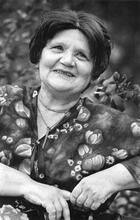
Amalia Kahana-Carmon
Amalia Kahana-Carmon literary works are known for their expression of Woolfian Modernism, expressed in Kahana-Carmon’s reluctance to admit the relevance of personal factors such as sex and class to the artistic process. In the mid-1980s, Kahana-Carmon became an outspoken feminist critic of Israeli and Jewish culture. Wedding Franz Fanon’s analysis of the otherness of race to the critique of gender otherness in the tradition of Simone de Beauvoir, Kahana-Carmon published Up in Montifer (1984), in which she probes and compares three categories of otherness—gender, race, and class. Conducting a dialogue with de Beauvoir and contemporary feminist sensitivities, she opened a space for a postmodern, multicultural feminism in Israel. She was awarded the Israel Prize for literature in 2000.
Gentiles and Jews, they are like men and women, my father used to say. ‘Why,’ I once asked. ‘Only because of preconceived judgments. Of each side: about oneself; about the other, too,’ my father smiled. Each side has its own picture, my father always said. Its image of the other. Therefore, when addressing someone from the other side, to the image and not to the person one would speak. (Up in Montifer, 1984)
Early Life and Family
field_section_text_value
Kahana-Carmon’s Woolfian Modernism
This superb (and idiosyncratic) Hebrew stylist has long been associated in the Israeli literary mind with Virginia Woolf, on two counts: the uniqueness of her poetics, and her thematization of women’s plight, on a scale previously unrivalled in Hebrew literature. A typical Kahana-Carmon protagonist is a frustrated woman, one who seems to have lost her ability to reach the highest level of existence, which she had experienced before marriage, in her aspiring university or war years. Yet despite this preoccupation, the protagonists of Kahana-Carmon’s early work, starting with the lyrical, beautifully crafted stories of her first book, Under One Roof (Hebrew, 1966), are allowed epiphanic “visions,” moments of a (sometimes mutual) enchantment, that “lift” their narratives above and beyond a narrow feminist angle. Kahana-Carmon apparently shares in the general Modernist endeavor to redeem a world cut loose from its spiritual anchors through “involuntary memories” (Marcel Proust), “elusive epiphanies” (James Joyce), or visionary “moments of being” (Woolf).
Kahana-Carmon’s Woolfian Modernism is expressed also in her reluctance to admit the relevance of such personal factors as sex, class, and the like, to the artistic process, as a conversation with a fictional (male) writer in her first novel And Moon in the Valley of Ayalon (Hebrew, 1971) clearly attests. This refusal complicates her early feminist leanings, dictating a world full of “others”: Not only the women, but most of her characters enter the scene other-wise. They are fully aware of their “otherness” as women and wives, sometimes as mothers or children, as artists or new immigrants; sometimes as 1948 Israelis (of either sex) marooned in the Tel Aviv of 1967 and after; sometimes as a (male) artist trapped in a “masculinist” system, ironically represented by a young, goal-oriented American female scientist, who frustrates his dream of “work and love” (Magnetic Fields, Hebrew, 1977). Theirs is a disabling otherness of the worst kind—almost crippling, yet rendered with the most powerful literary mastery.
Postmodern Israeli Feminism
field_section_text_value
Literary Legacy and Death
Interestingly, the author chose to end her 1996 book, Here We’ll Live (Hebrew), a carefully reorganized selection of her fiction, with the narrative of Clara. Indeed, this narrative turns out to be not only Kahana-Carmon’s model for feminist liberation, but also her most subversive confrontation with the “fathers’ tongue.” Although her style had always been marked by stark appropriations from Scriptures, it is in Up in Montifer that appropriation turns into subversion, along the way exposing both national and sexual biases inadvertently imbedded in the biblical fathers’ tongue.
Kahana-Carmon died on January 16, 2019, in Tel-Aviv, at the age of 92.
Selected Works by Amalia Kahana-Carmon
Hebrew
Under One Roof (novellas and stories), 1966.
And Moon in the Valley of Ayalon (novel), 1971.
A Piece for the Stage, in the Grand Manner (monodrama), 1975.
Magnetic Fields (novella and stories), 1977.
High Stakes (stories), 1980.
Up in Montifer (novella and stories), 1984.
With Her on Her Way Home (novel), 1991.
Here We’ll Live (novellas), 1996.
Feldman, Yael S. Feldman. No Room of Their Own: Gender and Nation in Israeli Women’s Fiction. New York: 1989, Chapter 3 (See Notes for Chapter 3 and Bibliography pp. 309–310).
Feldman, Yael S. “Returning the Gaze: Traces of Simone de Beauvoir in Hebrew Literary Feminism.” Re’eh (Paris), Fall 1999, 25–32.
Feldman, Yael S. “‘A People That Dwells Alone?’ Toward Subversion of the Fathers’ Tongue in Israeli Women’s Fiction.” AJS Review 28:1 (2004): 83-103.
More on Amalia Kahana-Carmon
Double your impact to amplify Jewish women’s stories—
All gifts matched up to $35,000
Before you close this article, please consider supporting the Jewish Women’s Archive and uplifting Jewish women’s voices.
At JWA, we preserve the voices of Jewish women and gender-expansive people past and present, share them freely with millions online, and empower a new generation of Jewish feminists to lead with courage, creativity, and conviction.
But none of this happens without you. JWA is an independent nonprofit— we rely on people, like you, who believe that history belongs to all of us and that the voices of Jewish women must remain powerful, and heard.
This month, a generous JWA board member will match every gift dollar for dollar—up to $35,000—through June 30. Your contribution goes twice as far right now.
Every contribution—no matter the size—helps us document, teach, and inspire through Jewish women’s stories.
It takes less than a minute to make a difference.
Thank you for being a part of the JWA community,


Judith Rosenbaum, CEO

