

Jewish Women and Contemporary Dance in Argentina

In the mid-twentieth century, contemporary dance styles emerged in Argentina, largely due to the contributions of Jewish women, including Ana Itelman, Renate Schottelius, and Ana Kamien, who played critical roles in pioneering modern dance styles in Argentina. These women founded dance studios and choreographed performances in an era plagued by dictatorships and cultural repression. Contemporary dance was a medium through which artists bravely combatted the stifling of culture. Schottelius, for example, choreographed a dance influenced by the political devastation in Argentina. In 1983, when democracy was reestablished in Argentina, contemporary dance was able to flourish, allowing choreographers like Ana Kamien and Ana Itelman to experiment with the visual, choreographic, and musical elements of dance.
Introduction
field_section_text_value
Ana Itelman (August 20, 1927—September 16, 1989)
Ana Itelman was born in Chile and migrated as a child with her family to Argentina. In the 1940s she joined Argentina’s first modern dance company, led by Myriam Winslow. From 1945 to 1947, she trained in the United States with Martha Graham, Hanya Holm, Louis Horst, and José Limón. Returning to Argentina, Itelman began choreographing and performing solo work. In 1950 she created a modern dance studio with the aim of developing her own company. The company made its debut in 1955 with her fusion-style piece Esta ciudad de Buenos Aires (This City of Buenos Aires), which combined tango dynamics with classical choreography.
Itelman later returned to the United States, where she joined Bard College’s Dance Department as a professor and later as head of the department. She continued her own dance training with Merce Cunningham and Alwin Nikolais and reached out to any source she could for enrichment, such as lighting design classes and acting lessons with Lee Strasberg.
In 1970, Itelman returned to Buenos Aires, where she founded the Café Estudio de Teatro Danza. Her first production there was Alicia en el país de las Maravillas (Alice in Wonderland).
Itelman developed a marvelous body of choreographic work while crafting a personal method for teaching choreography. Her ongoing composition class served as fertile terrain for many dancers who wanted to become independent choreographers. Itelman combined elements she had learned from many different sources, including, among others, the Alwin Nikolais–Murray Louis Improvisation Method, ideas from drama and acting classes, and her own taste and knowledge of classic Russian literature. In the 1980s and 1990s, all the important figures-to-be in contemporary dance in Argentina attended Itelman’s composition classes.
Itelman developed her own choreographic work mostly with the San Martín Theatre’s Grupo de Danza Contemporánea (Contemporary Dance Group), today renamed Ballet Contemporáneo (Contemporary Ballet). Her many iconic pieces included El capote (The cloak), Historia del soldado (The Soldier’s Tale), Las casas de Colomba (The Houses of Colomba, inspired by Tennessee Williams's A Streetcar Named Desire), Paralelo al horizonte (Parallel to the Horizon), Suite de percal (Percale Suite), and Y ella lo visitaba (And She Visited Him). She was posthumously honored with the Konex Award for choreography in 1989.
Itelman lent her own property to host the San Martín Theatre Workshop, where many of the finest dancers enrolled in (and still take) a free three-year program; she later donated the property to the Workshop. After Itelman’s suicide in 1989 following a serious depression, her family donated all of her choreographic notes, video material, and bibliography for archival purposes to the Documentation Center at the same theater. In 2018, through an open, online voting campaign, the Center was named after her. In Argentina, as in other Latin American countries with the exception of Mexico, there are as yet no serious dance history archives; Itelman’s is the only well-preserved dance collection in the country.
In 2014, the Buenos Aires Contemporary Dance Festival’s Homage for Ana Itelman was led by young choreographers Jimena Pérez Salerno and Josefina Gorostiza, along with filmmakers Natalia Ardissone and Jimena Cantero. The evening they crafted included a restaging of Itelman’s early piece Tango and the screening of the commissioned documentary Apuntes sobre Ana Itelman (Notes on Ana Itelman). The directors’ statement published in the festival program reads:
[Itelmania]… a work that questions the relationship between the power of memory, the living archive of the bodies, and the staging of an homage…. We were born in 1984…. We know that Itelman lived until 1989… [We were too young] to build our version of Ana Itelman so we depended on others’ stories and experiences.
The performance featured a dozen of Itelman’s notable disciples, who joined the directors onstage: Monica Fracchia, Sofía Ballvé, Rubén Szuchmacher, Doris Petroni, Roxana Grinstein, Liliana Toccacelli, Diana Szeinblum, Ana Deutsch, Sandro Nunziata, Virginia Ravenna, and Silvia Pritz.
The most striking moments of Itelmania were the times when each of the ten performers (most of them choreographers and/or theater directors in their own right) evoked an exercise or assignment from Itelman’s choreography class. A wave of life seemed to travel through the stage when they recalled names of assignments, either shouting them out or reading them from a piece of paper. These names had been found decades later in notes Itelman kept in a diary of her classes. This element of the performance seems to raise a question about legacy and the different ways artists (especially choreographers) leave a mark on their disciples. What is a stronger learning experience for a new choreographer: assignments in class or watching a piece in a theater? How, if at all, is it possible to follow the invisible thread of an artist’s legacy through generations?
Renate Schottelius (December 8, 1921—September 27, 1998)

In 2016, the Buenos Aires Contemporary Dance Festival commissioned choreographer Susana Szperling to direct its Homage to Renate Schottelius. To do so, Szperling revisited both her own memories as a student and the memories of many notable Schottelius disciples, including Oscar Araiz, Ana Maria Stekelman, Ana Deutsch, Andrea Chinetti, Diana Theocharidis, and Alejandra Vignolo. In her interviews, Szperling asked these Argentinean dance giants to evoke, in movement as well as in words, their memories of Schottelius. Ana Deutsch was particularly moving when she recreated an improvisation exercise from Schottelius’s class about moving from one’s gaze.
In the resulting Renate virtual y sus actuales (Virtual Renate And Her Actuals), these artists appear on stage only virtually, projected on screen. Their voices and their bodies constitute the framework for a stage piece in which three dancers (Susana Szperling, Mauro Cacciatore, and Liza Rule Larrea) embody Schottelius’s choreography from her pieces Aria and Paisaje de gritos, as well as exercises from both her technique and composition classes. The screen is also the surface for images extracted from choreographic pieces, classes, and a short documentary in which Schottelius’s own voice is heard, marking the end of the Homage.
Two scenes made up of monologues particularly stand out. One, by pianist Aníbal Zorrilla, who was the accompanist for Schottelius’s technique classes for more than twenty years, tells stories related to Schottelius’s involvement with music for her class. She would ask for particular rhythms and speeds: “I want them to be surprised,” she used to say. In one class she said: “Yes, it is OK to feel the violence of the speed of movement.” The other monologue, by Susana Szperling, is a spoken word plus movement scene, in which Szperling recalls being the odd one out at Schottelius’s class, where she was told: “You don’t respect forms.” Szperling asks herself onstage: “Why did they commission me, if I was not one of Renate’s preferred students?”
Renate virtual y sus actuales premiered on Schottelius’s birthday in 2016 and has had a life beyond the festival, with performances the following year at two theaters in Buenos Aires (25 de mayo and Centro Cultural de la Memoria Haroldo Conti). It also became a performance-lecture presented in December 2018 at Ciclo Cuerpos (Bodies Series, Centro Cultural Matienzo), as well as at academic venues such as the Universidad Nacional de las Artes (National University of the Arts). On June 30, 2022, it was restaged at Borges Cultural Center, funded by the Ministry of Culture of the Nation.
Itelman and Schottelius Collaborate
Democracy was reestablished in 1983, and by 1987, spirits were high; people were experiencing freedom of expression and movement after decades of repression. The streets of Buenos Aires were very much alive and Ana Itelman and Renate Schottelius joined forces to curate a series of dances that would take place outside the black “empty” space of the traditional theater stage. The result was Otras danzas (Other Dances), a series that occupied many unusual spaces at Recoleta Cultural Center, a marvelous building that had been an abandoned monastery, a home for the elderly, and finally a city-owned cultural center. Young choreographers, many presenting their first pieces, were called to perform their own pieces at the building’s patios, staircases, and hallways. Itelman and Schottelius (with the assistance of Silvia Pritz) advised the choreographers about the pieces to be developed onsite. This was one of the first opportunities the Buenos Aires dance community had to exchange artistic views outside the theater and the classroom. Otras danzas marked the beginning of a sense of community for people in the dance field and was a milestone in terms of authorizing dance students to consider themselves artists.
Ana Kamien (b. May 15, 1934)

Dancer and choreographer Ana Kamien has been part of the avant-garde movement of contemporary dance since the 1960s. She was a member of the group of artists gathered in and around the Di Tella Institute in Buenos Aires, a major venue and think tank that encouraged avant-garde artists in visual arts, music, and performing arts (theater and dance). The director and curator of the Performing Arts Series, Roberto Villanueva, gave equal importance to theater, dance, and mime, at a time when most dance recitals were isolated events, rather than a four- to eight-week season.
Ana Kamien and her colleagues Marilú Marini and Graciela Martínez made the Di Tella their center of operations and presented piece after piece there, including Danza Actual (Current Dance, 1963), an experimentation with objects and fabrics that modified the human body, and Danse Bouquet (1965), which included Marvila la Mujer Maravilla contra Astra la Superpilla del Planeta Ultra y su monstruo destructor (Marvilla the Wonder Woman against Astra the Super Villain from the Ultra Planet and her Destructor Monster), in which they played with a pop comic-like sense of humor. For La fiesta, hoy (The Party, Today, 1966), they worked very closely with Kamien’s husband Leone Soninno, a photographer who was very keen to experiment with the slide projection system, altering the images and creating visual scenographies.
The core of these artists’ work at Di Tella in the 1960s was interdisciplinary. In the film Danza Argentina en los 60 (Argentinean Dance in the ‘60s), Kamien reflected: “I want to state that, since the visual artists designed our costumes, the visual aspect was at the same level of importance as the choreographic and the musical aspects… Choreography was not the Supreme God to whom we said ‘Let’s see how we dress this.’ Suddenly the costume determined how we danced. Or the music did. It was a whole thing.” She recalled that many artistic interdisciplinary collaborations started out by chance encounters with visual artists on the streets surrounding the Di Tella building, on a square that was called La manzana loca (The Crazy Apple or The Crazy Square; manzana means both in Spanish).
Marcelo Epstein’s 1971 film Ana Kamien, shot in black and white just after Di Tella Institute was closed down by the dictatorship, shows Ana Kamien dancing in her heyday. Several scenes embody the most distinctive characteristics of the group composed of Martínez, Marini, and Kamien, portraying the elements the dancers were working on, including abstraction of the body using props and costumes that modified and deformed its shape.
As scholar Rodrigo Alonso states:
Ana Kamien, together with filmmaker Marcelo Epstein, also created the first work that can be considered, in all senses, “dance for the camera”… In this film, the stage was completely replaced by a neutral and physical space created through the movements of the camera and the dancer’s body. The spatial fragmentation promoted a visual abstraction. Every movement was considered according to the position of the camera; every shot enhanced the movement isolated from the whole choreography, which remains incomprehensible beyond its audiovisual representation. The editing created its own choreography through the fragments of movement: it did not reconstruct a preexisting kinetic organization. For all this, Ana Kamien is not only one of the first examples of dance for the camera in Argentina: it is also one of the best” (Alonso, “From Tango to Video Dance”).
 view larger
Mauro Cacchiatore and Lisa Rule Larrea in Susana Szperling’s Homage to Renate Schottelius, “Renata virtual y sus actuales,” at the Festival de danza contemporánea de Buenos Aires 2016. Courtesy of Susana Szperling.
view details view larger
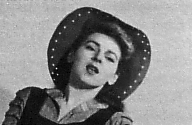
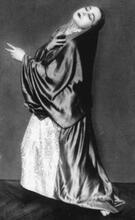
Argentine dancer Ana Kamien, 1971. Photograph by Leone Sonnino. Courtesy of Leone Sonnino.
view details view larger
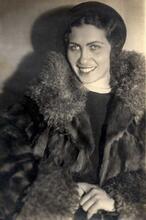
Argentine dancer Ana Kamien, 1970. Photograph by Leone Sonnino. Courtesy of Leone Sonnino.
view details view larger
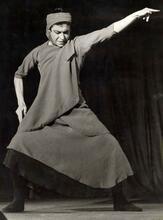
Caption: Argentine dancer Ana Kamien, 1971. Photograph by Leone Sonnino. Courtesy of Leone Sonnino.
view details view larger
Argentine dancer Ana Kamien, 1978. . Photograph by Leone Sonnino. Courtesy of Leone Sonnino.
view detailsAlonso, Rodrigo. “From tango to video dance: Dance for the Camera in Argentina.” Paper presented at Dance for the Camera Symposium, University of Wisconsin, 2000; http://www.roalonso.net/en/videoarte/tango.php, accessed 01-24-2023).
Fortuna, Victoria. Moving Otherwise: Dance, Violence and Memory in Buenos Aires. New York: Oxford University Press, 2019.“Legado de una maestra de la danza.” La Nación, September 16, 2004; https://www.lanacion.com.ar/espectaculos/danza/legado-de-una-maestra-de-la-danza-nid636634/
Prieto, Carolina. “Tributo a una maestra y coreógrafa.” Página 12, November 12, 2017; https://www.pagina12.com.ar/75364-tributo-a-una-maestra-y-coreografa.
Reinhart, Stephanie. “Dance in the Bottom of the World in Argentina.” In Dancing Female: Lives and Issues of Women in Contemporary Dance, edited by Sharon E. Friedler and Susan B. Glazer. Routledge: New York, 1997.
Videography:
Apuntes de Ana Itelman (Notes on Ana Itelman), by Natalia Ardissone and Jimena Cantero (2014), https://vimeo.com/108850187 accessed 02/25/2023.
Renate virtual y sus actuales (Virtual Renate and Her Actuals), by Susana Szperling (2016): https://susanaszperling.com/susanaszperlingrenate.html.
Paisaje de gritos, by Renate Schottelius (1981, restaged 1993), https://www.youtube.com/watch?v=NVc0aiQDrF4.
Ana+Leone, by Laura Arensburg (2018) https://vimeo.com/229501057.
Ana Kamien, by Marcelo Epstein (1970) https://vimeo.com/133870952
More Like This

Double your impact to amplify Jewish women’s stories—
All gifts matched up to $35,000
Before you close this article, please consider supporting the Jewish Women’s Archive and uplifting Jewish women’s voices.
At JWA, we preserve the voices of Jewish women and gender-expansive people past and present, share them freely with millions online, and empower a new generation of Jewish feminists to lead with courage, creativity, and conviction.
But none of this happens without you. JWA is an independent nonprofit— we rely on people, like you, who believe that history belongs to all of us and that the voices of Jewish women must remain powerful, and heard.
This month, a generous JWA board member will match every gift dollar for dollar—up to $35,000—through June 30. Your contribution goes twice as far right now.
Every contribution—no matter the size—helps us document, teach, and inspire through Jewish women’s stories.
It takes less than a minute to make a difference.
Thank you for being a part of the JWA community,


Judith Rosenbaum, CEO