

Susan Braun

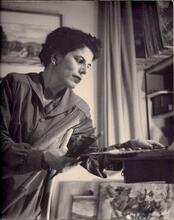
Susan Braun trained as a visual artist at the Parsons School of Design and the Art Students League before turning her interest to dance. From 1949–1953 she studied Isadora Duncan’s dance technique under Anita Zahn. In 1950 she began working with Daniel Livingston at the New York Dance Films Society, eventually becoming co-director. The Society was devoted to showing the few dance films available at the time, mostly 16-millimeter Russian ballet movies. When the organization folded, Braun founded Dance Films Association as a resource for makers of dance films, with a newsletter, a comprehensive catalogue of dance films, and an annual competitive film festival called Dance on Camera—the first film festival exclusively for dance, begun in 1971. The Association helped create a cohesive community of dance filmmakers and film lovers, generating interest and support for this new cinematic genre.
Article
Recognizing the need for a new genre that combined dance and film, Susan Braun single-handedly set up a place where artists could come together and plan how to merge the ideas of choreographers and filmmakers. She founded Dance Films Association in 1956, an organization that presaged the ever-growing development of work between filmmakers and dancers, and that continues to provide a haven for these artists. Dancers are not only preserving their works on film, but are establishing a new medium, a dance and film evening, that merges the two art forms. The dancer can now make a second career—that of the filmmaker.
Susan Braun was born July 24, 1916, in New York City to Alfred and Georgina (Ballin) Braun. Alfred Braun, born in Hungary to Jewish parents, became a distinguished otolaryngologist after he immigrated to the United States. Georgina Braun, who had German roots, died when her daughter, an only child, was just two years old. Although Braun had a rigid “old world New York” upbringing on the Upper East Side of Manhattan, the world of music and painting enlightened her childhood. Although not religious by nature, she learned and maintained a great reverence for the symbolic rituals of all faiths. Her father executed many fine paintings, and her uncle Maurice Braun, a popular California artist, had a considerable influence on her. Alfred Braun frequently took his daughter to the Metropolitan Opera, thus beginning her lifelong love of music. Braun attended the Parsons School of Design, Jamesine Franklin School of Professional Arts, and the Jessie Ansbacher Group at the Art Students League.
From 1949 until 1953, Braun studied Isadora Duncan dance technique with Anita Zahn, thereby discovering that dance would play a major part in her life. Having been trained for a career in art, she did an about-face and focused on dance. In the early 1950s, other than some 16mm films on Russian ballet, very little film documentation of dance existed. After having helped Daniel Livingston with the New York Dance Films Society, Braun started Dance Films, Incorporated, in 1956 when his organization folded. It soon became Dance Films Association, Incorporated, a not-for-profit service center for the dance and film community, and the first such center in the United States. She also created the Dance on Camera Festival, the first film/video/dance festival.
Susan Braun died in New York City on October 3, 1995. In her work, she crossed paths with and was admired and respected by almost all the luminaries of the dance and film world.
Lipari, Victor. “A Singular Vision: Susan Braun and Dance Films Association.” Sightlines: The Journal of the American Film and Video Association (Summer 1992): 26–27.
Tish, Pauline. “Dance Films Association Is Still Growing.” Performing Arts Review 10, no. 1 (1980): 85.Towers, Dierdre. “Susan Braun, 79, Dies.” Dance on Camera News (September–October 1995): 1.
Who’s Who of American Women (1958–1959): 159.
More on Susan Braun
Double your impact to amplify Jewish women’s stories—
All gifts matched up to $35,000
Before you close this article, please consider supporting the Jewish Women’s Archive and uplifting Jewish women’s voices.
At JWA, we preserve the voices of Jewish women and gender-expansive people past and present, share them freely with millions online, and empower a new generation of Jewish feminists to lead with courage, creativity, and conviction.
But none of this happens without you. JWA is an independent nonprofit— we rely on people, like you, who believe that history belongs to all of us and that the voices of Jewish women must remain powerful, and heard.
This month, a generous JWA board member will match every gift dollar for dollar—up to $35,000—through June 30. Your contribution goes twice as far right now.
Every contribution—no matter the size—helps us document, teach, and inspire through Jewish women’s stories.
It takes less than a minute to make a difference.
Thank you for being a part of the JWA community,

Judith Rosenbaum, CEO

