

Images of Jewish Women in Medieval European Literature

Medieval European representations of Jewish women by Christian authors from the thirteenth through fifteenth centuries reveal anxieties about Jews and their imagined intentions. Some of these writings, which first appear in exempla, didactic stories used in Christian preaching, portray young Jewish women as easily seduced by Christian men and Christian teachings. Their evil fathers, conversely, are threats to Christians and must be thwarted and humiliated. An English ballad tradition depicts a beautiful but malevolent Jewish woman who leads a Christian boy to his ritual murder. Supposed sexual liaisons between rulers and Jewish women, including legends about the Spanish monarch Alfonso VIII and the “Jewess of Toledo” and the Polish King Casimir’s love for Esterke, express perceptions of Jewish threats to the Christian state.
This article discusses representations of Jewish women in medieval European religious and secular literature by Christian authors from the thirteenth through the fifteenth centuries. The texts considered here come from England, France, Germany, Spain, and Poland and were written in Latin and vernacular languages.
Literary Representations from England, France, and Germany
Moralistic stories known as exempla, which were a feature of medieval Christian sermons, are an early and significant source of literary images of Jewish women. These vivid and sometimes salacious tales entertained listeners while imparting spiritual lessons. In the thirteenth century, collections of exempla circulated throughout Europe as handbooks for preachers. Among these are the early thirteenth-century Dialogus Miraculorum of Caesarius of Hesterbach (d. 1240), the mid-thirteenth-century Bonum Universal de Apibus of Thomas of Cantimpré (d. 1272), and the Tractatus de diversis Materiis Praedicabilibus of Stephen of Bourbon (d. 1261). Jewish conversion was a theme in some of these exempla and scholars have pointed to strikingly different portrayals of Jewish men and women. Jacob Lackner has written that Jewish “men are represented as evil adversaries whose conversions typically took place after they had attempted to cause some harm to a Christian or to Christianity, only to see their evil act prevented or reversed by a miracle that convinced them to convert” (Lackner, 24). Jewish women, on the other hand, generally depicted as young and attractive, are willing converts; some are described as becoming Christians of their own accord, “while others call out to the Virgin Mary in a time of need and choose to convert after receiving her miraculous help” (Lackner, 24). Lackner has suggested that such narratives promoted “the intercessory powers of the Virgin, which were becoming a more prominent aspect of Christian theology in the twelfth and thirteenth centuries.” Such stories taught, as well, that Jewish women possessed an inclination for the truths of Christianity that was absent in Jewish men. Portrayals of malleable Jewish women also reflected medieval ideas about women “as receptive by nature to suggestion and conversion” (Lackner, 28). As Anthony Bale has written, the image of the Jewish woman convinced by the truths of Christianity “gained an enduring cultural importance as the medieval ancestor of Marlowe’s Abigall in “The Jew of Malta” (c. 1592) and Shakespeare’s Jessica in “The Merchant of Venice” (c. 1598), and cognate characters of the ‘beautiful Jewess’ appear throughout the post-medieval period” (Bale, 95).
Several exempla focus on a stereotypically ugly male Jew and his beautiful daughter. In one popular story, “The Clerk and the Jew’s Daughter” (Sicher, 33), a Christian clerk seduced the daughter of a Jew; when she became pregnant, he relayed a purportedly divine message to her parents that their daughter would give birth to the long-awaited messiah. The baby was a girl and the father demonstrated “the callous cruelty of the Jews” by killing” the infant (Sicher, 33). Anthony Bale writes that this “narrative is a moral parody of the Annunciation (Luke 1:26–38), with the clerk as mock-Gabriel and the Jewess as anti-Virgin” (Bale, 90). While there are parallels in other genres of medieval literature, often intended as humorous, in which a clerk impregnates a young naïve virgin, in this version it is the Jewishness of the woman that is central and no humor is present. The conclusion of this story declares that the clerk had sex with the woman in order to shame her, her father, and their co-religionists. In contrast to “similar exempla in which saintly men maintain their chastity in the face of brazen female sexual temptation,” the clerk is not criticized for his lack of chastity. Apparently, Bale writes, Christian sexual morality may be suspended if it leads to Jewish humiliation (Bale, 99).
In other exempla, young Jewish women convert in repulsion at their fathers’ actions, which sometimes are said to involve invoking the aid of demons (Sicher, 32). A story in the Dialogus Miraculorum describes a young Christian clerk who is interested in an attractive Jewish girl; she returns his affection but complains that her father watches her too closely. They decide that the only time of the year that they can be together is on A seven-day festival to commemorate the Exodus from Egypt (eight days outside Israel) beginning on the 15th day of the Hebrew month of Nissan. Also called the "Festival of Mazzot"; the "Festival of Spring"; Pesah.Passover, when a “flow of blood” weakens Jewish men; this is a reference to the medieval superstition that Jewish men, who were believed to have female qualities, experienced menstruation (Lackner, 32). As Joan Young Gregg has written, this and similar exempla contain “the perceived Jewish sexual threat through the feminization of the Jewish male…. Cross-gendering the Jewish male as lascivious but female defused the threat of his physical aggression while maintaining his image as a peril to Christian purity through illicit sexual activity, which a clericized medieval society had already linked to devils and women in general” (187).
The couple are discovered by the angry father, but he refrains from killing the Christian because he recognizes him as a relative of the bishop. The next day, the clerk goes to repent for his sins at the same time as the Jews of the community enter the Church to protest his behavior. However, through a miracle, they are unable to speak, and the bishop forgives his relative. At this point, the young Jewish woman converts. This story reinforces the ruling that “Jews should not enter churches for any reason, as decreed by various church councils in the thirteenth century,” while demonstrating Christianity’s opposition to Judaism and heresy (Lackner, 32). At the same time, it emphasizes the ripeness of Jewish women as both willing sexual objects and subjects for conversion.
In a somewhat different iteration of these themes, the beauty and sexuality of the Jewish woman is depicted as dangerous for Christian males. The evil Jewish woman, “whose cruelty represents the collective malevolence of the Jews and the sexual rapaciousness of women in juxtaposition to the merciful figure of the chaste Virgin Mary” (Sicher, 25), also originates in exempla literature. This representation of perilous female carnality is central to ballads that developed in late thirteenth-century England in the aftermath of the 1255 blood libel against the Jews of Lincoln. (Bale, 100 ff.; Sicher, 25 ff.). The earliest surviving example of the ballad “Sir Hugh, or the Jew’s Daughter” was first transcribed in eighteenth-century Scotland, so it is not possible to determine when the “Jew’s daughter” motif was first introduced into legends about “Little Saint Hugh of Lincoln.” It does not appear in the version of the blood libel story in “The Prioress’s Tale” in Geoffrey Chaucer’s Canterbury Tales (ca. 1392), nor in the earliest surviving version of the ballad, written in Anglo-Norman in the third quarter of the thirteenth century. However, Sicher points to “the portrayal of the cruel Jewess as a predator and anti-type of the Virgin Mary in fifteenth-century paintings depicting the ritual murder of Simon of Trent,” an indication that the association of Jewish women with the blood libel was already longstanding (26).
Anthony Bale has written that by the later Middle Ages these ballads strongly established the association between Jewish women and eroticized danger. The ballads describe how the Jew’s daughter entices a little boy into her garden with an apple; she then murders him and drains his blood. Bale notes that the ballad, while not sexual in any explicit way, casts the Jewess as “a new Eve engaged in a solitary physical ritual of blood that unites a range of forbidden desires and appetites” (Bale, 100). The Jewish woman attempts to hide the body in a well dedicated to the Virgin Mary, which “reveals her misconceived femininity, as well as calling to mind the rite of baptism” (Bale, 100-101), but the dead boy’s singing alerts the Christian community. Bale writes that this medieval representation of the Jewish woman demonstrates “a fallen, sexy, secret and yet open body, engaged with the most precious symbols of Christianity,” including the crucifixion, the eucharist, and the salvific role of the Virgin Mary (102).
In the “Sir Hugh” ballad tradition, which remained popular for centuries, the Jew’s daughter became an embodiment of both sexual anxiety and death (Sicher, 29); she is “a dire warning of the femme fatale, who lures men to their death,” and a threat of what, collectively, Jews might do to little boys (Sicher, 31). It is interesting, however, that, as Miri Rubin has noted, images of Jewish women played no significant roles in any of the many extant tales of Jewish host desecration in thirteenth- and fourteenth-century Europe (76). In those narratives, Jewish men were always portrayed as the perpetrators and, ironically, they were often assisted in obtaining communion wafers by Christian women motivated by economic necessity (Rubin, 73-77).
Literary Representations from Spain
field_section_text_value
Queen Esther in Poland
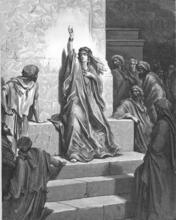
The story of the biblical Esther also played a significant role in Polish folklore about Esterke, a Jewish woman who was the said to be the mistress of Casimir the Great, King of Poland between 1310 and 1370. She is first mentioned in the fifteenth-century chronicle of Jan Długosz (1415–1480, also known as Johannes Longinus), a Polish priest and writer who is considered Poland's first historian. Długosz blamed Casimir’s encouragement of Jewish settlement in Poland, and the extensive privileges he granted the Jews, of which Długosz disapproved, on the king’s overwhelming love for Esterke. As is evident in Długosz’s account, the story of Esterke was likely invented to explain why Casimir enlarged the rights and prerogatives of Polish Jews. Chone Shmeruk and Haya Bar-Itzhak are among scholars who have explored the expansion of legends about Esterke in popular culture and in literary works by both Polish and Jewish writers over the centuries. The earliest Jewish version was by David Gans (1541-1613): In his chronicle, Tsemaḥ David, published in Prague in 1592, Gans maintained that Esterke was actually married to the king. Over the centuries, the story inspired literary works in Polish, Yiddish, and Hebrew, as well as numerous artistic renditions (Bar-Itzhak, ch. 4; Sicher, 58-62). Bar-Itzhak notes that a house in Kazimierz Dolny, Poland, supposed to be that of Esterke, remains a tourist attraction (Bar-Itzhak).
Conclusion
Depictions of Jewish women in medieval literature of the thirteenth through fifteenth centuries emphasize the supposed susceptibility of young and beautiful Jewish women to Christian seduction, both literal and spiritual. They also portray Jewish women as dangerous to the individual Christian and to the interests of the Christian state. Thus, accounts of liaisons between Jewish women and powerful Christians represented the humiliation and feminization of Jewish men, while stories about malevolent and dominant Jewish women expressed ongoing Christian anxieties about the influence and intent of the alien other. These narratives are not as much about Jewish women as they are expressions of medieval disquiet about the presence of Jews and the perils they were imagined to pose to overwhelmingly Christian cultures.
Aizenberg, Edna. “‘Una judía muy fermosa’: The Jewess as Sex Object in Medieval Spanish Literature and Lore.” La Corónica 12 (1984): 187-194.
Bale, Anthony. “The Female ‘Jewish’ Libido in Medieval Culture.” In The Erotic in the Literature of Medieval Britain, ed. Amanda Hopkins and Cory James Rushton, 94-104. Cambridge, UK: D. S. Brewer, 2007.
Bar-Itzhak, Haya. Jewish Poland: Legends of Origin. Ethnopoetics and Legendary Chronicles. Detroit: Wayne State University Press, 2001.
Boyarin, Adrienne Williams. Miracles of the Virgin in Medieval England: Law and Jewishness in Marian Legends. Cambridge, UK: D.S. Brewer, 2010.
Gregg, Joan Young. Devils, Women, and Jews: Reflections of the Other in Medieval Sermon Stories. Albany, NY: State University of New York Press, 1997.
Lackner, Jacob. “Violent Men and Malleable Women: Gender and Jewish Conversion to Christianity in Medieval Sermon Exempla.” Nashim: A Journal of Jewish Women's Studies & Gender Issues 30 (Spring 2016): 24-47.
Marcus, Ivan. “The Image of the Jews in the Exempla of Caesarius of Heisterbach.” In From Witness to Witchcraft: Jews and Judaism in Medieval Christian Thought, ed. Jeremy Cohen, 247-256. Wiesbaden: Harrassowitz, 1997.
Nirenberg, David. “Deviant Politics and Jewish Love: Alfonso VIII and the Jewess of Toledo.” Jewish History 21, no. 1 (March 2007): 15-41.
Rubin, Miri. Gentile Tales: The Narrative Assault on Late Medieval Jews. New Haven: Yale University Press, 1999.
Shmeruk, Chone. The Esterke Story in Yiddish and Polish Literature: A Case Study in the Mutual Relations of Two Cultural Traditions. Jerusalem: Zalman Shazar Center, 1985.
Sicher, Efraim. The Jew's Daughter: A Cultural History of a Conversion Narrative. Lanham, MD: Lexington Books, 2017.
More Like This

Double your impact to amplify Jewish women’s stories—
All gifts matched up to $35,000
Before you close this article, please consider supporting the Jewish Women’s Archive and uplifting Jewish women’s voices.
At JWA, we preserve the voices of Jewish women and gender-expansive people past and present, share them freely with millions online, and empower a new generation of Jewish feminists to lead with courage, creativity, and conviction.
But none of this happens without you. JWA is an independent nonprofit— we rely on people, like you, who believe that history belongs to all of us and that the voices of Jewish women must remain powerful, and heard.
This month, a generous JWA board member will match every gift dollar for dollar—up to $35,000—through June 30. Your contribution goes twice as far right now.
Every contribution—no matter the size—helps us document, teach, and inspire through Jewish women’s stories.
It takes less than a minute to make a difference.
Thank you for being a part of the JWA community,


Judith Rosenbaum, CEO