

Habsburg Monarchy: Nineteenth to Twentieth Centuries

Jewish women in the Habsburg Monarchy experienced the stresses and strains of nineteenth- and twentieth-century Jewish life as Jews, as women of their particular social classes, and as inhabitants of the different regions of the Monarchy. In some regions, they modernized and acculturated, but the overwhelming majority remained deeply pious, traditional Jews. A tiny minority became famous “salon Jewesses” in the early nineteenth century, while ordinary Jewish women helped their families integrate into Austro-Hungarian society and remain devoted to the Jewish community. Jewish women experienced changes in their education and their roles in religious life over the course of the period.
Introduction
The experience of Jewish women under the Habsburg Monarchy differed greatly according to the part of this large and extremely diverse country in which they lived. The Habsburg Monarchy was a dynastic state, whose territory had been acquired over many centuries and whose inhabitants spoke a wide array of languages, practiced many different religions, and constructed many different ethnic, national, and cultural identities in the nineteenth and twentieth centuries. Habsburg territory included the Habsburg hereditary lands (roughly present-day Austria), where most people spoke German, and the provinces of Bohemia and Moravia (present-day Czech Republic), acquired during the wars of religion in the sixteenth century, whose inhabitants spoke Czech and German. Virtually all the people in these regions were Roman Catholics. In the seventeenth century, the Kingdom of Hungary, which also included Slovakia, Croatia, and Transylvania, joined the Monarchy. Its inhabitants spoke many languages—Magyar, German, Slovak, Croatian, Serbian, Slovene, Ukrainian, Romanian, and Yiddish—and most of them practiced the Catholic, Lutheran, Calvinist, and Orthodox faiths. Habsburg territory also included parts of northern Italy, as well as the provinces of Galicia and Bukovina, obtained through the partitions of Poland in the eighteenth century. Here the inhabitants spoke Polish, Ukrainian, and Yiddish and were either Catholics, Uniates (Orthodox Christians who followed the Pope in Rome), or Jews. In each of these regions Jews had different historical experiences, faced divergent demands made by the local populations in whose midst they lived, and accommodated to modernity in a different manner.
Jewish women experienced the stresses and strains of nineteenth- and twentieth-century Jewish life as Jews, as women of their particular social classes, and as inhabitants of the different regions of the Monarchy. They certainly shared legal status with all Jews, suffering traditional anti-Jewish economic and residential restrictions until Joseph II lifted some of them in his famous Edicts of Toleration in the 1780s and enjoying civil, legal, and political equality after the Austrian and Hungarian governments extended full emancipation in 1867. Yet as women they did not have access to higher education until the turn of the twentieth century, nor did they have the right to vote and participate in the political process until after World War I. They could not even join political organizations until 1908. Like all Jews, they suffered from widespread antisemitism, especially in the late nineteenth century and at the end of World War I, but given their different status in the public sphere they may have experienced antisemitism differently from men.
Like their male counterparts, Jewish women in some regions of the Monarchy—especially in Bohemia, Moravia, Vienna, and parts of Hungary, especially Budapest—modernized in the nineteenth century, adopting the languages, cultures, and social mores of the peoples in whose midst they lived, abandoning some or most of the rules and regulations of traditional Judaism, and attempting to become integrated members of their societies. As women, however, they probably remained more fully enmeshed in a Jewish social universe, socializing mostly with other Jews and adhering to Jewish tradition longer than their male relatives. Other Jewish women—the overwhelming majority of Habsburg Jewish women—remained deeply pious, traditional Jews just like the overwhelming majority of Jewish men. Over three-quarters of all Habsburg Jews lived in Galicia, Bukovina, and Hungary, the regions in which most Jews, despite legal equality, remained enmeshed in the traditional Jewish community, often as disciples of one or another hasidic rebbe. In this world, women experienced life from a different vantage point than men.
Population Movements
At the end of the eighteenth century approximately 338,000 Jews lived in the Habsburg Monarchy out of a total population of almost nineteen million. The population grew enormously in the following decades, largely by natural increase, so that by 1857 there were over one million Jews in the Austrian Empire, including 86,000 in Bohemia, 42,000 in Moravia, 478,000 in Galicia and Bukovina, and 407,000 in the Kingdom of Hungary. The population continued to expand: on the eve of World War I, over two million Jews lived in the Habsburg Monarchy (or Austria-Hungary, as it was called after 1867), 932,000 in the Kingdom of Hungary and over 1,300,000 in the Austrian “half” of the Monarchy (that is, all the Habsburg territories except Hungary). Jews constituted about 4.5 percent of the total population of the Habsburg Monarchy, but in Galicia they formed eleven percent of the population and in Bukovina, thirteen percent. After the Revolution of 1848, and especially after all restrictions on freedom of movement were lifted in the 1860s, Jews from all regions of the Monarchy migrated to the cities, most of which had long been closed to Jews, and especially to the capitals, Vienna and Budapest. In the early nineteenth century, only a handful of extremely wealthy Jews resided in Vienna—those who could afford the exorbitant fees for the right of “toleration” in the city. By 1869, the city had 40,000 Jewish inhabitants; by 1890, 118,000; and by 1910, 175,000, or nine percent of a total population of just over two million. Budapest’s Jewish population grew at a similar rate but formed a larger proportion of the urban population. In 1880, the city had 70,000 Jews who formed twenty percent of the population; by World War I almost 200,000 Jews lived in the city, constituting a quarter of the total population.
Like Jewish men, Jewish women migrated in the nineteenth century, leaving their hometowns for better opportunities in the cities. Yet the statistics reveal that Jewish women followed a different migratory path from either gentile women or Jewish men, choosing far less often to move to Vienna. Gentile women migrated to the capital in large numbers, largely to work as domestic servants or factory workers, careers rarely pursued by Jewish women in nineteenth-century Central Europe. As a result of a lower rate of female Jewish migration to Vienna, there were more Jewish men in the capital than women, the opposite of the typical situation in which there are more women than men because of greater female longevity. In the late nineteenth century, there were 1,042 Jewish women for every 1000 Jewish men within Austria as a whole. But in Vienna in the same period, there were only 950 Jewish women for every 1000 Jewish men. The imbalance between Jewish men and women was far worse at the beginning of the period of migration. In 1869, when most of the Jews who migrated to Vienna came from Bohemia, Moravia, and Hungary, there were only 770 Jewish women for every 1000 Jewish men in the city. By the eve of World War I, after a large number of very poor Jews from Galicia had streamed into the capital, the male/female imbalance was not as great.
"Tolerated" Jews and Salon Jewesses: The Case of Vienna

In the early nineteenth century, Jews could not live in Vienna unless they purchased the right of toleration for a very large sum of money. In 1829 135 “tolerated” Jews lived in Vienna, mostly wealthy bankers and merchants, along with their families, employees, servants, and assorted hangers-on. In the list of seventy-one of these tolerated Jews who signed the new synagogue statutes in that year, there were six women, nine percent of the total. These women—Elisabeth Suchrovsky, Magdalena Leidesdorff, Amalia Kohn, Rosalia Levi, Rosalie Trebisch, and Julie Landauer—were all widows of tolerated Jews who carried on their husbands’ businesses and, as heads of their wealthy families, had rights and status within the Jewish community. With the exception of Rosalia Levi, they could sign their names in Latin letters, a reflection of the fact that they had received at least some secular education.
More famous than these women were Fanny Arnstein and Cäcilie Eskeles, the wives of two of Vienna’s leading Jewish bankers, Nathan Arnstein and Bernhard Eskeles, both ennobled by the Habsburgs for their services to the crown. Fanny and Cäcilie were sisters, the daughters of the wealthy Jewish banker Daniel Itzig of Berlin. In Vienna they both hosted literary salons on the model of those hosted by their sisters, cousins, and friends in late eighteenth-century Berlin. The Berlin “salon Jewesses,” wealthy, intellectual Jewish women with secular education, including Rahel Varnhagen, Henriette Herz, and Dorothea Mendelssohn Veit (von Schlegel), had participated in the highest reaches of Berlin’s Enlightenment intellectual circles, befriending (and sometimes marrying) aristocrats who found them exotic and alluring. For a few decades in Berlin, before the Prussian defeat by France in 1806 changed the complexion of intellectual life there, a small group of educated Jewish women managed to participate in the city’s culture and high society, an extraordinary feat given anti-Jewish restrictions, lack of equal rights, and a rigid, caste-conscious society.
Fanny Arnstein and Cäcilie Eskeles attempted to do the same in early nineteenth-century Vienna, inviting aristocrats into their homes for literary—and political—conversation, a task made easier by the fact that many Prussian aristocrats, already comfortable in Jewish salons, came to Vienna after Prussia’s defeat in 1806. During the Congress of Vienna in 1815, Arnstein tried to use her influence in her salon to persuade Austrian and Prussian nobles in attendance to grant Jews equal rights. Since her influence was severely limited, she was not successful. Arnstein played a role in Viennese cultural life beyond her salon, helping to found the “Society of the Friends of Music,” which organized public classical music concerts. Here she had the unusual opportunity of socializing with aristocratic women, who generally did not attend salons. Historians have been divided on whether she, like many of the Berlin salon Jewesses, converted to Christianity. A study by Anna L. Staudacher of Jews who were baptized in Vienna between 1782 and 1868 reveals that Arnstein served as honorary godmother in the Calvinist Church for the niece of one of her servants in 1804, a role she could not normally have played as a professing Jew. In this case, however, the pastor must have made an exception because the real godmother was her proxy—the child’s aunt. Given the fact that Arnstein was buried in a Jewish cemetery, it is unlikely that she converted. Fanny von Arnstein’s daughter, Henriette von Pereira-Arnstein, was, however, baptized. As in Berlin, the Vienna Jewish salons faded from view as new intellectual and political currents in the 1820s and 1830s made gentiles once again shun socializing with Jews.
At the same time as these wealthy women attempted to integrate into Viennese society, many poor Jewish women migrated to the city to work as domestic servants or seamstresses. They achieved a far higher level of social integration, working and living with gentiles, bearing their children, and frequently converting to Christianity in order to remain in the city or marry the fathers of their children.
The Impact of Emancipation and Embourgeoisement
field_section_text_value
Religion and Education
 view larger
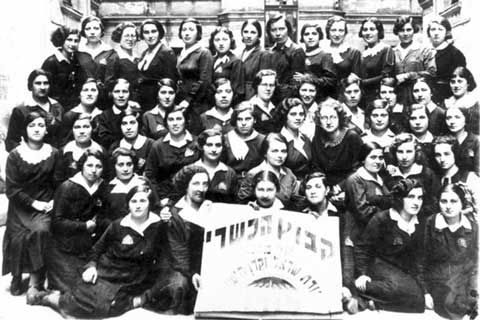
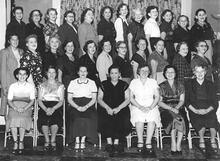
During the post World War I era, Sarah Schenirer, a Polish seamstress with a passion for Jewish tradition, developed the first school system for Orthodox girls in history. By the eve of World War II, the network encompassed over two hundred and fifty schools with more than forty thousand pupils, primarily in Eastern Europe. Pictured here is the second graduating class of the Bais Ya'akov in Lodz, Poland, in 1934.
Institution: Yehudis Bobker, Sydney, Australia.
view details view larger
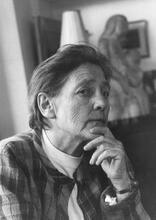
Psychoanalyst Helene Deutsch (1884 – 1982) expanded on theories of her mentor, Sigmund Freud, to develop her own outlook on women’s psychology, writing the first book with a psychoanalytic perspective on the subject.
Institution: Gidal-Bildarchiv im Salomon Ludwig Steinheim-Bildarchiv für deutsch-jüdische Geshichte e.g., Duisberg.
view detailsfield_section_text_value
Feminism
Many Austrian Jewish women also participated actively in the Austrian feminist movement, working to improve the status of women and gain the right to vote. The most prominent Austrian Jewish suffragettes included the journalists Henriette Herzfelder, who edited the Zeitschrift für Frauenstimmrecht (Newspaper for Women’s Suffrage) from 1911–1918, Leopoldine Kulka, Ernestine von Fürth, and Olly Schwartz, who after World War I headed the bureau of vocational counseling for the city of Vienna. Numerous Jewish women involved in Jewish women’s charitable organizations also served as activists in the Federation of Austrian Women’s Organizations and the more radical General Austrian Women’s Organization and contributed to the Austrian feminist press. Ottilie Bondy was one of the founders of the Vienna Housewives Association; Regine Ulmann, the director of various Jewish women’s organizations, including the umbrella organization Weibliche Fürsorge during World War I, helped found the interreligious Women’s Organization for Social Welfare; and Anitta Müller contributed to the feminist press and served as an officer of the General Austrian Women’s Organization. Many of these women converted out of Judaism (Bondy, Herzfelder, von Fürth, and Schwarz), but others, especially Ulmann and Müller, remained committed Jews. While the Austrian feminist movement avoided antisemitic politics, one of its prominent activists, Auguste Fickert, did not want her feminist newspaper, Neues Frauenleben, to fall into “Jewish hands,” possibly out of fear that the antisemites would label feminism “Jewish.” Nevertheless, her main disciple, Leopoldine Kulka, who did not become editor of the paper after Fickert’s 1910 death, continued to write for the paper, as did many other Jewish feminists.
Although the legal status of women improved after World War I as all of the Habsburg successor states granted women the right to vote, participate in the political process, and attend university, Jewish women still faced both antisemitism and misogyny in their attempt to participate fully in the new states.
Deutsch, Helene. Confrontations with Myself. New York: W.W. Norton & Company, 1973,
Freidenreich, Harriet Pass. Female, Jewish, Educated: The Lives of Central European University Women. Bloomington, IN: Indiana University Press,2002.
Freidenreich, Harriet Pass. Jewish Politics in Vienna, 1918–1938. Bloomington, IN: Indiana University Press, 1991.
Grunwald, Max. History of Jews in Vienna. Philadelphia: Jewish Publication Society of America, 1936.
Hertz, Deborah. Jewish High Society in Old Regime Berlin. New Haven: Yale University Press, 1988.
Iggers, Wilma A. Women of Prague: Ethnic Diversity and Social Change from the Eighteenth Century to the Present. Providence, RI: Berghahn Books, 1995.
Kaplan, Marion A. The Making of the Jewish Middle Class: Women, Family, and Identity in Imperial Germany. New York: Oxford University Press, 1991.
Lachs, Minna. Warum schaust du zurück. Erinnerungen 1907–1941. Vienna: Europaverlag, 1986.
Manekin, Rachel. The Rebellion of the Daughters: Jewish Women Runaways in Habsburg Galicia. Princeton, NJ: Princeton University Press, 2020.
Mauthner, Hella Roubicek. Hella. Washington, DC: 1996.
Miller, Michael Laurence. Rabbis and Revolution: The Jews of Moravia in the Age of Emancipation. Stanford, CA: Stanford University Press, 2011.
Rozenblit, Marsha L. Reconstructing a National Identity: The Jews of Habsburg Austria during World War I. New York: Oxford University Press, 2001.
Rozenblit, Marsha L. The Jews of Vienna, 1867–1914: Assimilation and Identity. Albany, NY: SUNY Press, 1983.
Rozenblit, Marsha L. “Creating Jewish Space: German-Jewish Schools in Moravia,” Austrian History Yearbook 44 (2013): 108-147.
Spiel, Hilde. Fanny von Arnstein: A Daughter of the Enlightenment, 1758–1818. Translated by Christine Shuttleworth. New York: Berg, 1991; orig. 1978.
Staudacher, Anna L. Jüdische Konvertiten in Wien 1782–1868. Frankfurt/Main, Berlin: Peter Lang, 2002.
Steiner, Herbert, ed. Käthe Leichter: Leben und Werk. Vienna: Europa Verlag, 1973.
Wistrich, Robert S. The Jews of Vienna in the Age of Franz Joseph. Oxford: Oxford University Press, 1989.
More Like This
Double your impact to amplify Jewish women’s stories—
All gifts matched up to $35,000
Before you close this article, please consider supporting the Jewish Women’s Archive and uplifting Jewish women’s voices.
At JWA, we preserve the voices of Jewish women and gender-expansive people past and present, share them freely with millions online, and empower a new generation of Jewish feminists to lead with courage, creativity, and conviction.
But none of this happens without you. JWA is an independent nonprofit— we rely on people, like you, who believe that history belongs to all of us and that the voices of Jewish women must remain powerful, and heard.
This month, a generous JWA board member will match every gift dollar for dollar—up to $35,000—through June 30. Your contribution goes twice as far right now.
Every contribution—no matter the size—helps us document, teach, and inspire through Jewish women’s stories.
It takes less than a minute to make a difference.
Thank you for being a part of the JWA community,

Judith Rosenbaum, CEO

