
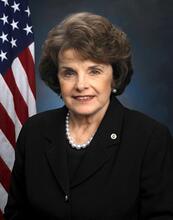
Dianne Feinstein

Trailblazing mayor-turned-senator from California, Dianne Feinstein was a long-time member of the U.S. Senate. She was a leading Democrat and a pioneering female senator. Her long and distinguished political career was marked by a series of firsts. In 1984, she was considered by the Democratic Party for nomination for vice president of the United States, in 1990, the Democrats selected her as their first female candidate for California governor, and in 2009 Feinstein became the first woman to chair the Select Committee on Intelligence as well as the first woman to preside over a U.S. presidential inauguration. She and Senator Barbara Boxer were the first women to serve simultaneously as U.S. senators from California, beginning in 1993.
Dianne Feinstein, former mayor of San Francisco, and United States senior senator from California since 1992, was a political pioneer and a long-time U.S. senator. Throughout her career, Feinstein earned a reputation as a leader, reformer, and principal member of the Democratic Party.
Family and Education
The eldest of three daughters, Feinstein was born on June 22, 1933, to Dr. Leon Goldman, a surgeon and professor at the University of California, San Francisco, and Betty (Rosenburg) Goldman. Both of her parents came from Russian immigrant families. The Goldmans were proud of their heritage and could trace their family tree back for generations. Sam Goldman, Dianne’s paternal grandfather, helped found several temples in California, while his son Leon became a prominent donor to San Francisco’s Mount Zion Synagogue. Dianne’s mother’s family, the Rosenburgs, had a more distant relationship with Judaism. Some of them belonged to the Russian Orthodox church.
Growing up, Feinstein was greatly influenced by her paternal uncle, Morris Goldman. In contrast to his Republican-minded brother Leon, Morris was a populist who worked in the city’s garment district and introduced Dianne to the idea of the working class. He took her to San Francisco’s City Hall to watch a meeting of the Board of Supervisors, sparking her interest in politics early on and encouraging her political education. By observing her father and her uncle, Feinstein learned to take a moderated approach to political issues, weighing both sides and considering the complexities of a particular issue or argument.
Feinstein attended a Jewish religious school but later enrolled at the Convent of the Sacred Heart, a prestigious private Catholic high school, in accordance with her mother’s wishes. At that time, she met California Attorney General Edmund (Pat) Brown, the father of a classmate. The teenaged Feinstein impressed Brown with her interest in political life. After Brown was elected governor of California in 1958, he sought out Dianne and gave her a job as an advocate for prison reform.
After graduating from Sacred Heart (the first Jew to do so), Feinstein entered Stanford University, where she excelled academically and became actively involved in politics. In addition to earning a B.S. in History, Feinstein was vice president of her class and joined the Young Democrats. After graduating in 1955, she worked as an intern in public affairs for the Coro Foundation and continued to study public policy.
In 1956, Feinstein eloped with Jack Berman (d. 2002), who served as a San Francisco superior court judge until 1992, but the marriage lasted less than three years. Feinstein and Berman disagreed fundamentally over what they deemed acceptable roles for women. Berman desired that his wife be first and foremost a wife and a mother to their daughter, Katherine (who was nine months old at the time of divorce). Feinstein saw herself in this role but also wanted a professional career in the public sector. In 1962, she married Bertram Feinstein, a distinguished neurosurgeon who was a colleague of her father and twenty years her senior. Their marriage, which lasted until Bertram’s death in 1978, gave Feinstein the freedom to pursue her political career. In 1980, she married Richard Blum, a successful investment banker who also acted in an advisory capacity for Feinstein.
Early Experiences in Politics
Around the time of Feinstein’s divorce from Berman, Governor Edmund S. Brown asked her to join the California Women’s Board of Terms and Paroles. She served from 1960 to 1966, and it was here that she gained her first experiences in criminal reform. In 1968 she served on the San Francisco mayor’s committee on crime and committee on adult detention; a year later, she became the first woman president of the San Francisco Board of Supervisors. Her success and popularity in this capacity won her reelection for two additional terms.
Feinstein was elected to the San Francisco Board of Supervisors in 1969 and became its first woman president for the 1970-1971 year. The 1970s saw San Francisco torn apart by political strife. After the assassinations of Mayor George Moscone and board colleague Harvey Milk in 1978, Feinstein decided to run for mayor. She won the election in 1979 and instituted tough legal and social reforms. Feinstein was admonished by peers for her support of the Carter-Mondale presidential ticket in 1980, when the majority of Bay Area Democrats supported Senator Ted Kennedy’s primary challenge to President Jimmy Carter. In 1983 she was reelected to a second four-year term as mayor. City and State magazine named her America’s Most Effective Mayor in 1987.
Feinstein’s top priority during her nine years as mayor was public safety. She fought crime by increasing the strength of San Francisco’s police department and by cutting down the response time for major emergencies from eight minutes to two. Fiscal responsibility and boosting the local economy were two other important concerns to her. She made sure that the city’s budget was balanced in every year she held office, and she developed relationships with major trading cities in Asia, Europe, and Africa. During her tenure, the famous San Francisco cable car system was rebuilt, city streets were repaved, and the sewer system was upgraded.
Joining the Senate
field_section_text_value
Honors
In recognition of her public service, Feinstein wasawarded honorary degrees by the University of San Francisco, Mills College, the University of Santa Clara, and Golden Gate University, and various awards, including the American Medical Association’s award for “outstanding contributions” to the betterment of public health. In 1984, French president François Mitterrand bestowed upon her the Légion d’Honneur, one of France’s highest honors. In 2001 she received the Woodrow Wilson Award for public service from the Woodrow Wilson Center of the Smithsonian Institution, and in 2002 she was recognized with the Nathan Davis Award for her service to public health by the American Medical Association.
Feinstein was also recognized with several awards specific to her role and pioneering career as a leading Jewish woman in public office. The American Friends of the Hebrew University of Jerusalem gave her the Scopus Award for outstanding public service in 1981. She received a distinguished public service award from the Los Angeles Anti-Defamation League of B’nai B’rith in 1984, the brotherhood/sisterhood award of the National Conference of Christians and Jews in 1986, and a public service award from the American Jewish Congress in 1987. Also notable is the portrayal of Senator Feinstein by Annette Benning in the 2019 film, The Report, which explored the investigation of the Senate Intelligence Committee into use of torture by the CIA.
Dianne Feinstein died on September 28, 2023.
“American Medical Association Awards for Outstanding Government Service.” American Medical Association. Accessed May 1, 2021. https://www.ama-assn.org/about/awards/american-medical-association-awards-outstanding-government-service.
“Bioguide Search,” Biographical Directory of the United States Congress, accessed May 1, 2021, https://bioguide.congress.gov/search/bio/F000062.
Broder, David S., et al. “Kennedy Ends Fight for Nomination.” Washington Post, August 12, 1980. https://www.washingtonpost.com/archive/politics/1980/08/12/kennedy-ends-fight-for-nomination/93b313cd-2fac-4f9e-a2e8-1d8241e3f9e8/.
Dianne Feinstein. Jewish Virtual Library. Accessed May 3, 2021. https://www.jewishvirtuallibrary.org/dianne-feinstein.
Fandos, Nicholas. “Democrats, Facing Critical Supreme Court Battle, Worry Feinstein Is Not Up to the Task.” New York Times, October 10, 2020. https://www.nytimes.com/2020/10/10/us/politics/dianne-feinstein-supreme-court-judiciary-committee.html.
Fandos, Nicholas. Feinstein, under Fire by Progressives, Says She Will Step down as Top Democrat on the Judiciary Committee.” New York Times, November 23, 2020. https://www.nytimes.com/2020/11/23/us/feinstein-under-fire-by-progressives-says-she-will-step-down-as-top-democrat-on-the-judiciary-committee.html.
Mahtesian, Charles. “Feinstein's Record: 7.3 Million Votes.” Politico, November 26, 2012. https://www.politico.com/blogs/charlie-mahtesian/2012/11/feinsteins-record-73-million-votes-150280.
Mayer, Jane, and Connie Bruck. “Dianne Feinstein's Missteps Raise a Painful Age Question Among Senate Democrats.” The New Yorker, December 9, 2020. Accessed April 28, 2021. https://www.newyorker.com/news/news-desk/dianne-feinsteins-missteps-raise-a-painful-age-question-among-senate-democrats.
Mazzetti, Mark, and Scott Shane. “'The Report' and the Untold Story of a Senate-C.I.A. Conflict.” New York Times, November 15, 2019. https://www.nytimes.com/2019/11/15/movies/the-report-adam-driver.html?searchResultPosition=5.
Mikuski, Barbara, et al. Nine and Counting: The Women of the Senate, New York: Morrow, 2000.
Morris, Celia. Storming the Statehouse: Running for Governor with Ann Richards and Dianne Feinstein. New York: Scribner’s Sons, 1992.
“Proclamation on Ending Discriminatory Bans on Entry to The United States.” The White House, January 21, 2021. https://www.whitehouse.gov/briefing-room/presidential-actions/2021/01/20/proclamation-ending-discriminatory-bans-on-entry-to-the-united-states/.
Roberts, Jerry. Dianne Feinstein: Never Let Them See You Cry. San Francisco, CA: Harper Collins West, 1994.
“Senators Introduce Bill to Repeal Muslim Travel Ban.” Dianne Feinstein United States Senator for California. Accessed May 17, 2021. https://www.feinstein.senate.gov/public/index.cfm/press-releases?id=268781C5-AAA5-45E8-AAFA-9ABAAC761045.
“United States Senator for California.” Dianne Feinstein United States Senator for California. Accessed May 1, 2021. https://www.feinstein.senate.gov/public/.
“U.S. Presidential Inaugurations: Barack Obama.” U.S. Presidential Inaugurations: Barack Obama (Virtual Programs & Services, Library of Congress). Accessed April 29, 2021. https://www.loc.gov/rr/program/bib/inaugurations/obama/index.html.
More on Dianne Feinstein
Double your impact to amplify Jewish women’s stories—
All gifts matched up to $35,000
Before you close this article, please consider supporting the Jewish Women’s Archive and uplifting Jewish women’s voices.
At JWA, we preserve the voices of Jewish women and gender-expansive people past and present, share them freely with millions online, and empower a new generation of Jewish feminists to lead with courage, creativity, and conviction.
But none of this happens without you. JWA is an independent nonprofit— we rely on people, like you, who believe that history belongs to all of us and that the voices of Jewish women must remain powerful, and heard.
This month, a generous JWA board member will match every gift dollar for dollar—up to $35,000—through June 30. Your contribution goes twice as far right now.
Every contribution—no matter the size—helps us document, teach, and inspire through Jewish women’s stories.
It takes less than a minute to make a difference.
Thank you for being a part of the JWA community,
Judith Rosenbaum, CEO