

Anarchists, American Jewish Women
The anarchist movement was based on a struggle against the tyranny of capitalism, on social equality and individual liberty, and on the promotion of positive communitarian ideals. Most Jewish women anarchists, while deeply committed to transforming a whole way of life, gave priority to the struggle against oppression by employers, and American Jewish anarchist women participated in immigrant labor organizations in most American cities. They created circles and organizations that represented uniquely anarchist concerns around education and culture/ Jewish women anarchists were at the forefront of radical campaigns that combined forces with gentiles and civil liberties activists to curb abuses of state power. In 1919, the anarchist movement became the target of government persecution, with many members imprisoned and eventually deported, including Emma Goldman and Mollie Steimer.
Early Development
field_section_text_value
Labor Organization
field_section_text_value

The union provided its members with a community where work struggles were combined with a social life. The anarchists created enclaves in the form of circles and organizations that represented uniquely anarchist concerns around education, culture, and a different way of life. The self-contained groups, however, maintained their roots within the Jewish community. Over twenty such anarchist organizations were branches of the Workmen’s Circle, the Jewish fraternal order. The extensive links with the community muted some of the early expressions of anarchist defiance against religious authority when the early anarchists’ notorious The Day of Atonement, which falls on the 10th day of the Hebrew month of Tishrei and is devoted to prayer and fasting.Yom Kippur balls were subsequently abandoned.
Community Building
field_section_text_value
Campaigns
Jewish women anarchists were at the forefront of radical campaigns that combined forces with gentiles and civil liberties activists to curb abuses of state power. Pauline Turkel organized a rally in Madison Square Garden on behalf of Tom Mooney and Warren Billings in 1917. Pesotta campaigned for the release of Mooney from prison in 1934. Other practical causes that they took up included the amnesty of anarchists in Russia in 1911 by the Anarchist Red Cross. Hilda Adel helped to organize the Political Prisoners’ Defense and Relief Committee in 1918 to help protesters who had been arrested for opposing United States intervention in World War I. Rose Pesotta, Emma Goldman, Rose Mirsky, and many others worked tirelessly in the defense of Sacco and Vanzetti in the 1920s.
Most anarchists, including Emma Goldman and Di Fraye Arbeter Shtime, subsequently renounced the violent strand of anarchism, which remained an undercurrent of the mainstream movement until the assassination of President William McKinley in 1901. An assassination attempt on the life of John D. Rockefeller, Jr., the perpetrator of the Ludlow massacre in 1914, was the exception. Marie Ganz, a young Jewish immigrant, tried to assassinate him in 1914, but the attempt was foiled. She was one of the militant Jewish anarchists who were inspired by the ideas of the Wobblies (International Workers of the World) and the upsurge of anarcho-syndicalism starting in 1905 and continuing through the period of World War I. In 1914, their activities included organizing the unemployed in New York City and anti-Rockefeller agitation in Tarrytown, New York. Becky Edelsohn, Helen Goldblatt, and Lillian Goldblatt were in the forefront of these confrontational activities.

A similar group set up a separate New York collective whose clandestine publication Der Shturm [The storm] (1917–1918) and subsequently Frayhayt [Freedom] (1918), which agitated against the war, defended the Bolshevik Revolution, and opposed American intervention in Russia, included Mary Abrams, Mollie Steimer, Hilda Adel, Clara Rotberg Larsen, and Sonya Deanin. Some of these women were employed in the garment industry, and Abrams had been in the Triangle Shirtwaist Fire. The New York groups joined with supporters from Mother Earth, representing the views of Emma Goldman and Alexander Berkman, to organize militant demonstrations against United States participation in the war, which often culminated in violent confrontations with the police.

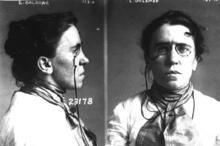
Emma Goldman's deportation portrait, 1919. In post-World War I America, foreigners and their "foreign ideas" were increasingly untolerated. Following her release from prison in 1919, Goldman was immediately re-arrested on the order of J. Edgar Hoover, then director of intelligence for the U.S. Justice Department. Hoover persuaded the courts to deny Goldman's citizenship claims, thus making her liable to deportation under the 1918 Alien Act, which allowed for the expulsion of any alien found to be an anarchist. On December 21, 1919, Goldman and 248 other foreign-born radicals were deported to the Soviet Union.
Courtesy of the Emma Goldman Papers, University of California, Berkeley.
The campaign to oppose the draft conflicted with the forces of Di Fraye Arbeter Shtime, which followed Kropotkin in its support of the war. A more formidable enemy was the U.S. Government. Opposition to the war and direct action advocated by Frayhayt were brutally suppressed through the 1918 Sedition Act. In 1919, the anarchist movement became the target of government persecution with many members being imprisoned and eventually deported, among them Emma Goldman and Mollie Steimer.
The anarchist movement declined as a result of other ideologies competing for the loyalty of the labor movement. For instance, the Bolshevik Revolution drew support from within the ranks of the Jewish immigrant workers in the 1920s, as did the New Deal ideology of the 1930s. However, Jewish anarchist cells and publications continued to exist. Much later, there was a brief upsurge of interest in anarchism among women in the 1960s, when Goldman became an icon again. Her ethics of personal and sexual liberation found many followers in the women’s movement. However, since the 1930s, the appeal of anarchism had given way not only to New Deal ideology, but also to the pro-Zionist orientation of many among American Jewry, which was accompanied by a decline in the use of Yiddish and the waning of the Jewish labor movement.
Avrich, Paul. Anarchist Portraits (1988), and Anarchist Voices. An Oral History of Anarchism in America (1995), and The Modern School Movement: Anarchism and Education in the United States (1980).
Leeder, Elaine J. The Gentle General: Rose Pesotta, Anarchist and Labor Organizer (1993).
Marsh, Margaret S. Anarchist Women, 1870–1920 (1981).
Pratt, Norma Fain. “Culture and Radical Politics: Yiddish Women Writers in America, 1890–1940,” in Women of the Word: Jewish Women and Jewish Writing, edited by Judith Baskin (1994).
Shepherd, Naomi. A Price Below Rubies: Jewish Women as Rebels and Radicals (1993).
More Like This

Double your impact to amplify Jewish women’s stories—
All gifts matched up to $35,000
Before you close this article, please consider supporting the Jewish Women’s Archive and uplifting Jewish women’s voices.
At JWA, we preserve the voices of Jewish women and gender-expansive people past and present, share them freely with millions online, and empower a new generation of Jewish feminists to lead with courage, creativity, and conviction.
But none of this happens without you. JWA is an independent nonprofit— we rely on people, like you, who believe that history belongs to all of us and that the voices of Jewish women must remain powerful, and heard.
This month, a generous JWA board member will match every gift dollar for dollar—up to $35,000—through June 30. Your contribution goes twice as far right now.
Every contribution—no matter the size—helps us document, teach, and inspire through Jewish women’s stories.
It takes less than a minute to make a difference.
Thank you for being a part of the JWA community,

Judith Rosenbaum, CEO

