Trauma and Tourism: Carrying Contradictions in A Real Pain


The first time I watched Jesse Eisenberg’s Oscar-winning film A Real Pain was in the winter of 2025—at home with my family, all of us cuddled together on the couch. The second time was the following July, during the plane ride home from Krakow, Poland, my head resting on the shoulder of a girl who had been a stranger three weeks earlier and had become one of my closest friends. In my pocket, a piece of brick from Auschwitz, small and rough. A reminder.
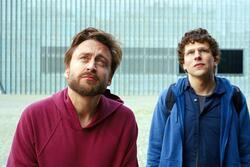
A Real Pain follows the story of cousins David and Benji as they journey through Poland to connect with their Holocaust-survivor late grandmother’s past. Both cousins carry the weight of generational trauma, but they respond to it in very different ways: Benji is loud and emotional, while his cousin David is anxious and introverted, seeing his pain as insignificant—something to be hidden, pressed into his bones and carried silently. At the core of the film is a deceptively simple question: what makes pain “real?” David grapples with this question throughout the movie. Because his traumas and suffering cannot begin to compare with what his ancestors experienced, does he have less of a right to his own pain?
As a Jew today, I often find myself wondering that same question. In comparison to so many Jews around the world, both past and present, my suffering pales. I will never—God forbid—experience the terror of a concentration camp or pogrom. I am not in a bunker waiting for the next missile to be fired; I am not even being harassed at a university. I flinch when I see posters calling Jews baby killers, but I still wear the Hebrew necklace I got for my Bat Mitzvah over my shirt. Sometimes, like David, I feel like I don’t have the right to feel threatened—to claim pain.
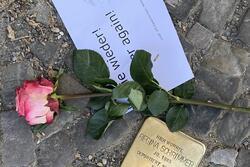
These questions haunted me as I traveled through Central and Eastern Europe in the summer of 2025. At the time, the war in Israel was intense, with flights to the country canceled, adding another layer to my experience. Traveling through Jewish history with a group of BBYO teens in modern Europe overwhelmed me with dualities—in the same breath, we learned about both the vibrant life and violent destruction of Europe’s Jewish communities; we visited waterparks and concentration camps, and it felt almost like a betrayal. An ocean of pride flags next to the hollowed shell of a Nazi base, streaming rainbows in the wind. A slur tagged on the wall. A former ghetto transformed, picturesque—I stole a bite of my friend’s ice cream, laughing, in a place where Jewish people once starved by the thousands.
A Real Pain understands this tension and gains its power through treating historical trauma not as a separate entity but as something that tangles itself, sometimes awkwardly and messily, into the present. A key element of the story is the interplay between tourism and memory, tragedy and humor. The charismatic, erratic Benji convinces the group to pose for pictures with statues commemorating the Warsaw uprising, but also refuses to sit in first class on a train in a country where his ancestors were shoved into cattle carts. The film masterfully captures an honest and messy response to facing the history of the Holocaust outside of a textbook or even a museum—there is a sense of double vision: the past layered onto the present, and sometimes it’s just as hard to focus on one as it is to hold them both. Sometimes, doing either feels wrong.
Watching the movie on the plane ride back from Europe felt different than my first viewing at home. I connected with the story in a deeper way than I had before—my journey echoed David and Benji’s both literally and emotionally. I rolled the stone I had picked up off the railroad tracks of Auschwitz between my fingers, and in comparison to the horrors that stone had seen, my own anxieties and problems were embarrassing in their smallness. “I know that my pain is unexceptional, so I don't feel the need to, like, I don’t know, burden everybody with it, you know?” David tells his cousin, and in a way, he’s right.
And yet, at the same time, he’s wrong—and this is another duality the film grapples with. Through the journey of David and Benji—cousins who represent opposite sides of the spectrum of emotional expression—the film urges its viewers to embrace that contradiction. This life I live, full of Jewish joy and laughter, is one my ancestors could have only dreamed of—but that doesn’t erase my own hurts. Because the thing about pain is that it doesn’t require justification, and it isn’t weighed against the suffering of others. It doesn’t have to be exceptional to hurt you—and it doesn’t need to be shouted to be real.
This piece was written as part of JWA’s Rising Voices Fellowship.
Double your impact to amplify Jewish women’s stories—
All gifts matched up to $35,000
Before you close this article, please consider supporting the Jewish Women’s Archive and uplifting Jewish women’s voices.
At JWA, we preserve the voices of Jewish women and gender-expansive people past and present, share them freely with millions online, and empower a new generation of Jewish feminists to lead with courage, creativity, and conviction.
But none of this happens without you. JWA is an independent nonprofit— we rely on people, like you, who believe that history belongs to all of us and that the voices of Jewish women must remain powerful, and heard.
This month, a generous JWA board member will match every gift dollar for dollar—up to $35,000—through June 30. Your contribution goes twice as far right now.
Every contribution—no matter the size—helps us document, teach, and inspire through Jewish women’s stories.
It takes less than a minute to make a difference.
Thank you for being a part of the JWA community,

Judith Rosenbaum, CEO