A Kippah of One’s Own: Claiming My Place Within Tradition


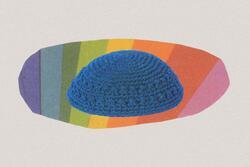
On the first day of kindergarten, I carefully decided what to wear. I tied my jangly heart necklace with a pleather cord over my white dress with the rhinestone peace sign on it, put my new lunchbox in my new backpack, and, of course, clipped on my kippah. It was the kind of kippah I see old ladies wearing, a lacy white thing covered in frills and beads to the point of ridiculousness, like putting a doily on my head. To my five-year-old self, it was the most beautiful kippah I had ever laid eyes on. I had picked it out with my mom from a local Judaica store the week before, and I was bubbling with excitement to start at my new Jewish school with my fancy new kippah. Everything seemed so shiny and bright.
When I stepped into my new classroom, though, something felt…off. It took me a moment to realize what it was, and I did a double-take, blinking in confusion. All the boys had kippot on, but none of the other girls did. Not one.
This was a divide I had never experienced before. Coming from a highly progressive synagogue where little kids asked, “Can boys be rabbis, too?”, I was unprepared for the more conservative environment of my Jewish day school. Their dress code was simple, but it drew clear gendered distinctions. They had just three rules: girls couldn’t show “inappropriate” skin, everyone had to dress nicely on Shabbat, and boys had to wear kippot. Only boys.
Every morning for the next seven years, my little brother would complain in the car that he lost his good kippah again. Every day, I would see boys sent downstairs to the bin to get a papery black yarmulke because they forgot theirs at home. Every day, every boy in my school covered his head, whether or not he wanted to—and every day, not a single girl did.
Standing in the kindergarten classroom on the first day of school, I didn’t know this yet, but I could already feel the outlines of that future taking shape around me, gaining solidity. I touched my lacy, beautiful kippah, suddenly uncertain in this sea of basketball and Coca-Cola kippot. I felt self-conscious, confused—was I doing something wrong?
The next morning, before school, I clipped my kippah on, then bit my lip and took it off, gently placing it back in the drawer.
There are so many spaces that exclude women, not just through outright bans but through persistent traditions, through a culture of quiet exclusion. My school’s kippah policy became one of those spaces for me, my beaded doily gathering dust beneath the piles of kippot we brought home from b’nei mitzvot. No one at my school told me I wasn’t allowed to wear one—but no one told me I could, either. No teacher told me to cover my head so I would remember God was above me, and so the whole world could see it.
I don’t remember how long I didn’t wear my kippah to school. Maybe just a couple of months. Maybe years. But one Saturday, as I was looking for a kippah to wear to synagogue, my fingernail snagged in a bit of lace. I carefully extracted the kippah I had worn so proudly on the first day of kindergarten and held it up to the light. I didn’t think it was the most beautiful kippah in the whole world anymore, but it was my kippah, and that’s what mattered. In that moment, I decided I didn’t care if I would be the only girl in my class wearing one. That it didn’t matter if my school only thought they should only be for boys.
This was my faith. My choice.
And I began to wonder if all the other girls in my class were afraid to be the only ones, too. This realization burning on my tongue, I marched to the rabbi’s office and asked him why the rules should be so different between genders—why boys were not just expected but required to outwardly present their faith, while girls were left forgotten. These expressions of faith should be a choice, and no one at my school truly had that.
He had no good answer for me.
After that, I wore my kippah with pride (though eventually, to my mom’s secret relief, I switched to a less gaudy one). It was a turning point for me—the first time my Judaism and feminism had intersected tangibly, and the first time I had ever consciously made the choice to bridge them. My decision didn’t go unnoticed: one day, the only female rabbi at my school stopped me in the hall.
“Nice kippah,” she said quietly, and I smiled.
She was wearing one, too.
Jewish feminism doesn’t have to be about breaking traditions. Sometimes, I’ve realized, it can just be claiming our place within them.
This piece was written as part of JWA’s Rising Voices Fellowship.
Double your impact to amplify Jewish women’s stories—
All gifts matched up to $35,000
Before you close this article, please consider supporting the Jewish Women’s Archive and uplifting Jewish women’s voices.
At JWA, we preserve the voices of Jewish women and gender-expansive people past and present, share them freely with millions online, and empower a new generation of Jewish feminists to lead with courage, creativity, and conviction.
But none of this happens without you. JWA is an independent nonprofit— we rely on people, like you, who believe that history belongs to all of us and that the voices of Jewish women must remain powerful, and heard.
This month, a generous JWA board member will match every gift dollar for dollar—up to $35,000—through June 30. Your contribution goes twice as far right now.
Every contribution—no matter the size—helps us document, teach, and inspire through Jewish women’s stories.
It takes less than a minute to make a difference.
Thank you for being a part of the JWA community,


Judith Rosenbaum, CEO