
How Riot Grrrls Teach Us That It’s Ok to Be Angry


The year was 2014, and music blasted on the car speakers in my family’s dark gray Prius as my mom drove five-year-old me to school. As long as I’ve been alive, my mom has hated driving, but our morning drives to school were a highlight for both of us. My mom would put on a playlist, and we would both sing along. As we drove to kindergarten, I would belt my heart out to songs like Dinosaur Jr.’s “Feel the Pain,” Superchunk’s “Detroit Has a Skyline,” and Sleater-Kinney's “Modern Girl.” This was my first introduction to Riot Grrrl music.
I was young, but I was already awake to the injustices of this world. I still distinctly remember one of the first times I thought, “Wow, why do we say it’s okay for boys to do this?” My gloves were drying in the hallway of my elementary school when a boy took them and threw them in the snow outside. I was told that apparently, boys do this when they want to be friends with people, and I remember marveling at the sheer stupidity of that idea. Why was it ok for a boy to throw my gloves in the snow? Why did I feel like I would be chastised for doing the same thing? This boy was allowed to be awful because “boys will be boys.” This instance was when I first realized that being a terrible person would always be excused if you had the excuse of being a man. I was only six, but I was already filled with righteous feminist anger.
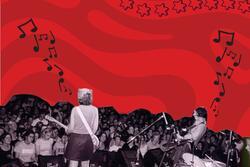
Riot Grrrls were the soundtrack of the feminist anger of my mother’s generation. Bands like Sleater-Kinney and Bikini Kill sang about their anger for society’s injustices. They sang about how women aren’t taken seriously, are attacked for their gender, and about the apparent inherent negativity of being a woman. I found a page from a zine in The Riot Grrrl Collection, a book by Lisa Darms (founder of the feminist arts and musical festival, Ladyfest), Johanna Fateman (of the band Le Tigre), and Kathleen Hanna (of Bikini Kill), that encompasses why the Riot Grrrl movement was so important when it was created. “Girls crave records and books and fanzines that speak to us, that we feel included in, and can understand in our own ways.” The Riot Grrrl movement was a cultural, musical, and aesthetic phenomenon. But, at its core, it was a deeply political and feminist movement. The art of the Riot Grrrl movement is inextricably linked to feminism, which has kept it relevant, even more than 20 years after its heyday.
I attended a Jewish day school from grades four to six, and there, we had mandatory Jewish studies lessons. One of the ideas we covered was being a tzaddik, a righteous person. In Dvarim 16:20, we are told, “justice, justice you must pursue.” This is what it means to be a Riot Grrrl. Riot Grrrls believe in a feminist future, and aren’t going to stop until they have one. One of my favorite Riot Grrrl songs is the Bikini Kill song about rape culture, “White Boy.” The song begins with an intro where a male voice is in conversation with band member Kathleen Hanna. The man says, “I don't think it's a problem 'cause most of the girls ask for it,” and Hanna responds, in a patronizing tone, “Uh huh, how do they ask for it?” This song is a critique of rape culture at its core, and tells society that we need to wake up and notice how men are empowered by society to be predatory because we view women as inherently sexualized.
Riot Grrrl songs are often about injustice, and about how we can, and must, act to fix it. Sleater-Kinney’s song, “Combat Rock,” addresses the bigotry of the United States post 9/11, singing, ironically, “Hey, look, it's time to pledge allegiance/I love my dirty Uncle Sam/Our country's marching to the beat now/And we must learn to step in time.” Not only does this song bring awareness to injustice, but it is a call to action. “Those who disagree are afraid to show their face,” but Riot Grrrls know that change is only possible if we speak up and pursue justice in the face of hatred.
The values of a Riot Grrrl are not too dissimilar from key Jewish ideas. In fact, artists from the Riot Grrrl movement like Sleater-Kinney's Carrie Brownstein and Janet Weiss are Jewish as well. As I looked more carefully at Riot Grrrl music, I noticed the importance of justice in many songs. This centralization of justice resonates with me because my feminism is shaped by my Judaism and my Jewish values of pursuing justice. It was exhilarating to realize that this core Jewish value of mine is in conversation with the Riot Grrrl movement’s belief in justice.
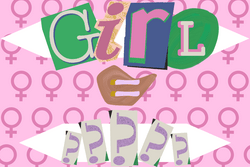
Riot Grrrl bands were defined by the moment of feminism when they were created, but the messages in their songs still ring true with feminists today, myself included. Since a young age, I have felt ostracized for the “crime” of being a girl who cares about justice. A “girl” is something that you can’t wait to evolve from, because a “woman” fits into the patriarchy cleanly and neatly. A “woman” is a wife and a mother, while a “girl” is just the step before that. Riot Grrrls responded to the connotations of the word “girl” by reclaiming it. “Girl” becomes “grrrl,” the growl at the center of this word symbolic of the righteous anger we feel as girls facing injustice. But grrrls don’t just sit down and let injustice happen; they riot. The Riot Grrrl movement lets girls be unapologetically angry. In fact, it encourages anger.
In the current political climate, I have increasingly felt the pressure of what it means to be a girl. Anger is generally discouraged; if women are too emotional, then no one will take them seriously. The success of the Riot Grrrl movement forces us to confront that idea and realize that anger is actually a powerful tool. Passivity serves patriarchy. A girl can’t steal her male classmate’s gloves and throw them in the snow. If girls aren’t angry, they aren’t dangerous; they won’t riot against injustice. The Riot Grrrl movement tells us anger is not only ok, but necessary. Maybe a girl can’t throw your gloves in the snow, but a grrrl definitely can. A grrrl knows that she is allowed to be angry, and that her anger is what makes her powerful. The Riot Grrrl movement confronted issues like sexism head-on and wasn’t afraid to be seen as emotional because Riot Grrrls knew their anger was a feminist tool. As Bikini Kill sings in “White Boy,” “I'm so sorry if I'm alienating some of you/Your whole fucking culture alienates me.” This is a lesson that we, as modern feminists, can all stand to learn. We don’t need to make our feminism easy to digest for society because society doesn’t make life easy to digest for women. In order to be a Jewish feminist, “justice, justice” we must pursue; or, as Bikini Kill puts it, “We want revolution girl-style now!”
This piece was written as part of JWA’s Rising Voices Fellowship.
Double your impact to amplify Jewish women’s stories—
All gifts matched up to $35,000
Before you close this article, please consider supporting the Jewish Women’s Archive and uplifting Jewish women’s voices.
At JWA, we preserve the voices of Jewish women and gender-expansive people past and present, share them freely with millions online, and empower a new generation of Jewish feminists to lead with courage, creativity, and conviction.
But none of this happens without you. JWA is an independent nonprofit— we rely on people, like you, who believe that history belongs to all of us and that the voices of Jewish women must remain powerful, and heard.
This month, a generous JWA board member will match every gift dollar for dollar—up to $35,000—through June 30. Your contribution goes twice as far right now.
Every contribution—no matter the size—helps us document, teach, and inspire through Jewish women’s stories.
It takes less than a minute to make a difference.
Thank you for being a part of the JWA community,


Judith Rosenbaum, CEO