Finding My Voice on the Bimah


For as long as I can remember, the High Holidays have been central to my Jewish life. A great deal of that Jewish life has come from Congregation Beth Yeshurun, a place that is not just my synagogue but somewhere I consider my second home. I’ve taken on many roles there, first as the shy six-year-old in the children’s choir, then as a leader of the teen-led mincha service, and now, as the first student cantorial apprentice at my congregation. All these experiences led to the moment that stands out the most in my mind.
On Yom Kippur morning last year, I stood on the bimah with a Yad in my right hand and looked out past the Torah to see hundreds of congregants listening to my chanting. I felt a sense of pride, but at the same time, a peculiar realization came upon me. My mother and I were the only women, and I was the only teenager on the bimah, surrounded by grown men and rabbis wrapped in their tallits.
My Jewish identity has always been active and evolving. As young children, my siblings and I participated in the children's choir at Congregation Beth Yeshurun for several years. Like most of the group, our parents signed us up. At the time, I didn’t think much of it; I enjoyed singing, especially Jewish music, with my siblings and friends. As I got older, though, and when the choir unexpectedly ended because of COVID, I didn’t know how I would contribute to the High Holiday service and realized how central it was to my Jewish identity. Although it hadn’t begun as my choice, Jewish music had become an integral part of my life, and just because the choir ended, that didn’t mean my involvement had to come to an end as well. I realized my passion for leading services, along with Jewish leadership, ran beyond the children’s choir, and thankfully, my participation continued even without it.
When the world shut down in 2020, everything was put on pause, including synagogue life. Despite all the regulations and mandates, I was one of the few people allowed to come in person to help lead the mincha service, a service that takes place in the afternoon and is led by teenagers at my synagogue. Since it was before my Bat Mitzvah, I was granted special permission to take part in the service. Typically, people are not allowed to lead a congregation in prayer until they have become a Bar or Bat Mitzvah, which I had not been at the time. At this service, I wasn’t singing because my parents had signed me up, but because I genuinely wanted to.
That day was one I will never forget: the first time I led a congregation in prayer as an eleven-year-old girl. It was surreal to see about twenty masked faces scattered through the empty sanctuary instead of the lively crowd of over 2,500 people who usually filled the huge space. Even though the emptiness was so prominent, it made the experience very personal—just me, a few others, and the Hebrew prayers carrying through the silence. With so few congregants in the crowd, I became more aware of my own voice and role in making sure the service could even take place at all.
For the past five years, I have returned to the teen-led mincha service, taking on more responsibility each time. Chanting haftorah, leading prayers, and simply being in synagogue to pray during the High Holidays are some of the highlights of my entire year.
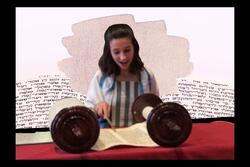
As of recently, though, my role has begun to expand past the mincha service. After my Bat Mitzvah, I was approached by one of my rabbis who asked me to join the “Yad Squad,” a group of volunteer Torah readers who chant throughout the year. Since then, I have been a regular Torah reader at my congregation and have had the honor of being the second female Torah reader on Yom Kippur, following in the footsteps of my mom. Reading Torah is a task that few women in my community take on, and when I stand in front of the scroll, I want to be an inspiration for girls to step into a space that men have historically dominated. My biggest hope is that girls sitting in services will feel inspired and empowered to see themselves not just as participants, but as future leaders of Torah and prayer.
Heading into the High Holidays this year as the first student cantorial apprentice at Beth Yeshurun, I feel a greater, but more rewarding type of responsibility. For the first time, I am leading my Jewish community in prayers with a new level of commitment and pride. This opportunity came about last spring when my cantor called me into her office. She told me about a new student cantorial apprenticeship my synagogue was starting and said she thought of me immediately. I remember sitting there, feeling beyond excited and honored about this new opportunity and the cantor’s confidence in my abilities. What began with an activity I hadn’t chosen has grown into something bigger, a deeper connection to my Jewish identity.
Looking beyond the High Holidays, I hope to continue growing as a Jewish leader while carrying the experiences that have guided me this far. To me, being a Jewish feminist means ensuring women’s voices are used to their full potential in Jewish life. Above all, my greatest hope is for other young girls to stand on the bimah and feel the same pride in Judaism as I do.
This piece was written as part of JWA’s Rising Voices Fellowship.
Double your impact to amplify Jewish women’s stories—
All gifts matched up to $35,000
Before you close this article, please consider supporting the Jewish Women’s Archive and uplifting Jewish women’s voices.
At JWA, we preserve the voices of Jewish women and gender-expansive people past and present, share them freely with millions online, and empower a new generation of Jewish feminists to lead with courage, creativity, and conviction.
But none of this happens without you. JWA is an independent nonprofit— we rely on people, like you, who believe that history belongs to all of us and that the voices of Jewish women must remain powerful, and heard.
This month, a generous JWA board member will match every gift dollar for dollar—up to $35,000—through June 30. Your contribution goes twice as far right now.
Every contribution—no matter the size—helps us document, teach, and inspire through Jewish women’s stories.
It takes less than a minute to make a difference.
Thank you for being a part of the JWA community,
Judith Rosenbaum, CEO