
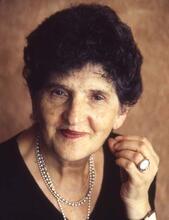
Vele Rabinowitz Zabludowsky

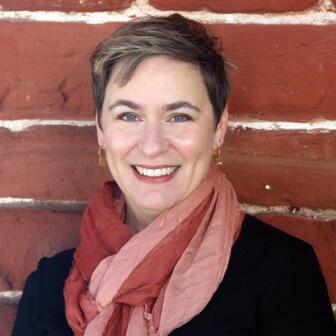
Mexican Jewish educator Vele Zabludovsky, 2015. From the Yiddish Book Center's Wexler Oral History Project (https://www.yiddishbookcenter.org/collections/oral-histories/interviews/woh-fi-0000745/vele-zabludovsky-2015).
Vele Rabinowitz Zabludovsky's dedication to Yiddish language and its culture was a constant throughout her life. Born in Poland in 1923, she emigrated to New York 1935. In 1944, she traveled to Mexico, where she dedicated over fifty years to teaching Yiddish language and culture. She helped to form the Naye Yiddishe Schule (New Jewish School) in Mexico City. Exactly four months before Zabludovsky passed away on February 26, 2016, in an interview conducted in Mexico City with Christa Whitney of the Yiddish Book Center, Zabludovsky spoke of Yiddish with great hope and optimism for its future.
"Talking about Vele's history is talking about Naye Schule history. That tends to happen when a person creates something and then dedicates more than fifty years of their lives to an institution, especially in the way Vele did" (Strauch).
The Importance of Yiddishkayt
Vele Rabinowitz Zabludovsky has been characterized as a Yiddish and Hebrew teacher who worked with love, but above all as someone who taught her pupils what is called Yidishkayt as a profoundly Jewish part of life. Like the teacher Joseph Opotoushu (1886–1954), she asked herself, "Vos is Yidishkayt?" (What is Yidishkayt?), and answered, "Yidishkayt is altz und nokh epes" (Yidishkayt is everything and a little more). Yidishkayt formed part of her life as a whole. Remembering Vele Rabinowitz Zabludovsky, who served as a lererke (teacher) for more than fifty years, and remembering Naye Yiddishe Schule (New Jewish School) at which she worked are like remembering the same thing.
Exactly four months before Zabludovsky passed away on February 26, 2016, in an interview conducted in Mexico City with Christa Whitney of the Yiddish Book Center, she reflected on an interesting phenomenon: Younger generations have begun to take an interest in Yiddish. This phenomenon gave Zabludowsky great hope. Yet she pondered, why Yiddish? She reflected, "Perhaps it is that in Yiddish, they found a language without ceremony, without pretensions. A language full of tenderness and wisdom that opens a large window to great literature… Yiddish has not died. Why? Because as long as one person talks to another person or two people, I know it is not dead. That is what I hope. And I truly believe it will not die."
Zabludovsky's optimism and fight on behalf of the Yiddish language and its culture were constant at the schools where she worked and all the places she believed Yiddish had the potential to be taught. She dedicated her life to promoting Yiddish’s very existence: "To continue with Yiddish is not a nostalgic act or due to sentimentalism, but because it holds the rescue of a whole culture."
Early Life and Education
Zabludovsky was born in Bialystok, Poland, in 1923, the youngest of ten children of Harry Rabinowitz (1880–1962) and Mina Gimpelewich (1885–1967). The family was liberal and religious: at home, her mother had a Term used for ritually untainted food according to the laws of Kashrut (Jewish dietary laws).kosher kitchen, and the Jewish holidays were observed without any taint of fanaticism; her father was a carpenter and a shul yid (a Jew who went to the synagogue) whose fine voice led to his being a "baaltfile" (precentor). Bialystok was a city with vibrant Jewish political activity, political parties, and the modern school of Tzisho (Di Zentrale Yidishe Organizatzie). Rabinowitz's home was a living reflection of the discussions and antagonisms that prevailed in those days, given that her siblings were members of different parties: Communists, Zionists, Bundists, and apolitical.
In 1929 Zabludovsky’s father left Poland for the United States of America, and six years later, his wife and five daughters joined him. When Zabludovsky arrived in New York, she was eleven years old and was the only child in the family chosen by her parents to study.
At first, she spoke only Yiddish, her first language, with which she communicated in the Jewish neighborhood in Brooklyn, New York, where she lived. From grammar school until high school, she attended public school in the morning and a Jewish school in the afternoon. While studying at Thomas Jefferson High School from 1941 to 1943, she also attended night school at the Workmen's Circle Seminar. The Seminar had a socialist and secular tendency, similar to the Bundists. Bible and general subjects were taught in Yiddish, while Hebrew, with an Jews of European origin and their descendants, including most of North and South American Jewry.Ashkenazi pronunciation, held second place.
In 1944–1945 Zabludovsky traveled to Mexico to visit one of her sisters and met Samuel Zabludovsky (b. 1908), whom she married in New York in December 1945. The couple had no children. When Samuel died in 1971 at the age of sixty-one, he left a young widow. "In my pupils, I found the children I would have liked to have, from them I obtained love and satisfaction," Zabludovsky later reflected.
Teaching in Mexico
field_section_text_value
Legacy
In an interview with the Yiddish Book Center in Mexico City in October 2015, Talia Margolis Chomstein reflected on her experience as a student of Zabludovsky. Chomstein admired Zabludovsky’s work and reflected, “She is still understanding the relevance of Yiddish, even today. It is amazing how she is always looking for new things, new materials.” Chomstein had the opportunity to read Zabludovsky’s essays from her career and reflected: “I was amazed she was criticizing at that time the behavior of the community towards Yiddish…. She was so critical that I thought, this is still modern, this is still something we have to be sharing.” Students remember Zabludovsky as someone “who taught them to fight for education, equality, love, wisdom, knowledge, and language. Vele taught us to leave behind our fears and put words first” (Chomstein). In December 1999, the Mexico-Israel Cultural Institute awarded Zabludovsky a prize acknowledging her work in Mexico's Jewish Community.
Vele Rabinowitz Zabludovsky passed on Thursday, February 25, 2016, in Mexico City.
Ashkenazi de México, Kehila. “ ‘Flor y Canto: Las Voces De Los Poetas Yiddish Asesinados En La Unión Soviética’..” https://diariojudio.com/comunidad-judia-mexico/revive-el-evento-flor-y-canto-las-voces-de-los-poetas-yiddish-asesinados-en-la-union-sovietica-texto-de-vele-zabludovsky-velada-artistica/34109
Avni, Haim, ed. Testimonios de la Historia Oral. Judíos en México. UHJ y Amigos UHJ Mexico: 1990.
Chomstein, Talia Margolis. “Falleció La Lererke, Nuestra Lererke: Diario Judío México.” Diario Judío: Diario De La Vida Judía En México y El Mundo, 25 Feb. 2016, diariojudio.com/comunidad-judia-mexico/fallecio-la-lererke-nuestra-lererke/158974/.
Cimet de Singer, Adina. The Ashkenazi Jewish Community in Mexico: Ideologies in the Structuring of a Community. Albany, NY: State University of New York Press,: 1997.
Cimet, Adina. “Nacionalismo y Lengua: Los Judíos Ashkenazitas En México, 1940-1950.” Revista Mexicana de Sociología 58, no. 4 (1996): 69–96.
Finkelman de Sommer, Maty. Instruye a tus hijos. In Generaciones judías en México. Kehila Ashkenazi (1922–1992). Alice G. Backal (Coord.). Mexico: Comunidad Ashkenazí de México, 1993.
Strauch, Morris. “La Historia De Vele Zabludovsky Z‘L Es La Historia De La Naye.” Enlace Judío, February 26, 2016. https://www.enlacejudio.com/2016/02/25/la-historia-de-vele-zabludovsky-zl-es-la-historia-de-la-naye/.
Whitney, Christa. “A Window to a World: Thoughts on Why Young People Come to Yiddish.” The Yiddish Book Center's Wexler Oral History Project, October 26, 2015. https://www.yiddishbookcenter.org/collections/oral-histories/excerpts/woh-ex-0004148/window-world-thoughts-why-young-people-come-yiddish.
Whitney, Christa. “Talia Margolis Chomstein's Oral History.” The Yiddish Book Center's Wexler Oral History Project, October 29, 2015. https://www.yiddishbookcenter.org/collections/oral-histories/interviews/woh-fi-0000743/talia-margolis-chomstein-2015?segment=4425.
Zabludowsky, Vele. Interview with Naty G. de Okon, August 1988. Ivgn Testimonios de la Historia Oral. Judíos en México Avni, Haim, editor. México: 1990.
Zabludowsky, Vele. Interview with Frida Staropolsky. February 2 and August 27, 2002.
More Like This
Double your impact to amplify Jewish women’s stories—
All gifts matched up to $35,000
Before you close this article, please consider supporting the Jewish Women’s Archive and uplifting Jewish women’s voices.
At JWA, we preserve the voices of Jewish women and gender-expansive people past and present, share them freely with millions online, and empower a new generation of Jewish feminists to lead with courage, creativity, and conviction.
But none of this happens without you. JWA is an independent nonprofit— we rely on people, like you, who believe that history belongs to all of us and that the voices of Jewish women must remain powerful, and heard.
This month, a generous JWA board member will match every gift dollar for dollar—up to $35,000—through June 30. Your contribution goes twice as far right now.
Every contribution—no matter the size—helps us document, teach, and inspire through Jewish women’s stories.
It takes less than a minute to make a difference.
Thank you for being a part of the JWA community,
Judith Rosenbaum, CEO