

Anzia Yezierska

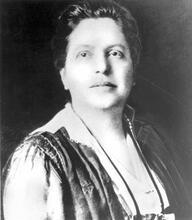
Immigrating with her family from the Russian Pale of Settlement to the United States in the early 1890s , Anzia Yezierska turned the frustrations and indignities she suffered in New York’s tenements into stories that depicted the lives of Jewish immigrants. In 1915, she published her first short story, “Free Vacation House,” about the humiliations charitable organizations perpetrate on the women they claim to help. In 1922, her collection Hungry Hearts was made into a silent film. Her first novel, Salome of the Tenements (1923), drew on the experiences of famed labor organizer, Rose Pastor Stokes. Yezierska, dubbed the "Cinderella of the Sweatshop," wrote her best-known novel, Bread Givers (1925), about an immigrant daughter struggling against her Orthodox father's rigid idea of Jewish womanhood. Her work fell into obscurity until the 1975 reissue of Bread Givers.
“My one story is hunger.” So declared the protagonist of Anzia Yezierska’s novel Children of Loneliness (1923). Having immigrated with her family from Eastern Europe, Yezierska chronicled the hunger of her generation of newly arrived Jewish Americans around the turn of the century. Her novels, short stories, and autobiographical writing vividly depict both the literal hunger of poverty and the metaphoric hunger for security, education, companionship, home, and meaning—in short, for the American dream.
Family and Personal Life
field_section_text_value
Fictional Writings and Themes
field_section_text_value
Literary Criticism
Critical assessment of Yezierska’s work has fluctuated since her earliest publications. Initially lauded as an authentic voice of the tenements as “Cinderella of the sweatshops,” by the 1940s, Yezierska had fallen into obscurity. Seen by the American mainstream as “too Jewish,” within the Jewish community her writing was offensive to both immigrant and Americanized Jews who felt mocked and exposed. Because of the growing interest in both ethnic and women’s writing, the 1980s saw a resurgence of appreciation for her writing. Bread Givers was reissued in 1975, followed by editions of many of her other works. Most contemporary critics approach her work sociologically rather than aesthetically, drawn by her compelling depictions of cultural and geographic displacement, the American dream and the harsh reality of immigrant life, and the struggle to acculturate.
In the main, Yezierska has been seen as aesthetically inferior to other writers of the Jewish immigrant and assimilation experience. Many critics praise the raw power of her writing but see in it no real artistry. They cite the proliferation of stock characters—the overworked mother, the ineffectual father, the intellectual gentile or assimilated male savior, the cold WASP, the rootless Americanized Jew, the condescending social worker, the passionate and intelligent young Jewish immigrant woman. Often, readers read the work as veiled autobiography, taking the voice of her protagonists as her own.
Death and Resurgent Legacy
But there has been a renewed appreciation for her oeuvre as a crafted literary work. In a biography of Yezierska, her daughter discusses her mother’s imaginative inventiveness and also contrasts the stylized “Yinglish” dialect of the fiction with her mother’s more proper, standardized English. Some contemporary readers note Yezierska’s artful use of metaphor, her ability to present multiple points of view, and the broad humor of her exaggerated types.
Anzia Yezierska died of a stroke on November 21, 1970, in Ontario, California.
Selected Works by Anzia Yezierska
All I Could Never Be (1932).
Arrogant Beggar (1927).
Bread Givers: A Struggle between a Father of the Old World and a Daughter of the New (1925. Reprinted 1975 and 1984).
Children of Loneliness (1923).
How I Found America: Collected Stories of Anzia Yezierska (1991).
Hungry Hearts (1920).
Hungry Hearts and Other Stories (1985).
The Open Cage: An Anzia Yezierska Collection (1979).
Red Ribbon on a White Horse (1950. Reprint, 1981).
Salome of the Tenements (1992).
AJYB 24:217.
BEOAJ.
EJ.
Gornick, Vivian. Introduction to How I Found America: Collected Stories of Anzia Yezierska, by Anzia Yezierska (1991).
Henriksen, Louise Levitas. Afterword to The Open Cage: An Anzia Yezierska Collection, by Anzia Yezierska (1979).
Henriksen, Louise Levitas. Introduction to Red Ribbon on a White Horse, by Anzia Yezierska (1981).
Henriksen, Louise Levitas, with Jo Ann Boydson. Anzia Yezierska: A Writer’s Life (1988).
Levin, Tobe. “Anzia Yezierska.” Jewish American Women Writers: A Bio-Bibliographical and Critical Sourcebook, edited by Ann Shapiro et al. (1994).
NAW modern.
Obituary. NYTimes, November 23, 1970, 40:2.
Rosen, Norma. John and Anzia: An American Romance (1989).
Schoen, Carol. Anzia Yezierska (1982).
Stinson, Peggy. “Anzia Yezierska.” American Women Writers 4 (1982): 480–482.
UJE.
Who’s Who in American Jewry (1926, 1928, 1938).
Who’s Who in American Jewry 7.
More on Anzia Yezierska

Double your impact to amplify Jewish women’s stories—
All gifts matched up to $35,000
Before you close this article, please consider supporting the Jewish Women’s Archive and uplifting Jewish women’s voices.
At JWA, we preserve the voices of Jewish women and gender-expansive people past and present, share them freely with millions online, and empower a new generation of Jewish feminists to lead with courage, creativity, and conviction.
But none of this happens without you. JWA is an independent nonprofit— we rely on people, like you, who believe that history belongs to all of us and that the voices of Jewish women must remain powerful, and heard.
This month, a generous JWA board member will match every gift dollar for dollar—up to $35,000—through June 30. Your contribution goes twice as far right now.
Every contribution—no matter the size—helps us document, teach, and inspire through Jewish women’s stories.
It takes less than a minute to make a difference.
Thank you for being a part of the JWA community,

Judith Rosenbaum, CEO

