

Vashti: Midrash and Aggadah

According to a midrashic tradition, Vashti was a princess and Ahasuerus was her father’s steward who acquired regal status by marrying her. Their differences were reflected in Ahasuerus’s behavior at the banquet, when he summoned Vashti to appear before the men at their revelry. The Babylonian Rabbis cast Vashti in a negative light. In contrast, their counterparts in Erez Israel portrayed her in a positive manner. Vashti came to an end when Memucan, one of the seven eunuchs of King Ahasuerus, counseled the king to depose Vashti. In the midrashic depiction, when Ahasuerus grew sober, he regretted what he had done. He recalled Vashti and her proper behavior, and he also remembered how he had improperly condemned her.
Vashti’s Identity
The Rabbis state that Vashti was one of the four women who were enthroned, two of whom ruled over Israel (Jezebel and Athaliah) and two over other peoples (the heathen Semiramis and Vashti) (Esther Rabbah 3:2).
The A type of non-halakhic literary activitiy of the Rabbis for interpreting non-legal material according to special principles of interpretation (hermeneutical rules).midrash conveys that Vashti was the orphaned daughter of Belshazzar; God was her help and kept her alive and she was wed to the emperor of Persia and Media, even though she was a Chaldean ( = Babylonian) (Esth. Rabbah 3:5). In the midrashic account of these events, on the night that Belshazzar was killed, Cyrus the Persian and Darius the Mede were guests at his table. The candelabrum fell and dashed out Belshazzar’s brains. Darius was crowned in his stead and sat in Belshazzar’s customary place. The death of Belshazzar caused total pandemonium in the palace. Some killed, while others engaged in looting. Vashti, Belshazzar’s daughter, was a young girl. She saw the tumult in the castle and ran among the guests. Thinking that her father was still alive, she mistakenly sat in Darius’s lap, in the belief that he was her father. Darius took pity on her and married her to his son Ahasuerus. (Midrash Panim Aherim [ed. Buber], version B, para. 1).
According to another midrashic tradition, Vashti was a princess and Ahasuerus was her father’s steward, in charge of the royal stables. He acquired regal status by marrying her (Esth. Rabbah 3:14; BT Lit. "scroll." Designation of the five scrolls of the Bible (Ruth, Song of Songs, Lamentations, Ecclesiastes, Esther). The Scroll of Esther is read on Purim from a parchment scroll.Megillah 12b). The difference in their stations was reflected in Ahasuerus’s behavior at the banquet, when he summoned Vashti to appear before the men at their revelry. Esth. 1:10 attests: “on the seventh day, when the king was merry with wine,” from which the Rabbis understood that the king was intoxicated. The midrash relates that Vashti sent a messenger to her husband with the message: You were Father’s steward. My father Belshazzar would drink wine in the measure of one thousand men and would not be inebriated, while you act the fool from the wine of a single man! She thereby hinted to him that she was the daughter of royalty, while he was a simple person who had reached his exalted status thanks to her (BT Megillah loc. cit.).
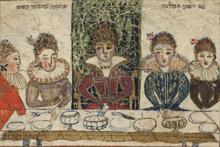
Vashti’s feast is portrayed as a “banquet for women,” which, the Rabbis explain, was different from the men’s revel. She gave them different types of drinks that women like and served them different manner of sweets that are favored by women. Esth. 1:9 tells that this banquet was held “in the royal palace of King Ahasuerus.” One midrash explains that the festivities were conducted in decorated and adorned rooms that suited women’s tastes, while another tradition says that she hosted the women in spacious rooms, so that if they wished to use them for licentious behavior, one would not be ashamed in front of her fellow. Yet a third midrashic tradition tells that she hosted them in an inner chamber of the king’s, so that if the husband of any of these women wanted to rebel against the king, his wife would be a hostage in the hands of Ahasuerus and Vashti, thus forestalling any seditious activity by their spouses (Esth. Rabbah 3:10). According to another tradition, Vashti hosted them in the royal palace, since it is the way of women to want to know all. She brought them in to where the king sleeps, and told them: “This is where the king sits, this is where he eats, this is where he drinks, this is where he sleeps” (Midrash Panim Aherim, version B, para. 1).
Vashti as Seen by the Babylonian Rabbis
field_section_text_value
Vashti as Seen by the Rabbis of Erez Israel
In contrast to the negative depiction of Vashti by the Babylonian Rabbis, their counterparts in The Land of IsraelErez Israel portrayed her in a positive manner. Vashti was a scion of a royal dynasty and deported herself with the proper honor and nobility. The midrash relates that when Ahasuerus sent his sarisim (i.e., important ministers, some of whom were eunuchs) to bring Vashti, she sent emissaries back to him three times, in an attempt to persuade him to withdraw his demand. She sent him messages to which he would be receptive. She told him: “If they see me and think me beautiful, they will want to lie with me, and they will kill you. And if they see me and think me ugly, you will be disgraced because of me.” She hinted to him, but he did not take the hint; she aimed her barb at him, but he was not stung. She sent a message to him: “You were my father’s steward, and you were accustomed to have naked harlots come before you. Now that you have become king, you have not mended your degraded ways!” She hinted to him, but he did not take the hint; she aimed her barb at him, but he was not stung. She sent a message to him: “You want me to come naked—even my father, when he judged litigants in a trial, would not judge them when they were naked” Esth. Rabbah 3:14). Vashti in this midrash is blessed with wisdom. She cleverly seeks different ways by which to persuade Ahasuerus to withdraw his request. First she appeals to logic by setting forth all the possible scenarios that might result from his demand, all of which are to his disadvantage. Then she addresses his sense of honor and self-respect, demanding that he act as is fitting for a king. Finally, she appeals to his compassion, and asks that he not insist upon her appearing naked before all his guests. By means of her messengers, Vashti hints to her husband that he does not consider the consequences of his actions and that he wields the scepter only because of his marriage to her; accordingly, it is not appropriate that he order her to do something against her will. The reader sees Ahasuerus, in contrast with Vashti, as a ruler who acts rashly and does not think even one single step ahead. The hints that his wife sends Ahasuerus merely bounce off the thick-skinned king. Even in his palace his behavior is inappropriate, and he continues to act in a disgraceful manner, like a steward.
Despite the positive depiction of Vashti by the Erez Israel Rabbis, they find a flaw in her, for which she is punished by God and is deposed. They assert that Ahasuerus wanted to rebuild the Temple, but Vashti stayed his hand. She told him: “You wish to rebuild what my forefathers destroyed?” She was therefore punished by the loss of her crown (Esth. Rabbah loc. cit.; Midrash Panim Aherim [ed. Buber], version B, para. 1). For the Rabbis of Erez Israel, Vashti apparently represented the Babylonian rule that laid waste to the Temple. Her replacement by Esther symbolized the reversal that occurs in the Book of Esther and the hope that the ravagers of the Temple would receive their punishment and the people of Israel would return to its former glory.
Vashti’s End
As recorded in Esth. 1:12, Ahasuerus is enraged when he hears Vashti’s response: “The king was greatly incensed, and his fury burned within him.” In the Rabbinic account, God fanned the flames of Ahasuerus’s anger. He told the angel of fury: “Go and kindle a flame within him, breathe it into his body and throw sulphur into his oven.” His rage did not subside during all the years after Vashti’s banishment, until Esther’s appearance. According to one opinion, his anger was assuaged only when Haman was hanged, as is said in Esth. 7:10: “So they hung Haman on the gallows which he had put up for Mordecai, and the king’s fury abated.” In the Rabbinic interpretation, this monarch represents God, the King of kings, who was angered by Haman’s hatred of the Jews and who directed matters so that Haman would be hanged and his decree frustrated. Consequently, the hanging of Haman abated God’s fury (Esth. Rabbah 3:15).
Memucan, one of the seven eunuchs of King Ahasuerus, counseled the king to depose Vashti. The Rabbis observe that Memucan was precipitate in offering advice without being asked, from which they learn that “A commoner (hedyot, here: fool) leaps first.” Memucan had his own private interests when he advised the king to remove Vashti. There are three different views as to why Memucan wished to be revenged upon Vashti. According to one, Vashti would strike him back and forth on the face with her shoe. In consequence, Memucan says (Esth. 1:16): “Queen Vashti has committed an offense not only against Your Majesty,” that is, she acted unjustly towards him, as well, and because of this he wanted a severe punishment to be inflicted upon her. The second midrashic direction has Memucan wanting to be avenged because Vashti did not invite his wife to the women’s banquet. And so he says (Esth. 1:17): “For the queen’s behavior will make all wives despise their husbands.” He speaks in general language and not in a personal tone, because he did not include himself and his wife in this statement. According to the third position, Memucan had a daughter and wanted Vashti to be deposed so that his daughter could marry Ahasuerus. Therefore he says (Esth. 1:19): “And let Your Majesty bestow her royal state upon another who is more worthy than she,” hinting at his own daughter (Esth. Rabbah 4:6).
The Book of Esther is not explicit regarding Vashti’s fate. Esth. 2:1 relates: “Some time afterward, when the anger of King Ahasuerus subsided, he thought of Vashti and what she had done and what had been decreed against her,” but without specifying what had befallen her. Four verses earlier (1:19), Memucan suggests: “If it please Your Majesty, let a royal edict be issued by you, and let it be written into the laws of Persia and Media, so that it cannot be abrogated, that Vashti shall never enter the presence of King Ahasuerus. And let Your Majesty bestow her royal state upon another who is more worthy than she.” Memucan possibly proposed that the king depose her as queen and banish her from the palace. A recurring theme in the midrashim is that Vashti was not merely deposed, but executed.
Thus God fulfilled his prophecy in Isa. 14:22: “and I will wipe out from Babylon name and remnant, kith and kin” (Midrash Panim Aherim [ed. Buber], version B, para. 1). Memucan’s suggestion, as presented in the midrash, was to place Vashti’s head on a plate (i.e., to behead her), and Ahasuerus accepted his proposal (Esth. Rabbah 4:9, 12). Another midrash explains that the negative effect of wine is like a snakebite, separating life and death. Thus Ahasuerus’ excessive drinking led to the death of Vashti (Lev. Rabbah 12:1).
The midrash tells us that Ahasuerus acted improperly when he issued the decree (Esth. 1:22): “that every man should wield authority in his home.” This is not the way of the world: if a man wants to eat lentils, and his wife desires peas, he cannot force his will upon her. Rather, she acts as she wishes. Similarly, Ahasuerus acted inappropriately when he attempted to compel Vashti to obey him (Esth. Rabbah 4:12).
In the midrashic depiction, when Ahasuerus grew sober, he regretted what he had done. He recalled Vashti and her proper behavior, and he also remembered how he had improperly condemned her (Esth. Rabbah 5:2). Another tradition has Ahasuerus wanting his wife when the effects of his intoxication wore off. He was told: “You killed her!” He asked: “Why?” They replied: “You said for her to come before you naked and she did not come.” He admitted to them: “I did not act nicely. And who counseled me to kill her?” They told him: “The seven ministers of Persia and Media.” He immediately killed them. Consequently, the seven eunuchs are not mentioned again in the Book of Esther (Midrash Abba Gurion [ed. Buber], version B, beginning of chapter 2).
More Like This





Double your impact to amplify Jewish women’s stories—
All gifts matched up to $35,000
Before you close this article, please consider supporting the Jewish Women’s Archive and uplifting Jewish women’s voices.
At JWA, we preserve the voices of Jewish women and gender-expansive people past and present, share them freely with millions online, and empower a new generation of Jewish feminists to lead with courage, creativity, and conviction.
But none of this happens without you. JWA is an independent nonprofit— we rely on people, like you, who believe that history belongs to all of us and that the voices of Jewish women must remain powerful, and heard.
This month, a generous JWA board member will match every gift dollar for dollar—up to $35,000—through June 30. Your contribution goes twice as far right now.
Every contribution—no matter the size—helps us document, teach, and inspire through Jewish women’s stories.
It takes less than a minute to make a difference.
Thank you for being a part of the JWA community,


Judith Rosenbaum, CEO

