

Sophie Tucker

Courtesy of the Jacob Rader Marcus Center of the American Jewish Archives.
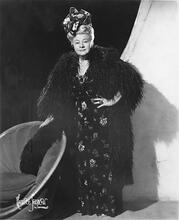
The “Last of the Red-Hot Mamas,” Sophie Tucker defied convention with her saucy comic banter and music. Tucker moved to New York to sing, performing in cafes before breaking into vaudeville. In 1910, she first sang what became her signature song, “Some of These Days.” That same year, she was hauled offstage and tried for obscenity, but the judge threw out the case. For the next several weeks, her shows were sold out. Tucker delighted audiences throughout America and Europe in the 1920s and 1930s. In 1945, she created the Sophie Tucker Foundation, which supported various actors’ guilds, hospitals, synagogues, and Israeli youth villages. Although Tucker also performed in movies, she preferred performing on Broadway. When she died in 1966, she had two years of engagements planned.
Early Life and Family

field_section_text_value
Vaudeville Career
In 1907, Tucker got her first break in vaudeville, singing at Chris Brown’s amateur night. After her initial audition, she overheard Brown muttering to a colleague, “This one’s so big and ugly, the crowd out front will razz her. Better get some cork and black her up.” Despite her protestations, producers insisted that she could be successful only in blackface. Quickly booked into Joe Woods’s New England circuit, she became known as a “world renowned coon singer,” a role that she couldn’t bear to let her family know she had taken. A stroke of luck befell her when her costume trunks were lost while touring; she debuted onstage in Boston without blackface, declaring to the shocked audience: “You-all can see I’m a white girl. Well, I’ll tell you something more: I’m not Southern. I’m a Jewish girl and I just learned this Southern accent doing a blackface act for two years. And now, Mr. Leader, please play my song.”
It wasn’t long before Tucker was performing out of blackface to increasingly adulating audiences. Songs like “A Good Man Is Hard to Find,” “I’m Living Alone and I Like It,” “I Ain’t Takin’ Orders from No One,” and “No Man is Ever Gonna Worry Me” were hits with female and male audiences alike, at venues such as Tony Pastor’s Palace, Reisenweber’s supper club, vaudeville houses throughout the United States, and music halls throughout Europe. In 1910, African-American composer Shelton Brooks wrote her immensely popular signature song “Some of These Days.” This, like many other songs, Tucker purchased exclusive rights to sing.
My Yiddishe Momme
field_section_text_value
Philanthropy
Courtesy of the Jacob Rader Marcus Center of the American Jewish Archives.
Tucker was known for her reverence of the Hebrew principle of Modestyzedakah, charity, and acts of good will toward others. In 1945, she established the Sophie Tucker Foundation, donating time, energy, and resources to an ecumenical assortment of causes. Tucker contributed to the Jewish Theatrical Guild, of which she was a life member, the Negro Actors Guild, and the Catholic Actors Guild, as well as the Will Rogers Memorial Hospital, the Motion Picture Relief Fund, synagogues, and hospitals. She supported Israel Bonds, and her foundation endowed a Sophie Tucker chair at Brandeis University in 1955. In 1959, on the first of several trips to Israel, Tucker dedicated the Sophie Tucker Youth Center at Bet Shemesh in the Judean Hills. Two years later, she sponsored another youth center at Kibbutz Be’eri in the northern Negev near Gaza. In 1962, she sponsored the Sophie Tucker Forest near the Bet Shemesh amphitheater and raised money for another forest. She also donated time and money to numerous hospitals and homes for the aged.
Tucker used her economic independence to empower herself and others, which created tensions in her personal life. Early in her career, Tucker had helped many of the prostitutes who lived in the same rooming houses as she, stashing money from their pimps, noting that, “Every one of them supported a family back home, or a child somewhere.” While on tour, she brought her band to play in houses of prostitution for women who’d taken the night off in her honor. Tucker felt that it was her economic independence that doomed her marriages to Tuck, accompanist Frank Westphal, and manager Al Lackey, all of which ended in divorce. As she explained it: “Once you start carrying your own suitcase, paying your own bills, running your own show, you’ve done something to yourself that makes you one of those women men like to call ‘a pal’ and ‘a good sport,’ the kind of woman they tell their troubles to. But you’ve cut yourself off from the orchids and the diamond bracelets, except those you buy yourself.”
Career Successes and Legacy
field_section_text_value
Allen, Robert C. Horrible Prettiness: Burlesque and American Culture (1991);
AJYB 68:534;
Brown, Janet. “The ‘Coon-Singer’ and ‘Coon-Song’: A Case Study of the Performer-Character Relationship.” Journal of American Culture 7, 1–2 (Spring/Summer 1984): 1–8;
Cohen, Sarah Blacher, ed. From Hester Street to Hollywood: The Jewish-American Stage and Screen (1983), and Jewish Wry: Essays on Jewish Humor (1987);
DAB 8;
EJ; “500 at Funeral of Sophie Tucker.” NYTimes, February 14, 1966;
Fricker, Karen. “Experience the Divine Bette Midler.” New York Financial Times, October 4, 1993;
Gilbert, Douglas. American Vaudeville: Its Life and Times (1963);
Green, Abel. “Two in One Week: Sophie Tucker Dies at 82, Billy Rose Succumbs at 66.” Variety (February 16, 1966);
Kaplan, Mike, ed. Variety Who’s Who in Show Business (1985);
Lifson, David S. The Yiddish Theater in America (1985);
Loy, Pamela, and Janet Brown. “Red Hot Mamas, Sex Kittens and Sweet Young Things.” International Journal of Women’s Studies 5, no. 4 (September–October 1982): 338–47;
Nachman, Gerald. “‘Hudl Mitn Shtrudl’ and Other Stage Delicacies.” San Francisco Chronicle, December 2, 1990, 17;
NAW modern;
“A Nip of Tucker.” San Francisco Chronicle, January 12, 1997;
Rogin, Michael. “Making America Home: Racial Masquerade and Ethnic Assimilation in the Transition to Talking Pictures.” Journal of American History (December 1992);
Rosenberg, Joel. “Jewish Experience on Film.” AJYB (1996);
Sandrow, Nahma. Vagabond Stars: A World History of Yiddish Theater (1977);
“The Singing Yiddishe Momma.” Israel Post, February 11, 1966, 5A;
Slide, Anthony. The Encyclopedia of Vaudeville (1994);
Sochen, June. “Fanny Brice and Sophie Tucker: Blending the Particular with the Universal.” In From Hester Street to Hollywood: The Jewish-American Stage and Screen, edited by Sarah Blacher Cohen (1983);
“Sophie Tucker Dies Here at 79 [sic].” NYTimes, February 10, 1966, 1:8;
Tucker, Sophie. Some of These Days (1945);
Unterbrink, Mary. Funny Women: American Comediennes 1860–1985 (1987);
Vicinius, Martha. “Happy Times ... If You Can Stand It: Women Entertainers During the Interwar Years in England.” Theater Journal 31 (1979): 358;
WWIAJ (1926, 1928, 1938);
WWWIA 4;
Yellen, Jack. “My Yiddishe Momme.” The Lawrence Wright Song and Dance Album (1925).

Double your impact to amplify Jewish women’s stories—
All gifts matched up to $35,000
Before you close this article, please consider supporting the Jewish Women’s Archive and uplifting Jewish women’s voices.
At JWA, we preserve the voices of Jewish women and gender-expansive people past and present, share them freely with millions online, and empower a new generation of Jewish feminists to lead with courage, creativity, and conviction.
But none of this happens without you. JWA is an independent nonprofit— we rely on people, like you, who believe that history belongs to all of us and that the voices of Jewish women must remain powerful, and heard.
This month, a generous JWA board member will match every gift dollar for dollar—up to $35,000—through June 30. Your contribution goes twice as far right now.
Every contribution—no matter the size—helps us document, teach, and inspire through Jewish women’s stories.
It takes less than a minute to make a difference.
Thank you for being a part of the JWA community,

Judith Rosenbaum, CEO