

Olga Taussky-Todd

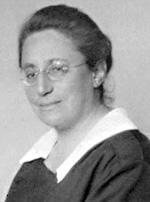
Mathematician Olga Taussky-Todd in Göttingen, Germany, 1932.
Courtesy of Konrad Jacobs via Wikimedia Commons.
A self-proclaimed torchbearer for matrix theory, Olga Taussky-Todd made the previously little-known field essential for scientists and mathematicians. After earning a PhD in algebraic number theory in Vienna, Taussky-Todd took various academic positions around Europe. She turned her interests to matrix theory while working on aircraft design at the National Physical Laboratory in London during the war years. Taussky-Todd immigrated to America in 1947, living first in Washington, D.C., and then moving to California to work and teach at CalTech. Olga Taussky-Todd published roughly 200 papers in her lifetime, was acclaimed the LA Times’ 1963 Woman of the Year, served on the councils of both the London and American Mathematical Societies, and was honored with the Austrian Cross of Science and Art.
Olga Taussky-Todd called herself a “torchbearer for matrix theory.” Her subject originated in the mid-nineteenth century, remaining a province of mathematicians until physicists reinvented it in the 1920s to interpret quantum mechanics. Her work and passion helped shape matrix theory and draw other talented mathematicians to its development. A century after its inception, matrix theory joined calculus as an essential component of a scientist’s education.
Early life and work: Austria and England
field_section_text_value
Immigration to America
In 1947, her husband received a year’s appointment at the National Bureau of Standards in Washington. The matrix theorists assembled there and stirrings of the embryonic computer revolution made the offer appealing. Both were hired, traveling to America on a Liberty ship with a hundred war brides. They remained until 1957, when they were lured to the California Institute of Technology, Todd to be a professor of mathematics, and Taussky-Todd to be a research associate. She received tenure in 1963, but had to wait until 1971 for a professorial appointment, well after she had become internationally known. She published two hundred papers in her lifetime, most during her fertile thirty-eight years at Cal Tech, where she guided fourteen doctoral students.
Taussky-Todd’s Legacy
Among her many honors and awards were the Los Angeles Times Woman of the Year (1963) and the Mathematical Association of America’s Ford Prize (1970). She served on the councils of both the London and the American Mathematical Societies, and was vice president of the latter in 1986–1987. Both the journals Linear Algebra and its Applications and Linear and Multilinear Algebra published issues dedicated to her.
Taussky-Todd was visiting professor at the University of Vienna in 1965, accepted the Austrian government’s Cross of Honor in Science and Art in 1980, and later became a corresponding member of the Austrian and the Bavarian Academy of Sciences. Historians and others puzzle over the warm feelings some Austrian Jews, Taussky-Todd among them, retained for their country of origin in the face of Austria’s long tradition of virulent antisemitism. Her writings ascribe her career difficulties to academe’s prejudice against women, not to antisemitism. Though of Jewish birth, she identified herself with an international intellectual community, not a specifically Jewish one.
Olga Taussky-Todd died on October 7, 1995, in Pasadena, California, survived by her husband of fifty-seven years.
Selected works by Olga Taussky-Todd
“An Autobiographical Essay.” In Mathematical People: Profiles and Interviews, edited by Donald J. Albers and G.L. Alexanderson (1985).
“How I Became a Torchbearer for Matrix Theory.” American Mathematics Monthly 95 (1988): 801–812.
Berkley, George. Vienna and Its Jews (1988).
Brewer, James W., and Martha K. Smith. Emmy Noether (1981).
Davis, Chandler. “Remembering Olga Taussky-Todd.” The Mathematical Intelligencer 19, no. 1 (1997): 15–21.
Grinstein, Louise S., and Paul J. Campbell. Women of Mathematics (1987).
Luchins, Edith H., and Mary Ann McLoughlin. “In Memoriam: Olga Taussky-Todd.” Notices of the American Mathematical Society 43, no. 8 (1996).
Reid, Constance. Courant in Gottingen and New York (1976).
Schneider, Hans. “On Olga Taussky-Todd’s Influence on Matrix Theory and Matrix Theorists.” Linear and Multilinear Algebra 5 (1977/8): 197–224.
More on Olga Taussky-Todd
Double your impact to amplify Jewish women’s stories—
All gifts matched up to $35,000
Before you close this article, please consider supporting the Jewish Women’s Archive and uplifting Jewish women’s voices.
At JWA, we preserve the voices of Jewish women and gender-expansive people past and present, share them freely with millions online, and empower a new generation of Jewish feminists to lead with courage, creativity, and conviction.
But none of this happens without you. JWA is an independent nonprofit— we rely on people, like you, who believe that history belongs to all of us and that the voices of Jewish women must remain powerful, and heard.
This month, a generous JWA board member will match every gift dollar for dollar—up to $35,000—through June 30. Your contribution goes twice as far right now.
Every contribution—no matter the size—helps us document, teach, and inspire through Jewish women’s stories.
It takes less than a minute to make a difference.
Thank you for being a part of the JWA community,
Judith Rosenbaum, CEO


