

Tamar: Midrash and Aggadah

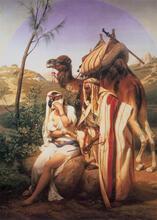
"Judah and Tamar," by Horace Vernet, 1840. Via Wikimedia Commons.
Tamar marries into Judah’s family, first to his son Er, and then to his son Onan after Er’s death. The Tamar narrative in the Bible casts the characters in a human, and not very complimentary, light. The later Rabbis sharply criticize Judah and his sons, but they describe Tamar positively, despite the fact that she is a convert. Her actions during her relationship with Judah demonstrate her purity, and her behavior shows the proper way in which all future women should perform. Judah sentences Tamar to death after finding out she is pregnant with his child, but Tamar stays silent, waiting for him to acknowledge his responsibility. Ultimately, Judah’s honesty rewards him much praise, and Tamar gives birth to twins, one of whom is an ancestor of David.
Introduction
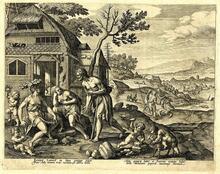
The Tamar narrative casts the Biblical characters in a human, and not very complimentary, light. Judah’s son spills his seed rather than provide offspring for his brother; Judah does not keep his promise to give his younger son Shelah to his widowed daughter-in-law; and Tamar, whose husbands die one after the other, arrays herself as a harlot and sleeps with her father-in-law. Only at the last moment is Tamar saved from being burnt at the stake.
The Rabbis spare no criticism of Judah and his sons, pointing out the sins that were responsible for their bitter fate, but they display a different attitude toward Tamar. Although her behavior could be interpreted as an act of sexual licentiousness and wantonness, the midrashim defend Tamar and praise her. They describe her as a woman with sterling qualities, who maintained the strictures of modesty and faithfully observed the laws of Menstruation; the menstruant woman; ritual status of the menstruant woman.niddah. Tamar had been intended for Judah from the outset and she was a virgin when he engaged in relations with her. Their encounter on the way to Timnah was significant and decisive in the annals of the Israelite nation. Divine intervention was active throughout the entire incident: the hand of God directed Judah to the tent, and it revealed the pledge and thereby saved Tamar and her unborn children from the stake. Thus, Perez and Zerah came into the world, King David was descended from Perez, and the Messiah eventually will be born from this line.
Tamar's Marriages to Er and to Onan
According to the Biblical account, Tamar was most likely a Canaanite. The A type of non-halakhic literary activitiy of the Rabbis for interpreting non-legal material according to special principles of interpretation (hermeneutical rules).midrash is relatively silent on her life before she married into the family of Judah. One tradition asserts that she was an orphan and was converted in order to marry (BT Suspected adulteressSotah 10a), while another claims that she was the daughter of Melchizedek, king of Salem, who was “a priest of God Most High” (Gen. 14:18). Consequently, Judah judged her according to the laws pertaining to the daughter of a priest (which are set forth in Lev. 21:9) and ordered that she be burnt when he thought that she had become pregnant as a result of an illicit tryst (Gen. Rabbah 85:10).
Tamar was married to Judah’s firstborn Er and after his death she was given in matrimony to his second son, Onan. The midrash relates that Er was seven years old when he married Tamar (Lit. "order." The regimen of rituals, songs and textual readings performed in a specific order on the first two nights (in Israel, on the first night) of Passover.Seder Olam Rabbah 2). The Torah she-bi-khetav: Lit. "the written Torah." The Bible; the Pentateuch; Tanakh (the Pentateuch, Prophets and Hagiographia)Torah declares that Er was “displeasing to the Lord” and was accordingly put to death (Gen. 38:7), while his brother Onan died because he did not want to do his duty as a brother-in-law, and rather spilled his seed on the ground (vv. 9–10). The Rabbis suggest that Judah’s two sons died because they engaged in unnatural intercourse with Tamar. Er acted in this manner so she would not become pregnant, for he feared that pregnancy would detract from her beauty, while Onan did so because he knew “that the seed would not count as his” (v. 9). Consequently, Tamar was still a virgin after the deaths of the two brothers (BT Yevamot 34b).
In another midrashic exegesis, the death of his two sons was a punishment for Judah, who had deceived Jacob by telling him that Joseph was dead. God said to Judah: “You have no children, so you do not know the grief at their loss. You deceived your father and told him that your son had died—by your life, you shall take a wife and bury your children, so that you will know the sorrow that comes from the loss of children” (Tanhuma [ed. Buber], Vayigash 10).
Yet another tradition views their death as punishment for Judah’s starting something but not finishing it. Judah persuaded his brothers not to kill Joseph, and instead sell him to the Ishmaelites (Gen. 37:26–27), but he did not bring this to a conclusion, since he could have completely saved Joseph: he should have carried Joseph on his shoulders to his father. He therefore was punished by having to bury his wife and his two sons, and also by coming down in the world, as it is said (Gen. 38:1): “Judah left [va-yered, literally, went down (from)] his brothers” (BT Sotah 13b; Gen. Rabbah 85:3).
The latter two traditions link the story of the sale of Joseph with the episode of Judah and Tamar, which are sequential in the Torah. Further to this juxtaposition, the midrash states that while the other brothers were engaged in the sale of Joseph, and Jacob was occupied by his sackcloth and fasting (over the presumed death of Joseph), Judah was busily engaged in taking a wife, and God was engaged in creating the light of the Messiah (who will eventually issue from the union of Judah and Tamar) (Gen. Rabbah 85:1). This midrash teaches that people are involved in their own affairs and troubles and do not see the sweeping divine plan that takes form before their very eyes, one that is for their own good and that gives them a future and hope.
Judah meticulously observed the laws of Marriage between a widow whose husband died childless (the yevamah) and the brother of the deceased (the yavam or levir).yibbum (levirate marriage), and when his firstborn son died childless, he ordered Onan to marry his dead son’s wife Tamar, to “establish the name” of the deceased. (Deut. 25:5–10). The Rabbis find Judah’s conduct praiseworthy: even though the Torah had not yet been given, he nonetheless took care to observe all the commandments (Lev. Rabbah 2:10).
Tamar and Judah
field_section_text_value
The Pledge
The Bible has Tamar asking Judah for a pledge, and, after his asking what to give her, “she replied, ‘Your seal and cord, and the staff which you carry’” (v. 18). The Rabbis say that she spoke with the spirit of divine inspiration (ruah ha-kodesh), for she would in fact receive these three items from Judah: “Your seal [hotamkha]”—this is kingship, for their descendants would include King Jeconiah son of Jehoiakim, of whom it is said: “a signet [hotam] on my right hand” (Jer. 22:24); “and cord”—this is the Sanhedrin, whose members are distinct, like the cord of tekhelet in the zizit [one of the eight cords of the fringe (zizit) at the corners of one’s garment must be of tekhelet, a special blue color—Num. 15:38]; “and the staff [u-matekha]”—this is the anointed king, the Messiah, who will issue from this union, and of whom it is said: “The Lord will stretch forth from Zion your mighty scepter [mateh]” (Ps. 110:2) (Gen. Rabbah 85:9).
Some midrashim argue that the embarrassing situation in which Judah found himself was punishment for selling Joseph. Tamar vanished, together with the pledge that Judah left with her, and he could not find her when he sent her the kid from his flock. God said to him: “You deceived your father with a kid [when you dipped Joseph’s coat of many colors in the kid’s blood, so that Jacob would think that his son was dead]—by your life, Tamar deceives you with a kid!” (Gen. Rabbah 85:9).
As Judah deceived his father by means of clothes, so, too, did Tamar similarly lead Judah astray with clothing. God said to Judah: “You told your father: ‘Please examine it [, is it your son’s tunic]’ [Gen. 37:32]—by your life, you shall hear ‘Examine these [: whose seal and cord and staff are these?]’ [Gen. 38:25]” (Gen. Rabbah 84:19).
The Rabbis learned from the Biblical account in Gen. 38:24, in which Judah became aware of Tamar’s pregnancy three months after their liaison, that a fetus is not noticeable in its mother’s womb for three months (Gen. Rabbah 95:8). Another tradition claims that Tamar made no effort to hide her pregnancy; on the contrary, she would pat her stomach and proclaim: “I am pregnant with kings and redeemers” (Gen. Rabbah 85:10).
When Judah heard that Tamar was with child by harlotry, he ordered: “Bring her out and let her be burned” (v. 24), but at that juncture she displayed the proofs the distinctive objects that were the pledge that Judah had entrusted with her. V. 25 states that she was “brought out [muzet],” which the Rabbis connected with the finding of a lost article (mezi’at avedah): Tamar had lost her proofs, and God provided others in their stead (Gen. Rabbah 85:11). A similar tradition avers that Samael (the Adversary) concealed the proofs, and God sent the angel Gabriel to find them. According to the Rabbis, this moment is depicted by David (Tamar’s descendant) in Ps. 56:1: “For the leader; on yonat elem rehokim [or: the silent dove of those who are far off]. Of David. A mikhtam.” When Tamar’s proof vanished, she was like a silent dove. God, however, intervened, on account of “Of David. A mikhtam,” for she was destined to be the forebear of David, who would be meek (makh) and perfect (tam) to all (BT Sotah 10b). These traditions stress the real dangers facing Tamar and her fetuses, and the fact that God miraculously intervened to ensure the existence of the future king.
When Tamar sent the proofs, that is, the pledge, to Judah, she said to him (v. 25): “I am with child by the man to whom these belong.” The Rabbis observe that she did not say outright: “I am pregnant by you,” from which they conclude that if Judah had not acknowledged his responsibility, Tamar was prepared to be burnt rather than publicly shame him. The Rabbis learn from this act by Tamar that it is better for a person to cast himself into a fiery furnace than to publicly shame his fellow (BT Sotah 10b).
"She Is More in the Right than I"
field_section_text_value
Twins
field_section_text_value
More Like This

Double your impact to amplify Jewish women’s stories—
All gifts matched up to $35,000
Before you close this article, please consider supporting the Jewish Women’s Archive and uplifting Jewish women’s voices.
At JWA, we preserve the voices of Jewish women and gender-expansive people past and present, share them freely with millions online, and empower a new generation of Jewish feminists to lead with courage, creativity, and conviction.
But none of this happens without you. JWA is an independent nonprofit— we rely on people, like you, who believe that history belongs to all of us and that the voices of Jewish women must remain powerful, and heard.
This month, a generous JWA board member will match every gift dollar for dollar—up to $35,000—through June 30. Your contribution goes twice as far right now.
Every contribution—no matter the size—helps us document, teach, and inspire through Jewish women’s stories.
It takes less than a minute to make a difference.
Thank you for being a part of the JWA community,


Judith Rosenbaum, CEO


