

Jessie Ethel Sampter

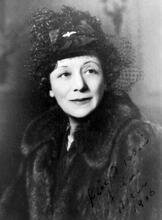
Jessie Sampter was a writer, thinker, and Zionist educator. She wrote in English and Hebrew about Jewish nationalism, Arab-Jewish relations, life in the Yishuv, and her own experiences. Born into an Ethical Culture household, Sampter turned to Judaism and Zionism as a young adult. In 1919, after several years of leadership within Hadassah, she moved from her native New York to Palestine. Once there, she established close relationships with other Zionists, including Leah Berlin; Berlin would live with Sampter for much of the rest of their lives. In 1934, they moved to Kibbutz Givat Brenner, where Sampter brought funds to establish a vegetarian rest home for workers. Although Sampter’s disability and non-normative family structure did not align with Zionist ideals of strong, healthy bodies, she championed Zionism, though not always uncritically.
Early Life
Jessie Sampter was born on March 22, 1883, in New York to attorney Rudolph Sampter and Virginia Kohlberg Sampter, well-off second-generation German-American Jews. Although both her parents were raised Jewish, Jessie and her older sister Elvie grew up in an Ethical Culture household, which included Christmas trees, Jewish and Christian visitors, and books from a variety of religious traditions.
Sampter’s parents valued education, so when they deemed her to be a frail and sickly child, they hired tutors to come to the house. Later, she audited courses at Columbia University. Throughout her life, she was an ardent student, including learning Hebrew as an adult.
When Rudolph died of tuberculosis in 1895 at age 44, Sampter was crushed. He had nurtured her love of reading, offered her help with her poetry, and encouraged her philosophical curiosity. As Sampter later wrote in an autobiographical novel, she “loved him just a little bit more, because he understood” (quoted in Badt-Strauss). A year later, Sampter contracted polio, which left her hands and back “deformed,” as she wrote, and caused her continued pain and exhaustion for the rest of her life.
Writing and Commitment to Education

field_section_text_value
Turn to Zionism
field_section_text_value
Move to Palestine

Sampter fell ill and was hospitalized upon her arrival in Jerusalem. Yet she did not see herself as a drain on the Zionist cause. Rather, her essays framed her experience as a celebration of Zionism for her English-speaking audiences: “To me it was almost worth the discomfort of a serious illness that I might spend several weeks as a patient, in the ranks of patients, in our own Hadassah Hospital in Jerusalem—the Rothschild Hospital” (“Bed Number Six”). Sampter did not always speak glowingly about all Zionist endeavors in the Yishuv, but she committed her time and limited energy to writing that she hoped would help create a Jewish society that made space for people beyond able-bodied Ashkenazi men.
Sampter spent the rest of her life in Palestine, apart from two trips back to the United States. Soon after her arrival, Sampter met Leah Berlin, a Russian Zionist, and the two decided to live together in Jerusalem. They lived apart for several years after Berlin’s family came to Palestine. During that time, Sampter adopted three-year-old Tamar, a Yemenite Jewish toddler, with whom she had developed a relationship during her visits to a Jerusalem orphanage. It was uncommon for single women to adopt children to whom they were not related, but Sampter’s interest in education meant she had long been around children. Jessie and Tamar moved into a house in Rehovot, but Sampter and Berlin always remained in very close contact.
During these years, Sampter continued to write for Hadassah, the ZOA, and other English-language periodicals. In 1927, she published The Emek, a collection of poems about the Jezreel Valley. She also began publishing in Hebrew, including poetry that appeared in the newspaper Davar.
Unlike many other American Zionists, Sampter explicitly discussed the relationship between Jews and Arabs in Palestine. She yearned for “brotherhood” between the two groups, and she blamed the British for stirring up animosity between them. In a very unusual move, Sampter applied and received her Palestinian passport in 1926 and she gave up her US citizenship. She wanted to make her commitment clear: this was her society, and she was invested in it.
Kibbutz Givat Brenner

In 1934, Sampter and Leah Berlin decided to become members of Kibbutz Givat Brenner. Members initially expressed ambivalence about them moving there, referring to the two women as “old” and wondering what use a disabled woman could be, apart from the money she would bring. Part of the issue was also that Sampter wanted the kibbutz to use some of her funds to build a vegetarian rest home where workers could recuperate, but individual members declaring how their money should be used went against its communal ethos of finances. After deliberation, the kibbutz members agreed, and the two women and Tamar joined. Sampter would write the kibbutz newsletter.
Sampter died on November 11, 1938, likely from complications from malaria. Szold presided over her funeral. The kibbutz renamed the rest home Bet Yesha in her honor.
Selected Works by Jessie Sampter
Around the Year in Rhymes for the Jewish Child. New York: Bloch Publishing, 1920.
“Bed Number Six.” Bnai Israel Bulletin [Pittsburgh] (1922): 12-13.
Coming of Peace. New York: Publishers Printing Company, 1919.
A Course in Zionism. New York: Federation of American Zionists, 1915.
The Emek. New York: Bloch, 1927.
Far Over the Sea: Poems and Jingles for Children. Cincinnati: Union of American Hebrew Congregations, 1939.
Great Adventurer. New York: Kerr Press, 1909.
Seekers. New York: Mitchell Kennerley, 1910.
Sefer ha-Goyim [Book of Nations]. New York: EP Dutton and Company, 1917.
“Speaking Heart” unpublished manuscript, Central Zionist Archives, Jerusalem.
Antler, Joyce. The Journey Home: Jewish Women and the American Century. New York: Simon and Schuster, 2010.
Badt-Strauss, Bertha. White Fire: The Life and Works of Jessie Sampter. Philadelphia: Reconstructionist Press, 1956.
Rebecca Boim Wolf. “Jessie Sampter’s School of Zionism.” In The Women Who Reconstructed American Jewish Education, 1910–1965, edited by. Carol K Ingall. Waltham, MA: Brandeis University Press, 2010
Chazan, Meir. “The Wise Woman of Givat Brenner.” In The Individual in History: Essays in Honor of Jehuda Reinharz, edited by ChaeRan Y. Freeze, Sylvia Fuks Fried, and Eugene R. Sheppard. Brandeis University Press, 2015.
Imhoff, Sarah. The Lives of Jessie Sampter: Queer, Disabled, Zionist. Durham, NC: Duke University Press, 2022.
More on Jessie Ethel Sampter

Double your impact to amplify Jewish women’s stories—
All gifts matched up to $35,000
Before you close this article, please consider supporting the Jewish Women’s Archive and uplifting Jewish women’s voices.
At JWA, we preserve the voices of Jewish women and gender-expansive people past and present, share them freely with millions online, and empower a new generation of Jewish feminists to lead with courage, creativity, and conviction.
But none of this happens without you. JWA is an independent nonprofit— we rely on people, like you, who believe that history belongs to all of us and that the voices of Jewish women must remain powerful, and heard.
This month, a generous JWA board member will match every gift dollar for dollar—up to $35,000—through June 30. Your contribution goes twice as far right now.
Every contribution—no matter the size—helps us document, teach, and inspire through Jewish women’s stories.
It takes less than a minute to make a difference.
Thank you for being a part of the JWA community,


Judith Rosenbaum, CEO