
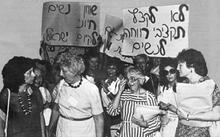
Frances Raday

Throughout her years in England, Africa and finally Israel, human rights advocate and litigator Frances Raday has sought to use law to achieve political justice and equality for every individual, regardless of sex, race or religion.
Photographer: Hezi Hojesta
Institution: Hebrew University, Jerusalem, Photo Archives
Frances Raday is a prominent academic, human rights advocate, and litigator. In 1968, she moved from England to Israel, where she became a feminist. She realized that, contrary to the myth that Israel has a high level of gender equality, there was a battle to be fought over women’s rights. After serving in various leadership positions, she published Women’s Status in Law and Society in Israel in 1995, the first feminist legal theory book to be published in Israel. From 2000 to 2003 Raday served as an independent expert for the UN Convention on the Elimination of Discrimination against Women Committee and had a global impact on the fight for gender equality.
Early life and Education
Frances Raday’s career as a leading human rights advocate, feminist academic, and litigator evolved on no less than three continents: starting in England, passing through Africa, and finally settling in Israel.
Raday was born on January 29, 1944. Her father, Julius Livingstone (b. Glasgow, 1908), was a family doctor. Her mother Pearl (née Levy, b. Manchester, 1918) studied law but never practiced it. Raday was raised with her older sister Morven (Heller, b. 1940) in Manchester. The family was assimilated although it stayed in close contact with the secular Jewish community. In 1977, Raday’s parents moved to join her in Israel.
In 1961, at the age of seventeen, Raday entered the London School of Economics; after graduating in law in 1964, she was accepted to Gray’s Inn as a barrister at law. It was there, at the traditional graduation dinner, that she first experienced male chauvinism, prompting what she would later recall as her “first feminist notion.” Being forced by her rowdy graduating colleagues, all but two of whom were men, to stand on the dinner table to render her graduation speech, she abandoned her prepared text and said only: “This is indeed a strange profession in which women are required to stand above men at its commencement and beneath them thereafter”—words that would echo later in her work and practice.
Interest in Israel
In 1964 Raday visited Israel, where she worked for three months at A voluntary collective community, mainly agricultural, in which there is no private wealth and which is responsible for all the needs of its members and their families.Kibbutz Kefar ha-Nasi. From 1964 to 1966 Raday worked as a research assistant in the British Institute of International and Comparative Law, where she found herself in an elite environment: the director of the international law section in which she worked was Lord Denning. Feeling that the glorious job and working conditions were too comfortable for her socialist views, she applied for a lectureship in the newly established University of East Africa at Dar-e-Salaam in Tanzania. Raday spent two years (1966–1968) in Tanzania, establishing for the first time a course in East African Labor Law and researching this field with its special importance and unique characteristics in the phases of colonialism, independence, and post-independence. She also co-founded the university’s Torts courses.
Ironically, it was in this Tanzanian context that Raday developed her interest in Israel. In June 1967, when Israel was on the verge of war, Raday, who was a member of a group of New Left lecturers, witnessed her colleagues mourn the imminent destruction of the young state of Israel. On the day of Israel’s victory, only six days later, the same people, who only days earlier had expressed their concern for the fate of the “only democracy in the Middle East,” switched to condemnation of the Jewish State, saying that as long as Israel survived in the Middle East, the Arabs would never reach their full political, economic, and cultural potential. Again, Raday found herself speaking out against a hostile group. “There is no nation in history that suffered more than the Jewish people from persecution and discrimination,” she said, adding that the Jews, no less than the Arabs, belong to Franz Fanon’s “Wretched of the Earth.” Of the group, only Walter Rodney, a professor of history, who was later assassinated as leader of the opposition in Guyana, agreed with Raday: “There are no colonizers and colonized between Jews and Arabs, only two peoples deprived by history of a homeland and fighting over one miserable strip of land.” It was as a direct result of this transformative moment that Raday decided to immigrate to Israel. When enquiring at the Israel Embassy how she could teach law in Israel, she was directed to Uri Raday (b. Israel, 1931), who was the Israeli consul in Zanzibar and himself a lawyer. Uri became the administrator of the Lit. "assembly." The 120-member parliament of the State of Israel.Knesset’s Foreign Affairs and Defense Committee. They married after her arrival in Israel in 1968.
Israel was not waiting for Raday with open arms. She did not know a letter of Hebrew and had no knowledge of Israeli law or culture. In 1969 she registered as a doctoral student in the Hebrew University Law School. Once again she found herself drawn to the world of labor law and to the beauty and importance she sees in it: balancing powerful and powerless people; combining elements of psychology, economics, and social justice; and determining the quality of life of members of society. On completing her doctorate in 1975, she taught and continued to research labor law at the Hebrew University, and in 1990 came to hold the Lieberman Chair in Labor Law.
A Feminist Legal Career
field_section_text_value
Selected Works by Frances Raday
“The Military, Feminism and Citizenship.” Plilim 9 (2000) (Hebrew) 185–216.
“The Decline of Union Power: Structural Inevitability or Policy Choice?” In Labor Law in a Period of Globalization, edited by Joanne Conaghan, Michael Fischl and Karl Klare, 353–377. Oxford: 2002.
“The Fight Against Silencing.” In Women of the Wall: Claiming Sacred Ground at Judaism’s Holy Site, edited by Phyllis Chesler and Rivka Haut. Woodstock, Vermont: 2002.
“On Equality: Judicial Profiles.” Israel Law Review 35 (2003): 380.
“Culture, Religion and Gender.” International Constitutional Law Journal, vol. 1, no. 3 (2003): 663.
“Self-Determination and Minority Rights.” Fordham International Law Journal 26 (2003): 453.
“If Netanyahu Defies the Supreme Court, Israel Will Become an Autocracy.” Haaretz, September 12, 2023.
More on Frances Raday
Double your impact to amplify Jewish women’s stories—
All gifts matched up to $35,000
Before you close this article, please consider supporting the Jewish Women’s Archive and uplifting Jewish women’s voices.
At JWA, we preserve the voices of Jewish women and gender-expansive people past and present, share them freely with millions online, and empower a new generation of Jewish feminists to lead with courage, creativity, and conviction.
But none of this happens without you. JWA is an independent nonprofit— we rely on people, like you, who believe that history belongs to all of us and that the voices of Jewish women must remain powerful, and heard.
This month, a generous JWA board member will match every gift dollar for dollar—up to $35,000—through June 30. Your contribution goes twice as far right now.
Every contribution—no matter the size—helps us document, teach, and inspire through Jewish women’s stories.
It takes less than a minute to make a difference.
Thank you for being a part of the JWA community,

Judith Rosenbaum, CEO