
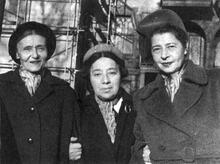
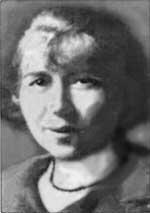
Rikudah Potash

Born in Tshenstokhov, Poland, Rikudah Potash began to write Yiddish poetry in the wake of the 1918 Lemberg pogrom. In 1934, after a divorce, she moved to Palestine, where she continued her illustrious writing career, maintaining Yiddish as a language despite the stigma around it in Zionist communities. Her writing covered tragedy, Biblical women, and the aftermath of the Holocaust. Eventually, she focused on the newly arrived Separdhi and Mizrahi immigrant communities in Jerusalem, sharing their lives and stories with the Yiddish world. She was crowned “the Poetess of Jerusalem” by the famous Yiddish writer Sholem Asch.
Introduction

Crowned “the Poetess of Jerusalem” by Sholem Asch (1880–1957), Rikudah Potash wrote in Yiddish about the landscape of her beloved city and its diverse ethnic communities. She brought to Yiddish readers the rarely seen Middle Eastern Jewish woman. Potash’s Jerusalem, both the heavenly and the earthly, was a capacious universe that she inhabited, body and soul, for thirty years.
Early Life
Potash was born into a prosperous and enlightened family from Tshenstokhov (Częstochowa), Poland. In 1904 the family moved to Skale-bay-Oytsov (Ojców, 16 km north-northwest of Cracow), the “Switzerland of Poland,” where Rikudah was born in 1906 and which inspired her early nature poetry. Her father, Yekutiel Potash, was a correspondent for Unzer Lebn; her older brother, Mordekhai Narkiss (1898–1957), a curator and art historian, was director of the Bezalel Museum in Jerusalem from 1932. Potash was raised in the traditional Jewish spirit but became enamored of Polish culture, which was reflected in her early writing.
When she was sixteen her poetry was published in “Swiat” (Cracow). In the aftermath of the Lemberg pogrom of November 1918 (which surpassed the Kishinev pogroms of 1903–1905 in brutality), she returned to Yiddish, familiarizing herself with its literature, particularly the new Yiddish literature. Her debut piece, “Tsvey lider” (Two Poems), was published in 1922 in the Lodzer volksblat. At this time she began to write and publish Yiddish poetry on nature and Sabbath motifs, short stories, children’s tales, and novellas about the lives of girls. These appeared in a variety of publications, including Shvelen, Ilustrirte Vokh, and Lodzer Tageblat. She began a mystery drama, “Skales,” produced years later in Israel, and a comedy, “Durkh der vant” (Through the Wall). She also translated Polish literature.
Life in Palestine

field_section_text_value
The Poetess of Jerusalem
She devoted the last years of her creative life to short stories and character portraits of the various ethnic groups in Jerusalem, which were published in the Yiddish and Hebrew press. Her only prose collection, In Geslekh fun Yerushalyim (In the Alleys of Jerusalem, 1968), published posthumously, centers on the vibrant ethnic communities in Jerusalem. A spellbinding storyteller, she populates her tales with the first generation of Descendants of the Jews who lived in Spain and Portugal before the explusion of 1492; primarily Jews of N. Africa, Italy, the Middle East and the Balkans.Sephardi and Lit. "Eastern." Jew from Arab or Muslim country.Mizrahi immigrants from Yemen, Salonika, Bukhara, Kurdistan, and Turkey and their Israeli-born children. Her stories are brief, dramatic moments disclosing the essence of life among the Mizrahi residents of Jerusalem. In a rich linguistic mix she portrays the struggles between the young who embrace the freedom of modern Israel and their parents, who are caught between two cultures.
Potash is unique among Yiddish writers in her attention to Mizrahi women: In “Prikhah’s Complaint to God” a clever but unschooled woman is derided in her attempts at independence; In “Shraby’s Daughter Comes Home” a young soldier is rebuked by her father for her devotion to the state, as he insists that “girl soldiers” delay the arrival of the Messiah. Her stories, like her poems, tell of old men married to impoverished young girls whose only escape is fantasy. When love, freely chosen, enters their lives, her characters are moved to transcend their past sorrows and shape new realities.
Her mother, Chana, died in Jerusalem in 1944 and Rikudah Potash died in Jerusalem on May 15, 1965.
Selected Works
Korman, Ezra. In Yidishe dikhterins antologiya. Chicago: 1928.
Vind Oyf Klavishen. Łódź: 1934.
Fun Kidron Tol. London: M. Oved, 1952.
Moled iber Timna lider. Jerusalem: Sifre Tarshish, 1959.
Yaffe, Mordekhai. Eretz Yisroel in der Yidisher literatur. Tel Aviv: Y.L. Perets, 1961.
Lider. Tel Aviv: Yidishn liṭeraṭn un zshurnalisṭn farayn in Yiśroel, 1967.
Geslekh fun Yerusholayim. Tel Aviv: Yiśroel-bukh, 1968.
“Five Stories from In the Alleys of Jerusalem.” In Frieda Forman et al. Found Treasures: Stories by Yiddish Women Writers. Toronto: Second Story Press, 1994.
Potash’s writings also appear in periodicals: Goldene keyt, Tsukunft, Yidishe kultur, Unzer vort, among others.
Chaver, Yael. What Must Be Forgotten: Yiddish in Zionist Palestine. Hebrew, Jerusalem; English, Syracuse: Syracuse University Press, 2004.
Glatstein, Jacob (Yankev Glatshteyn). In der Velt mit Yidish (In the World with Yiddish). New York: 1973.
Kagan, Berl. Leksikon fun der nayer Yidisher literatur. New York: R. Ilman-Kohen, 1968.
Reyzen, Zalmen, ed. Leksikon fun der Yidisher literatur, prese un filologye (Lexicon of Yiddish Literature, Press, and Philology), vol. 1 Vilna: B. Ḳletsḳin, 1928.
More on Rikudah Potash
Double your impact to amplify Jewish women’s stories—
All gifts matched up to $35,000
Before you close this article, please consider supporting the Jewish Women’s Archive and uplifting Jewish women’s voices.
At JWA, we preserve the voices of Jewish women and gender-expansive people past and present, share them freely with millions online, and empower a new generation of Jewish feminists to lead with courage, creativity, and conviction.
But none of this happens without you. JWA is an independent nonprofit— we rely on people, like you, who believe that history belongs to all of us and that the voices of Jewish women must remain powerful, and heard.
This month, a generous JWA board member will match every gift dollar for dollar—up to $35,000—through June 30. Your contribution goes twice as far right now.
Every contribution—no matter the size—helps us document, teach, and inspire through Jewish women’s stories.
It takes less than a minute to make a difference.
Thank you for being a part of the JWA community,
Judith Rosenbaum, CEO