

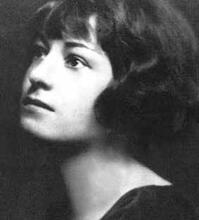
Dorothy Rothschild Parker

Courtesy of Wikimedia.
At 25, Dorothy Parker became Vanity Fair’s drama critic, an unprecedented position for a woman. She was an immediate success, known for being vicious and funny, but lost her job in 1920, when her reviews offended the theater elite. Parker was part of a small group of writers whose frequent gatherings became the famous “Algonquin Round Table.” Her first volume of collected poetry, Enough Rope (1926), was an instant best-seller, and her most acclaimed story, “Big Blond,” won the O. Henry Prize in 1929. Like many of Parker’s stories, it highlights the lack of possibilities faced by many women. Parker and her second husband became a Hollywood screenwriting team whose credits included the original A Star Is Born (1939). Parker was also committed to activism, being blacklisted in the 1950s for her pro-Left views.
Early Life
Brilliant, unrelenting, and fiercely witty, Dorothy Rothschild Parker came to signify the urbane and irreverent sensibility of New York City in the 1920s. As an adult, Parker rarely spoke of her family and Upper West Side upbringing, although she often hinted that her past had been tragic. The youngest of three siblings by many years, Dorothy was born on August 22, 1893, to a Jewish father, J. Henry Rothschild, and a Scottish mother, Eliza (Marston) Rothschild. Eliza Rothschild died when Parker was five years old, an event that devastated the child. Soon thereafter, her father, who had made a small fortune in the garment industry, married a strict Roman Catholic, whom Dorothy bitterly disliked.
As a young girl, she attended, and despised, a Catholic school in Manhattan, later transferring to Miss Dana’s, a boarding school. Henry Rothschild told the school authorities that his daughter was Episcopalian, but her dark Jewishness marked her as an outsider. She would always maintain this image of herself, and in the face of early alienation and many disappointments, she developed a biting and irreverent sense of humor. Late in life, she described herself as “one of those awful children who wrote verses,” but despite her writerly inclinations, she left school abruptly at age fourteen, never to return, to take care of her ill father, who was once again a widower. When he died in 1913, the twenty-year-old Dorothy made a living by playing piano at a Manhattan dance school.
Early Writing Career
field_section_text_value
Poetry and Other Publications
At the suggestion of a friend, Parker collected a volume of her poetry in 1926 to pay for an overseas trip, although she herself felt her verse was not good enough for a book. To her great surprise, Enough Rope became an instant best-seller, rare for a book of poems. In this and subsequent successful volumes of poetry—Sunset Gun (1928), Death and Taxes (1931), and Not So Deep as a Well (1936)—Parker poked fun at her own heartbreak, masochism, and hopefulness. Her most effective verse captures the breadth of her dreams and disappointments with bitter irony and perfect turns of phrase, but only hints at their depths.
Parker’s stories, like her poetry, resonate with heartache and disenchantment, and reflect her obsessions: incessant alcohol consumption, spoiled romance, social injustice, and the follies of the rich. Her most acclaimed story, “Big Blond,” won the O. Henry Prize in 1929. It depicts the drunken loneliness, male dependence, and increasing desperation of an aging “kept woman.” Like many of Parker’s stories, it highlights, with intense and desolate intimacy, the lack of possibilities faced by many women. Other stories were collected in Laments for the Living (1930), After Such Pleasures (1933), and Here Lies (1939). Parker also produced a great deal of literary criticism, published over many decades in the New Yorker (under the title “Constant Reader”) and, from 1958 to 1963, in Esquire. These reviews were often penned with the same unblinking brutality as her earlier drama reviews (of A.A. Milne’s The House at Pooh Corner, she said, “Tonstant Weader Fwowed Up”), although as often they were generously sensitive and enthusiastic.
Activism and Screenwriting
Despite her cynicism, Parker was deeply earnest about politics and maintained a lifelong, if intermittent, commitment to activism. She surprised her New York friends in the 1920s when she was arrested while marching for the release of the anarchists Sacco and Vanzetti. In later years, she went to Spain to work against Franco in the Spanish Civil War (“the proudest thing” she ever did), organized Hollywood screenwriters, and was blacklisted in the 1950s for her pro-Left views. While she still spent many weekends at the homes of rich friends, the pleasures she took in wealth were always mingled with fierce disdain.
In 1934, at age forty, Parker married the writer Alan Campbell, who was eleven years her junior. The couple became a Hollywood screenwriting team whose credits included the original A Star Is Born (1939). Although she found it hard to refuse the huge paychecks, Parker was not proud of her work in Hollywood and felt (as she did about reviewing) that screenwriting kept her from serious literary engagement. She was able to produce stories and poems only sporadically in the 1930s and later years, and never reached the level of productivity to which she aspired nor wrote the novel she had always dreamed of writing. Campbell, who was also half-Jewish, adored her, but was often eclipsed by her powerful talent and personality. Their relationship was complicated by economic woes, as well as their ongoing alcoholism and his homosexuality. The couple divorced in 1947, remarried in 1950, separated in 1953, and reconciled again in 1956, staying together until Campbell’s death in 1963.
Before her lonely death in New York on June 7, 1967, Parker disparaged the life that she and other Round Tablers had led. She also judged her own writing harshly as derivative and not living up to her promise. “I was following in the exquisite footsteps of Miss Edna St. Vincent Millay,” she once claimed, “unhappily in my own horrible sneakers.” Elsewhere she said that she had been “just a little Jewish girl trying to be cute.” However, her work uniquely catalogued society’s random pretensions and her own tough, intimate longings. She remains one of the most shrewdly sensitive and elegant satirists of the twentieth century.
SELECTED WORKS BY DOROTHY PARKER
After Such Pleasures (1933).
Death and Taxes (1931).
Enough Rope (1926).
Here Lies (1939).
Laments for the Living (1930).
Not So Deep as a Well (1936).
The Portable Dorothy Parker (1976).
Sunset Gun (1928).
A Star Is Born, with Alan Campbell (screenplay) (1939).
BEOAJ.
Cooper, Wyatt. “Remembering Dorothy Parker.” Esquire (July 1968).
DAB 8.
EJ.
Gaines, James R. Wits End: Days and Nights of the Algonquin Round Table (1977).
Harriman, Margaret Case. The Vicious Circle: The Story of the Algonquin Round Table (1951).
Hellman, Lillian. An Unfinished Woman: A Memoir (1969).
Keats, John. You Might as Well Live: The Life and Times of Dorothy Parker (1970).
Meade, Marion. Dorothy Parker: What Fresh Hell Is This? (1989).
NAW modern.
Obituary. NYTimes, June 8, 1967, 1:2.
Parker, Dorothy. Interview, June 1959. Oral History Collection, Columbia University, NYC, and Interview. In Writers at Work: The Paris Review Interviews, edited by Malcolm Cowley (1958).
UJE.
Woollcott, Alexander. “Our Mrs. Parker.” In The Portable Woollcott (1946).
WWWIA 4.
More on Dorothy Rothschild Parker

Double your impact to amplify Jewish women’s stories—
All gifts matched up to $35,000
Before you close this article, please consider supporting the Jewish Women’s Archive and uplifting Jewish women’s voices.
At JWA, we preserve the voices of Jewish women and gender-expansive people past and present, share them freely with millions online, and empower a new generation of Jewish feminists to lead with courage, creativity, and conviction.
But none of this happens without you. JWA is an independent nonprofit— we rely on people, like you, who believe that history belongs to all of us and that the voices of Jewish women must remain powerful, and heard.
This month, a generous JWA board member will match every gift dollar for dollar—up to $35,000—through June 30. Your contribution goes twice as far right now.
Every contribution—no matter the size—helps us document, teach, and inspire through Jewish women’s stories.
It takes less than a minute to make a difference.
Thank you for being a part of the JWA community,

Judith Rosenbaum, CEO


