

Shoshana Ornstein

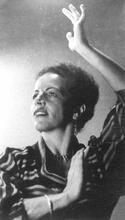
At the age of ten, Shoshana Ornstein emigrated with her mother, Margalit Ornstein, and twin sister, Yehudit, to Palestine. Her mother created dances for the two sisters in the spirit of German “Free Dance” and influenced by the family’s status as immigrants in the growing culture of Erez Israel in Palestine. Soon Shoshana started creating her own dances for the Children’s Theater and choreographed kibbutz celebrations. She taught for sixty years at the Ornstein Studio in Tel Aviv, one of Israel’s most prominent schools, and worked into her eighties.
Article
A dancer and choreographer born in Austria, Shoshana Ornstein came to Palestine in 1921 with her mother Margalit Ornstein and, together with her twin sister Yehudit, formed the celebrated Ornstein Sisters (Ha’ahayot Ornstein) duo. Shoshana studied with her mother and later at various schools, notably with Max Terpis in Berlin and Gertrud Bodenweiser in Vienna. In the 1950s she studied with Kurt Joos (1901–1979), Rosalia Chladek (1905–1995) and Mary Wigman (1886–1973). Her dances, created for her and for her sister by their mother or by themselves, were in the style and spirit of German “Free Dance” or Ausdruckstanz but influenced by their Mediterranean surroundings and their unique status as pioneers of a new secular culture in The Land of IsraelErez Israel. Shoshana was the more temperamental of the famous duo, with natural exuberance and curiosity. She created full evening dances for the Children’s Theater that was affiliated with the Teachers’ Union. These included Papillon, a dance suite entitled Hagei Israel (Israeli Festivals) and A Midsummer Night’s Dream, to the music by Felix Mendelssohn. Together with Katia Michaeli, Elsa Dublon and Tille Roesler, she founded the Chamber Quartet. She also choreographed for A voluntary collective community, mainly agricultural, in which there is no private wealth and which is responsible for all the needs of its members and their families.kibbutz celebrations at Ma’abarot (1945) and Negba (1959).

Shoshana was one of the first students of Dr. Moshe Feldenkreis and incorporated his theories of improving movement abilities in her own teaching. She taught for sixty years, most of them at the Ornstein Studio at 42 Ahad Ha’am Street in Tel Aviv, which became one of the country’s most prominent schools. She continued working until late into her eighties.
In December 1939 Shoshana Ornstein married Hans Herbert Aldor (b. Vienna, 1907), an engineer who had immigrated in 1934 and who died in 1991. The couple had two daughters, Gaby Aldor, herself also a theater director, choreographer and actress, and Elda Gertner.
Shoshana Ornstein died in 1998.
More on Shoshana Ornstein
Double your impact to amplify Jewish women’s stories—
All gifts matched up to $35,000
Before you close this article, please consider supporting the Jewish Women’s Archive and uplifting Jewish women’s voices.
At JWA, we preserve the voices of Jewish women and gender-expansive people past and present, share them freely with millions online, and empower a new generation of Jewish feminists to lead with courage, creativity, and conviction.
But none of this happens without you. JWA is an independent nonprofit— we rely on people, like you, who believe that history belongs to all of us and that the voices of Jewish women must remain powerful, and heard.
This month, a generous JWA board member will match every gift dollar for dollar—up to $35,000—through June 30. Your contribution goes twice as far right now.
Every contribution—no matter the size—helps us document, teach, and inspire through Jewish women’s stories.
It takes less than a minute to make a difference.
Thank you for being a part of the JWA community,
Judith Rosenbaum, CEO