

JWRC: Eleanor Leff Jewish Women's Resource Center

Institution: Eleanor Leff Jewish Women’s Resource Center (JWRC) of the National Council of Jewish Women, New York Section
The Jewish Women’s Resource Center was founded in 1976 by students affiliated with the Jewish Feminist Organization who were interested in exploring what it means to be both Jewish and female. The Center offered a wide range of seminars and workshops, shared information, and offered assistance to Jewish women who had specific requests or needs pertaining to the their feminism and/or Judaism. In 1982, the extensive library collection found a home at National Council of Jewish Women New York. It served as a clearinghouse for thousands of books, dissertations, liturgies for feminist ceremonies and rituals, and more. In 2009, the collection was gifted to the Jewish Theological Seminary Library.
field_section_text_value
Founding and Mission
The JWRC originated as the New York Women’s Center, which was founded by students affiliated with the Jewish Feminist Organization (JFO) who were interested in exploring what it means to be both Jewish and female. They envisioned a center that would appeal to as many college women as possible, “women who are certain of their identity as Jews but not as feminists, as well as feminists who are coming to terms with their identity as Jews.” In so doing, they changed the name of the JFO College Project to the New York Women’s Center and officially opened in October 1976.
The Women’s Center aimed to “enhance the education and self-growth of Jewish women and to become an educational, social, and resource center that would bring together Jewish women of different ages, backgrounds, and beliefs.” Toward this end, the Women’s Center offered a wide range of seminars and workshops, including such topics as the impact of Jewish feminism on daily living and zero population growth versus Jewish survival. A Jewish “womanschool” held classes on Jewish law, women in the A type of non-halakhic literary activitiy of the Rabbis for interpreting non-legal material according to special principles of interpretation (hermeneutical rules).Midrash, female heroes in Jewish folklore, and a practicum on ritual skills. In addition, a women’s prayer group met regularly.
The Women’s Center shared information and offered assistance to Jewish women who had specific requests or needs pertaining to their feminism and/or Judaism. Its growing collection of books by and about Jewish women was housed in volunteers’ apartments. By the end of 1977, the library had become an integral part of the Women’s Center, and programs were planned in conjunction with the development of its resources. At about this time, a decision was made to change the name of the Women’s Center to the Jewish Women’s Resource Center.
Finding a Home at NCJW NY
field_section_text_value

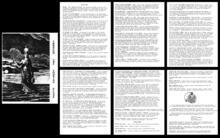
Over the past quarter of a century, feminists have developed a variety of new rituals to highlight women's life cycle events, in some cases building on traditional forms of female-oriented ritual. One example is the Simhat Bat ceremony to welcome baby girls, which finds precedent in the Zeved ha-Bat birth ceremonies held in past and present Sephardi, North African, and Syrian communities. Pictured here is a guide to the Simhat Bat ceremony published by the Jewish Women's Resource Center of the National Council of Jewish Women.
Institution: Eleanor Leff Jewish Women’s Resource Center (JWRC) of the National Council of Jewish Women, New York Section
Reporters, parents, professors, students, scholars, rabbis, and laypeople contacted the JWRC library collection for information on all aspects of Jewish women’s lives. It was a clearinghouse for books, dissertations, journals, prayers, ceremonies, liturgies, midrashim, study guides, and conference proceedings. The collection eventually grew to contain over fifteen thousand items, including books, dissertations, and liturgies for feminist ceremonies and rituals, such as naming ceremonies for girls, Lit. "daughter of the commandment." A girl who has reached legal-religious maturity and is now obligated to fulfill the commandmentsbat mitzvah and egalitarian wedding ceremonies, and feminist Lit. "order." The regimen of rituals, songs and textual readings performed in a specific order on the first two nights (in Israel, on the first night) of Passover.seders. In addition to being a comprehensive repository in the United States for materials by and about Jewish women, it was catalogued in such a way as to allow research on hundreds of topics pertaining to Jewish women, and so served as a national and international resource for browsers and scholars. Also included in the library collection were the archival materials containing the official records of the JWRC, which document the correspondence and programs from the 1970s through 2009, when the collection was gifted to the Jewish Theological Seminary Library.
Ongoing Programs
As part of its ongoing programs, the JWRC sponsors lectures, author receptions, and conferences. The first biennial conference, held in 1983, marked the dedication of the JWRC as a project of NCJW NY and celebrated the tenth anniversary of the first National Jewish Women’s Conference. Subsequent conference topics have included “Sarah the Matriarch,” “Jewish Women in the Arts,” “Di Froyen: Women and Yiddish,” “Transforming the Jewish World: A Feminist View,” and “In Celebration of Jewish Women Writers.” Other innovative programs have included a once-annual celebration of the biblical character of Ruth, a Jewish lesbian support group, and a once annual feminist Tu B’Shevat seder. For many years, the JWRC published works by Jewish feminist women writers, including a poetry annual, and sponsored Jewish Women’s Film Festivals.
The Jewish Women’s Resource Center has always maintained that there is no monolithic female Jewish community, but that there is strength in the process of learning, sharing, and studying together as women.
Cardin, Nina Beth. “Presentation to the Board of Directors of the National Council of Jewish Women New York Section.” Papers, Jewish Women’s Resource Center, September 1982.
Eisner, Rosalyn T. “Application for Recognition of Exemption.” Papers, National Council of Jewish Women Archives, NYC, Jewish Women’s Resource Center, 1977.
Hyman, Paula. “The Rise and Continuing Impact of Jewish Feminism.” Conference at Hebrew Union College–Jewish Institute of Religion, NYC, April 1991.
Rogow, Faith. Gone to Another Meeting: The National Council of Jewish Women, 1893–1993. Tuscaloosa, AL: University of Alabama Press, 1993.
“About Us.” National Council of Jewish Women. ncjw.org/about. http://www.ncjw.org/about (accessed March 7, 2021).
More Like This
Double your impact to amplify Jewish women’s stories—
All gifts matched up to $35,000
Before you close this article, please consider supporting the Jewish Women’s Archive and uplifting Jewish women’s voices.
At JWA, we preserve the voices of Jewish women and gender-expansive people past and present, share them freely with millions online, and empower a new generation of Jewish feminists to lead with courage, creativity, and conviction.
But none of this happens without you. JWA is an independent nonprofit— we rely on people, like you, who believe that history belongs to all of us and that the voices of Jewish women must remain powerful, and heard.
This month, a generous JWA board member will match every gift dollar for dollar—up to $35,000—through June 30. Your contribution goes twice as far right now.
Every contribution—no matter the size—helps us document, teach, and inspire through Jewish women’s stories.
It takes less than a minute to make a difference.
Thank you for being a part of the JWA community,
Judith Rosenbaum, CEO

