

Regina Jonas

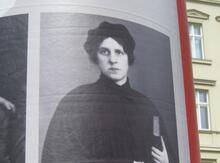
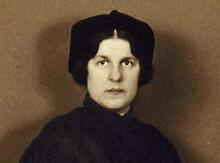
Regina Jonas longed to become a rabbi for most of her life but struggled with the restrictions against women in higher education and rabbinical studies. Her 1930 thesis argued that there was no law forbidding women to become rabbis and that there were many biblical and historical examples of women teaching and arbitrating Jewish law. Despite her professors’ praise for her thesis, Jonas was only granted a teaching degree. She continued to lobby for ordination, which she achieved in 1935. She worked as a pastoral counselor at the Jewish Hospital in Berlin and preached at liberal synagogues as the deportations of rabbis began. Even after her deportation to Theresienstadt she continued to preach, teach, and inspire her fellow inmates until her final deportation to Auschwitz.
field_section_text_value
Early Life
Regina Jonas was born in Berlin on August 3, 1902, the daughter of Wolf and Sara Jonas. She grew up in the Scheunenviertel, a poor, mostly Jewish, neighborhood. Her father, a merchant who died of tuberculosis in 1913, was probably her first teacher. Early on, Regina Jonas felt her rabbinic vocation. Her passion for Jewish history, Bible, and Hebrew was apparent even in high school, where fellow pupils recall her talking about becoming a rabbi.
Many people supported Jonas’s interests, among them the Orthodox rabbis Isidor Bleichrode, Felix Singermann, and Max Weyl, the last of whom was known for his open attitude regarding religious education for girls. Max Weyl often officiated in the Rykestrasse Synagogue, which Sara Jonas and her two children, Abraham and Regina, regularly attended. Until his deportation to Theresienstadt, Weyl and Jonas met once a week in order to study rabbinic literature— Lit. "teaching," "study," or "learning." A compilation of the commentary and discussions of the amora'im on the Mishnah. When not specified, "Talmud" refers to the Babylonian Talmud.Talmud, Lit. "the prepared table." A code of Jewish Law compiled by Joseph Caro (1488Shulhan Arukh, and texts. In 1923, Jonas passed her Abitur (final exam of secondary school) at the Oberlyzeum Weissensee. The following year, she attended a teachers’ seminar, enabling her to teach Jewish religion in girls’ schools in Berlin.
In 1924, Jonas matriculated at the Hochschule für die Wissenschaft des Judentums, founded in Berlin in 1872. This liberal institution admitted women as students, as did the Jüdisch-Theologisches Seminar in Breslau, founded in 1854, but Jonas was the only woman who hoped to be ordained as a rabbi. All her fellow women students were studying for an academic teacher’s degree.
Graduate Thesis
field_section_text_value
Career
field_section_text_value
Life in the Holocaust
field_section_text_value
Klapheck, Elisa, ed. Fräulein Rabbiner Jonas—The Story of the First Woman Rabbi. San Francisco: 2004. (Fräulein Rabbiner Jonas—Kann die Frau das rabbinische Amt bekleiden? Teetz: 2000).
Herweg, Rachel Monika. “Regina Jonas (1902–1944).” In Meinetwegen ist die Welt erschaffen. Das intellektuelle Vermächtnis des deutschsprachigen Judentums. 58 Porträts, edited by Hans Erler, Ernst Ludwig Ehrlich, and Ludger Heid. Frankfurt, New York: 1997.
Kellenbach, Katharina von. “God Does Not Oppress Any Human Being: The Life and Thought of Rabbi Regina Jonas.” In Leo Baeck Institute: Yearbook XXXIX (1994).
Kellenbach, Katharina von. “Forgotten Voices: German Women’s Ordination and the Holocaust.” In Proceedings of the Second Biennial Conference on Christianity and the Holocaust, Rider College II (1992).
Moore, Deborah Dash. “Saving Regina Jonas.” Frankely Speaking, Jean & Samuel Frankel Center for Judaic Studies (December 2014): 2.
Moore writes about the significance of Regina Jonas to modern Jewish rabbinical life in light of her trip to European sites that were a part of Jonas' life.
Reimer, Gail and Julie Mallozzi, dir. In the Footsteps of Regina Jonas. 2014.
Sarah, Elizabeth. "The Discovery of Fräulein Rabbiner Regina Jonas: Making Sense of Our Inheritance." European Judaism: A Journal for the New Europe 28, no. 2 (1995): 91-98.
Silverman, Emily Leah. Edith Stein and Regina Jonas: Religious visionaries in the time of the Death Camps. Routledge, 2014.
Sinclair, Stefanie. "Regina Jonas: forgetting and remembering the first female rabbi." Religion 43, no. 4 (2013): 541-563.
Sinclair, Stefanie. "Memory and identity: Female leadership and the legacy of Rabbi Regina Jonas." (2019).
von Kellenbach, Katharina. “Preaching Hope: Denial and Defiance of Genocidal Reality in Rabbi Regina Jonas’ Work.” In Ram's horn blown during the month before and the two days of Rosh Ha-Shanah, and at the conclusion of Yom Kippur. shofar (1998).
von Kellenbach, Katharina. "“God Does Not Oppress Any Human Being” The Life and Thought of Rabbi Regina Jonas." The Leo Baeck Institute Year Book 39, no. 1 (1994): 213-225.
More on Regina Jonas





Double your impact to amplify Jewish women’s stories—
All gifts matched up to $35,000
Before you close this article, please consider supporting the Jewish Women’s Archive and uplifting Jewish women’s voices.
At JWA, we preserve the voices of Jewish women and gender-expansive people past and present, share them freely with millions online, and empower a new generation of Jewish feminists to lead with courage, creativity, and conviction.
But none of this happens without you. JWA is an independent nonprofit— we rely on people, like you, who believe that history belongs to all of us and that the voices of Jewish women must remain powerful, and heard.
This month, a generous JWA board member will match every gift dollar for dollar—up to $35,000—through June 30. Your contribution goes twice as far right now.
Every contribution—no matter the size—helps us document, teach, and inspire through Jewish women’s stories.
It takes less than a minute to make a difference.
Thank you for being a part of the JWA community,

Judith Rosenbaum, CEO

