

Bessie Abramowitz Hillman
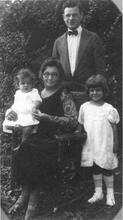
Bessie Abramowitz devoted her life to unions, organizing her first strike at fifteen, announcing her engagement on a picket line, and continuing her efforts for workers’ rights until her death. Abramowitz immigrated to America at fifteen and found work in a garment factory while attending night school at the famous Hull House, run by suffragist Jane Addams. She spearheaded walkouts over pay cuts and poor conditions, inspiring her future husband, Sidney Hillman, to join and lead strikes himself. Abramowitz organized workers for the Women’s Trade Union League along the East Coast before becoming education director of the Laundry Workers Joint Board in 1937. Abramowitz Hillman remained active in union activities until her death in New York City, on December 23, 1970, at age eighty-one.
Family and Immigration to the United State
“I was Bessie Abramowitz before he was Sidney Hillman.” Bessie Abramowitz Hillman, wife of famed labor leader Sidney Hillman (1887–1946), was a militant labor movement leader before her husband became involved and remained a union stalwart her entire life.
Bas Sheva Abramowitz (“Bessie” was created by an Ellis Island immigration officer) was born on May 15, 1889, in Linoveh, a village near Grodno in Russia. She was one of ten children born to Emanuel Abramowitz, a commission agent, and Sarah Rabinowitz. In 1905, Bessie, who spoke only Yiddish and some Russian, joined an older cousin in immigrating to America. Most 1905 immigrants fled czarist oppression and anti-Jewish violence, but Bessie reported that her aim in leaving home was to escape the services of the local marriage broker.
Becoming a Labor Activist
field_section_text_value

field_section_text_value
Jewish Identity
The Hillmans’ home life was determinedly secular. While Sidney Hillman became a close friend of Rabbi Stephen Wise, the noted Zionist and leader of Reform Judaism, the rabbi’s influence was limited to moral and political issues. Yet the Hillmans were firm in identifying as Jews. They spoke Yiddish at home and, while their daughters received no religious training, Jewish holidays were observed as family celebrations. When Jews, including some of Bessie Hillman’s brothers and sisters, fell victim to the Holocaust, the Hillmans protested vigorously. Their strong support of the war effort in the 1940s was, in large measure, part of their fight against the Nazi campaign to wipe out Jews. In 1947, Bessie Hillman traveled to Europe on a union-sponsored mission to examine the problems of displaced persons.
When Sidney Hillman, who insisted on a standard of living no better than that of a cutter in his union, died in 1946, he left virtually no estate. The Amalgamated hired Bessie Hillman as a paid vice president in charge of the union’s education programs. She spoke at union conferences, helped organize summer schools for rank-and-file leaders, and played a significant role at the union’s conventions, both as an inspirational link with the past and as a gadfly urging the union to greater efforts for civil rights, peace, and economic justice.
Over the years, Bessie Hillman served with the CIO and AFL-CIO Civil Rights Committees, the CIO Community Services Committee, the National Consumers League, the American Labor Education Service, Inc., the Committee on Protective Labor Legislation, the American Association for the United Nations, the Child Welfare Committee of New York, and the Defense Advisory Commission on Women in the Services, and she was appointed by President John F. Kennedy to the President’s Commission on the Status of Women.
Bessie Abramowitz Hillman remained active in union activities until her death in New York City, on December 23, 1970, at age eighty-one.
Amalgamated Clothing Workers of America. Archives. Cornell University School of Industrial and Labor Relations, Ithaca, N.Y.
Fraser, Steven. Labor Will Rule: Sidney Hillman and the Rise of American Labor (1991).
Josephson, Matthew. Sidney Hillman: Statesman of American Labor (1952).
Pastorello, Karen. A Power Among Them: Bessie Abramowitz Hillman and the Making of the Amalgamated Clothing Workers of America (2008).
More on Bessie Abramowitz Hillman
Double your impact to amplify Jewish women’s stories—
All gifts matched up to $35,000
Before you close this article, please consider supporting the Jewish Women’s Archive and uplifting Jewish women’s voices.
At JWA, we preserve the voices of Jewish women and gender-expansive people past and present, share them freely with millions online, and empower a new generation of Jewish feminists to lead with courage, creativity, and conviction.
But none of this happens without you. JWA is an independent nonprofit— we rely on people, like you, who believe that history belongs to all of us and that the voices of Jewish women must remain powerful, and heard.
This month, a generous JWA board member will match every gift dollar for dollar—up to $35,000—through June 30. Your contribution goes twice as far right now.
Every contribution—no matter the size—helps us document, teach, and inspire through Jewish women’s stories.
It takes less than a minute to make a difference.
Thank you for being a part of the JWA community,


Judith Rosenbaum, CEO

