
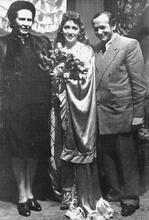
Esther Herlitz

Brigadier General Israela Oron, O.C Women's Corps, and Esther Herlitz, presenter, at "Dor l'Dor Yabia Omer," a meeting held on the occasion of a visit of Women Veterans of ATS (Auxiliary Territorial Service) and WAAF (Women’s Auxiliary Air Force) to the Chen Training Camp in Sarafand, June 19, 1996.
Institution: Esther Herlitz
Esther Herlitz was a feminist trailblazer in Israeli politics and diplomacy. After making Aliyah, she served in the Haganah and enlisted in the British Auxiliary Territorial Service in 1943. In 1950 she was appointed First Secretary at the Israeli embassy in Washington, D.C., and in 1966 she became the first female Israeli ambassador, serving in Denmark. One of six female Labor Party members who served in the eighth and ninth Knessets, she was also the first woman to serve on the Committee for Foreign and Affairs and Defense. Herlitz also served on the Commission on the Status of Women and helped formulate a liberal abortion law in 1977. In 2015, she was awarded the prestigious Israel Prize for lifetime achievement and special contribution to society and the State.
Family and Education

A staunch Zionist and dedicated volunteer, born in Berlin on October 9, 1921, Esther Herlitz inherited many of her admirable traits from her beloved “Yekke” parents. Her father, Georg Herlitz (1885–1968), was born in Oppeln, a small town in Upper Silesia, into a totally assimilated Jewish family and received a typical Prussian education. However, since his parents could not afford to send him to university, he registered—with the help of the local rabbi—at the Hochschule für die Wissenschaft des Judentums in Berlin, a center for the scientific study of Judaism and a rabbinical seminary. Here the liberal Jewish administration awarded him a stipend and here, also, both his studies and the Zionist movement introduced him to a new world. Returning home, he led the first Passover seder ever held in the history of the family, and when he resumed studies, this time at the University of Berlin, he became an ardent Zionist activist. On completing his studies in 1919, he refused to become a rabbi and instead founded the Central Zionist Archive. When the Zionist Federation, which was interested in influencing the local Jewish community, asked him to infiltrate the city’s large 3,500-member Reform synagogue, Herlitz and his friends took on the role of wardens and replaced the rabbi with one who was a Zionist. His wife, Irma (née Herzka, 1888–1970), who came from a traditional home in Moravia and whose father was a melamed (teacher) of little children, hated what she perceived as the empty ceremonial of the Reform Jews, but Esther herself came to love it.
Although Esther and her younger sister Miriam (1925–1975) attended a non-Jewish humanist gymnasium, they also from a very early age studied Hebrew with a kindergarten teacher whom her father and a few of his friends brought from The Land of IsraelErez Israel. From her childhood on, Esther knew that the family was on its way to Palestine, and she joined the Habonim-Kadimah youth movement. In 1933, when she was twelve years old, the social-democrat headmistress of her school was dismissed and she and two other girls in her class—one also Jewish, the other the daughter of an Englishman—were ostracized. Transferred to the Jewish-Zionist High School, she remained there for only six months before the family moved to Palestine, arriving on the first ship to dock in the new port in Haifa. Georg Herlitz succeeded in taking with him the entire Zionist Archive. In Jerusalem, he continued his work as the director of the World Zionist Archive.
Service in the Haganah and the ATS

field_section_text_value

Brigadier General Israela Oron, O.C Women's Corps, and Esther Herlitz, presenter, at "Dor l'Dor Yabia Omer," a meeting held on the occasion of a visit of Women Veterans of ATS (Auxiliary Territorial Service) and WAAF (Women’s Auxiliary Air Force) to the Chen Training Camp in Sarafand, June 19, 1996.
Institution: Esther Herlitz
During her four and a half years of service in the British army, Herlitz progressed from being an instructor of newly inducted recruits at the Sarafand Training Camp (now Zrifin) to serving as an officer in Egypt. At the same time, she continued her Haganah activities, since members of the Jewish community’s underground military organization in Palestine realized that such service provided excellent training opportunities for the anticipated Jewish struggle in the country. Since she was unmarried and childless, she was the last of the Palestinian Jewish volunteers permitted to leave Egypt at the end of World War II and returned home only at the beginning of 1946, after which she served for one year as the officer in charge of caring for ex-servicemen and women whose studies had been interrupted.
Becoming a Diplomat
In 1947 Herlitz was among the twenty-five candidates (of a total of several hundred applicants) who were accepted into the new school for diplomats established by the Jewish Agency. (There were four additional women in the group, which included Aura Herzog, née Ambache.) Their studies ended abruptly a year later when the War of Independence broke out. Meanwhile, on March 11, 1948, her father’s birthday, she was in the Jewish Agency (where the archive was located) when an Arab driver employed by the American consulate parked an explosive-laden car with its diplomatic license plates in the courtyard of the building. Both Esther and her father escaped from the building, where she had suffered a slight head injury caused by glass splinters.
At the beginning of March 1948, Esther Herlitz, together with other Jewish servicemen and women, was “conscripted” and began serving in the Etzioni Jerusalem brigade of the Haganah. Here she was asked to help establish the women’s corps in the besieged city and, with the rank of major, served as deputy commander of the unit composed of some one hundred and fifty women.

field_section_text_value
Service in the United States
In 1950, Herlitz was appointed First Secretary at the Israel embassy in Washington, D.C., where the ambassador was Abba Eban and other senior staff members included Teddy Kollek and Chaim Herzog. She maintained that from Eban she learned how to speak in public and how to project the image of Israel, as well as the importance of personal relations. From Kollek she learned how to “schnorr” (attempt to get money out of acquaintances any way one can). During her time as a minister, she played an important role in negotiating the Reparations Agreement between Israel and West Germany and in the establishment of Israel Bonds.
Between 1955 and 1958, Esther served as Consul in New York, where in addition to developing closer relations with Jewish organizations she also initiated a program to nurture Israeli students studying in the United States. During these years, she served as visiting consul in Boston.
Return to Israel
field_section_text_value
Appointed Ambassador and Elected a Member of Knesset
Herlitz thereupon returned to the ministry and in 1966 became the first Israeli woman to be appointed an ambassador (Golda Meir had previously served as Minister Plenipotentiary to Moscow). Sent to Denmark, she served successfully in that post until 1971, during a period that included the tense days before and throughout the Six-Day War in 1967.
In 1972, at the urging of Golda Meir, Herlitz established the Israel Voluntary Service, which she chaired until 1978. In 1974, she was one of six women members of the Labor Alignment who were elected to the Eighth Knesset (1974-1977) and entered the Ninth in (1979-1981), when she replaced Yehoshua Rabinovitz who passed away.
Immediately after the 1973 Yom Kippur War, Herlitz became the first woman to serve on the male-dominated Knesset Committee for Foreign Affairs and Defense. During the years in which she served, the committee was called upon to deal both with the highly critical Agranat Report on the conduct of the war and the response to the hijacking of an El Al plane to Entebbe. She also served as member on the
Internal Affairs Committee, the Constitution, Law and Justice Committee, Subcommittee for Public Petitions, Internal Affairs and Environment Committee, Subcommittee on Risks in Concern with Negligence of Gas Systems, and the Economic Affairs Committee.
Other Service
field_section_text_value

In 1994, Herlitz published a lively autobiography in Hebrew, the subtitle of which, How Far Can a Woman Go?, is taken from a disparaging comment made to her by then director-general of the Foreign Ministry, Walter Eytan, when she first joined his staff. The final sentences of the book cite the words that were inscribed on her father’s gravestone, at his request: “He tried to serve his people.” There is no doubt that the same can be said of his daughter, whom he imbued with his own ardent Zionism and with a profound love of her country and her people, which found such ample expression in both her professional and her voluntary activities.
Herlitz continued to maintain her contacts with the international community, and every Lit. "dedication." The 8-day "Festival of Lights" celebrated beginning on the 25th day of the Hebrew month of Kislev to commemorate the victory of the Jews over the Seleucid army in 164 B.C.E., the re-purification of the Temple and the miraculous eight days the Temple candelabrum remained lit from one cruse of undefiled oil which would have been enough to keep it burning for only one day.Hanukkah invited diplomats to eat potato pancakes in her north Tel Aviv apartment while she told them the story of the Maccabees. She worked indefatigably until her last days as a trailblazer on gender equality issues, among others, and never shied away from giving advice to feminists and their detractors alike.
Esther Herlitz passed away on March 24, 2016.
Herlitz, Esther. Esther – How Much Further Can a Woman Go? Tel-Aviv, 1994. [Hebrew]
Palzur, Mordechai. “In Memoriam: Esther Herlitz (1921–2016).” Israel Journal of Foreign Affairs Vol. 10.1 (2016): 115-118.
“World War II – The Story of a Jewish Soldier – Esther Herlitz.”
The Israel Defense Forces and Defense Establishment Archive
“The Jewish Fighters.” IDF & Defense Establishment Archives. http://www.archives.mod.gov.il/Exhib/TheJewishFighters/FighterEster/Pages/ExhibitionsImg.aspx?ExhbId=142
More on Esther Herlitz
Double your impact to amplify Jewish women’s stories—
All gifts matched up to $35,000
Before you close this article, please consider supporting the Jewish Women’s Archive and uplifting Jewish women’s voices.
At JWA, we preserve the voices of Jewish women and gender-expansive people past and present, share them freely with millions online, and empower a new generation of Jewish feminists to lead with courage, creativity, and conviction.
But none of this happens without you. JWA is an independent nonprofit— we rely on people, like you, who believe that history belongs to all of us and that the voices of Jewish women must remain powerful, and heard.
This month, a generous JWA board member will match every gift dollar for dollar—up to $35,000—through June 30. Your contribution goes twice as far right now.
Every contribution—no matter the size—helps us document, teach, and inspire through Jewish women’s stories.
It takes less than a minute to make a difference.
Thank you for being a part of the JWA community,
Judith Rosenbaum, CEO