
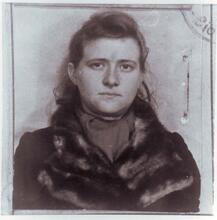
Bela Ya’ari Hazan

Courtesy of Yad Vashem, Jerusalem.
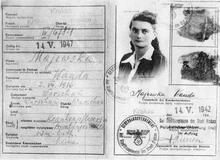
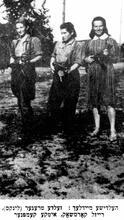
Born in Rozyszcze, Poland (now Ukraine), in 1922, Bela Hazan joined the He-Halutz ha-Za’ir-Dror movement as a teen. On the outbreak of World War II, Bela Hazan escaped to Vilna, where she worked as a smuggler for Dror, posing as a Pole. She was arrested by the Gestapo in 1942, though they did not know she was Jewish. She worked as a nurse in various concentration camps, including Birkenau, Auschwitz, Ravensbruck, Malchow, and finally Taucha in Leipzig. When Taucha was evacuated, she stayed behind, escaping with 140 inmates to American forces. She immigrated to Israel, where she died in 2004.
Family and Education
Bela Hazan was born in December 1922 in the town of Rozyszcze (Rozhishche) in the Volhynia region into a family of eight children. Her father, David, who led the prayers in the local bet-midrash, died when she was six, leaving the burden of earning the family’s livelihood to her mother Esther, who owned a small grocery store. The mother sent all the children to a school of the Tarbut network, mainly so that they would gain fluency in the Hebrew language, which was spoken at home. After completing elementary school, Hazan was sent to the ORT vocational school in the city of Kowel, where she supported herself by giving private Hebrew lessons.
Work with He-Halutz ha-Za’ir Dror
A member of the He-Halutz ha-Za’ir-Dror Zionist youth movement, Hazan participated in its seminars and summer camps. In the summer of 1939, the Rozyszcze chapter of the movement sent her to a Haganah course held in Zielonka, near Warsaw. There she made the acquaintance of two prominent members of He-Halutz’s head office: Frumka Plotnicka and Zivia Lubetkin. Upon completing the course, Hazan immediately began serving as a combat instructor at the A voluntary collective community, mainly agricultural, in which there is no private wealth and which is responsible for all the needs of its members and their families.kibbutz hakhsharah (training program) in Bedzin. Three months later, World War II broke out, and in late September 1939 occupied Poland was divided between Germany and the Soviet Union.
In early September, as German forces were approaching Bedzin, the halutzim (pioneers) of the kibbutz fled eastward, but they were forced to return to Bedzin after being outrun by the rapidly advancing Wehrmacht. While struggling to maintain their normal activities under the gory German occupation, they learned that in Vilna, which was still unoccupied, it would be possible to continue the movement’s activities and perhaps even depart from there to Palestine.
At the end of October 1940, a group of ten halutzim, Hazan being the only woman, embarked on a harsh trip, almost 2,000 kilometers long, to Vilna by way of German and Soviet eastern Poland. While crossing the German/Soviet border near Przemysl on the San river, the entire group was captured by Russian soldiers. Suspected of being German spies, they were imprisoned for interrogation. Hazan was separated from the men and released after three weeks. She stayed near the prison while incessantly begging the Russian officers for the release of her comrades. Finally, they were freed and the group continued its voyage. While resting in Kowel, Hazan traveled to her nearby hometown, Rozyszcze, to bid farewell to her family. This was the last time she saw her mother and five of her seven siblings, who were slaughtered in July 1941 by a Ukrainian militia after the town was captured by the Germans at the outset of the Barbarossa campaign. (Hazan's sister, Haya, immigrated to Israel in 1933 and her brother, Urzie, joined the Red Army and survived the war.)
After a long tortuous journey, the halutzim group crossed the Soviet/Lithuanian border in deep snow and reached Vilna on December 31, 1940. They were accommodated in He-Halutz ha-Za’ir-Dror’s kibbutz Shahariyya, where many halutzim escaping German-occupied Poland found shelter.
A Courier for the Resistance
field_section_text_value
Arrest and Imprisonment
field_section_text_value
Liberation
After a short recuperation period in an American hospital in Leipzig, Hazan traveled through Liège, Belgium, to Paris, where she discarded her assumed identity as Bronislawa Limanowska. Soldiers of the Jewish Brigade whom she encountered in Paris drove her in their truck to their headquarters in Tarviso in northern Italy. From there she was taken first to Rome and then to a Jewish DP camp in southern Italy, in the small fishermen's village of Santa Maria di-Bani. For three months, Hazan served as a counselor and teacher for a group of young orphan girls, most of them survivors from partisan family camps. She named the group “Frumka” to commemorate Frumka Plotnicka. On November 4, 1945, the group boarded SS Princess Kathleen, reaching Haifa four days later. After a short internment in the Atlit detention camp, they were taken to Kibbutz Ramat Ha'Kovesh. Hazan stayed with the group for another three weeks to assist their accommodation, after which she was sent by the He'Halutz main office to a convalescence home in Kibbutz Givat Brenner, where she spent a month writing her memoirs. The resulting document, stored in the archive of the Ghetto Fighters House, is one of the earliest testimonies of Jewish resistance and Nazi crimes. It was published in 1991 as a book, They Called Me Bronislawa.
On January 5, 1946, Hazan married Haim Zaleshinsky (1911-1982), a Jewish Brigade veteran and a journalist she had previously met in Rome. Zaleshinsky changed his surname to the Hebrew name Yaari. They lived in Kibbutz Glil Yam for a year and then moved to Tel Aviv. The couple had two children, Esther (b. 1947) and Yoel (b. 1949). Hazan passed away on January 18, 2004, in Jerusalem.
In May 2018, Hazan was posthumously awarded the "Jewish Rescuer Citation," conferred by the B'nai B'rith International organization, in "recognition of the devotion, courage and heroism exhibited in rescuing fellow Jews during the Holocaust."
Bender, Sara. The Jews of Białystok During World War II and the Holocaust. Hanover, NH: University Press of New England, 2008.
Gromb, Moshe. Jews who rescued Jews During the Holocaust. Tel Aviv, Nadav Books, 2020.
Hazan Ya’ari, Bela. They Called Me Bronislawa. Tel Aviv: Ha'Kibutz Ha'Meuhad, 1991. (Hebrew).
Klibanski, Bronka. Ariadne. Jerusalem: Halonot Publishers, 2002. (Hebrew).
Tek, Nehama, Resistance, Jews and Christians Who Defied the Nazi Terror. Oxford: Oxford University Press, 2013.
Zik, Gershon, ed. Rozyszcze, My Old Home. Tel Aviv: Association of Rozyszcze Jews, Achdut Press, 1976. (Hebrew).
Zilberscheid, Ya’akov, and Arye Fialkov, ed. Tel Hai: A Hakhsharah Kibbutz in Poland. Tel Aviv: Ha'Kibutz Ha'Meuhad, 1979. (Hebrew).
More Like This
Double your impact to amplify Jewish women’s stories—
All gifts matched up to $35,000
Before you close this article, please consider supporting the Jewish Women’s Archive and uplifting Jewish women’s voices.
At JWA, we preserve the voices of Jewish women and gender-expansive people past and present, share them freely with millions online, and empower a new generation of Jewish feminists to lead with courage, creativity, and conviction.
But none of this happens without you. JWA is an independent nonprofit— we rely on people, like you, who believe that history belongs to all of us and that the voices of Jewish women must remain powerful, and heard.
This month, a generous JWA board member will match every gift dollar for dollar—up to $35,000—through June 30. Your contribution goes twice as far right now.
Every contribution—no matter the size—helps us document, teach, and inspire through Jewish women’s stories.
It takes less than a minute to make a difference.
Thank you for being a part of the JWA community,
Judith Rosenbaum, CEO