
Blu Greenberg

Blu Greenberg grew up in a traditional Orthodox household that helped cement her love and commitment to Jewish law. As she grew, so did a growing dissatisfaction with women’s place in traditional Judaism. Her motto, “don’t throw out the baby with the bathwater,” led her to examine ways that women can have greater roles within Jewish law; her book On Women and Judaism: A View from Tradition inspired a generation of people to embrace being both Orthodox and feminist. Through the founding of the Jewish Orthodox Feminist Alliance (JOFA) she carved out the path for Orthodox women to become rabbis and explore greater participation in ritual. Through the creation of the International Beit Din (IBD), she has helped many agunot, women trapped in unwanted marriages.
The originator of an apt and now famous dictum—“Where there’s a rabbinic will, there’s a halakhic way”—Blu Greenberg (née Genauer) is a traditionally observant Jewish woman who has become a prime voice for feminism as applied to Orthodox Judaism.
Family and Education
A renowned “teacher of teachers,” Greenberg’s scholarly father, Sam Genauer, was born in Czernovitz, Austro-Hungary, in 1906, and brought to the United States at the age of two. He obtained a BA at Yeshiva University and in 1933 was ordained at its Rabbi Isaac Elchanan Rabbinical College. That same year, he married Sylvia Genser, who was born on the Lower East Side of New York in 1913. After graduating from Seward Park High School, she went to work as a legal secretary to help her family financially during the Depression.
Immediately after Rabbi Genauer’s ordination, the couple moved to Seattle, where Sam joined his family’s clothing business and Sylvia attended the University of Washington. It was there that their three daughters were born: Judy (Brickman) in 1934, Blu on January 21, 1936, and Rena (Schlaff) in 1938. The family returned to New York when Blu was in the fifth grade.
Greenberg was raised in a loving traditional home and grew up content with her role as a “good Jewish daughter.” As she states in her seminal book On Women and Judaism (1981), she “had a fine Jewish education, the best a girl could have.” This meant that she was exposed to all Jewish learning, with the exception of Lit. "teaching," "study," or "learning." A compilation of the commentary and discussions of the amora'im on the Mishnah. When not specified, "Talmud" refers to the Babylonian Talmud.Talmud studies. Greenberg’s father took even more interest in her Jewish studies than in her secular studies. The personal dignity his study sessions afforded her may have contributed to her later development as a seminal Jewish feminist.
In 1957 Blu married Irving (Yitz) Greenberg (b. Brooklyn, 1933), a rabbi and communal leader who served as a professor at Yeshiva University (1959-1972) and a pulpit rabbi in Riverdale, New York (1965-1972) and who is known for his creative theology and innovative Jewish social activity. The latter included founding CLAL (1973), an organization devoted to the Jewish education of leaders in the American Jewish community, and the Jewish Life Network (1995). A devoted couple who are mutually supportive of each other’s work, they had five children: Moshe (b. 1961), David (b. 1963), Deborah (b. 1964), Jonathan (J. J., 1965–2002), and Judith (b. 1967), two of whom now live in Israel.
Gradual Feminist Awakening
field_section_text_value
Developing Orthodox Feminism
field_section_text_value
The Ordination of Women
field_section_text_value
Advocate for Agunot
field_section_text_value
Achievements and Affiliations
field_section_text_value
SELECTED WORKS BY BLU GREENBERG
Books
On Women and Judaism: A View From Tradition. Philadelphia: Jewish Publication Society, 1981,
How to Run a Traditional Jewish Household. New York: Simon and Schuster, 1983.
Black Bread: Poems After the Holocaust. Hoboken, NJ: Ktav, 1994.
King Solomon and the Queen of Sheba. New York: Pitspopany Press, 1997.
Selected Articles
“Abortion: We Need Halachic Creativity.” Sh’ma, November 15, 1974.
“Abortion: A Challenge to Halakhah.” Judaism: A Quarterly Journal of Jewish Life and Thought (Spring 1976).
“Beyond “Woman of Valor”: How an Orthodox Woman Evolved into a Fervent Feminist.” Lilith, Spring-Summer 1982.
“Confrontation and Change: Women and the Jewish Tradition.” In Women of Faith in Dialogue, edited by V. R. Mollenkott. New York: Crossroad, 1987.
“Equality in Judaism,” Hadassah Magazine, December 1973.
“Female Sexuality and Bodily Functions in the Jewish Tradition.” In Women, Religion, and Sexuality, edited by J. Becher. Philadelphia: Trinity Press International, 1991.
“Feminism, Jewish Orthodoxy, and Human Rights: Strange Bedfellows?” In Religion and Human Rights, edited by Carrie Gustafson and Peter Juviller. Armonk, New York: M.E. Sharpe, 1999.
“The Feminist Revolution in Orthodox Judaism in America.” In Divisions between Traditionalism and Liberalism in the American Jewish Community: Cleft or Chasm, edited by Michael Shapiro, 55–78. Lewiston, NY: E. Mellen Press, 1991.
“Hear, O Israel: Law and Love in Deuteronomy.” In Preaching Biblical Texts: Expositions by Jewish and Christian Scholars, ed. by Herman E. Schaalman and Frederick C. Holmgren. Grand Rapids: William B. Eerdmans Publishing Company, 1995.
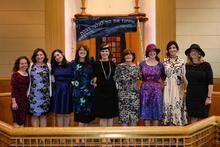
Double your impact to amplify Jewish women’s stories—
All gifts matched up to $35,000
Before you close this article, please consider supporting the Jewish Women’s Archive and uplifting Jewish women’s voices.
At JWA, we preserve the voices of Jewish women and gender-expansive people past and present, share them freely with millions online, and empower a new generation of Jewish feminists to lead with courage, creativity, and conviction.
But none of this happens without you. JWA is an independent nonprofit— we rely on people, like you, who believe that history belongs to all of us and that the voices of Jewish women must remain powerful, and heard.
This month, a generous JWA board member will match every gift dollar for dollar—up to $35,000—through June 30. Your contribution goes twice as far right now.
Every contribution—no matter the size—helps us document, teach, and inspire through Jewish women’s stories.
It takes less than a minute to make a difference.
Thank you for being a part of the JWA community,
Judith Rosenbaum, CEO