

Elisheva Cohen

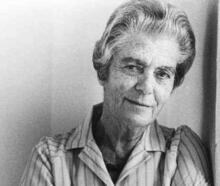
Elisheva Cohen, born in Frankfurt in 1911, showed an interest in art history from a young age. After studying at universities throughout Germany, she was forced to discontinue her studies and flee Germany during the rise of Nazism. After settling in Jerusalem, she began her career in the art world. Cohen introduced the cataloging system still in use in the Israel Museum, curated exhibits in the museum, and educated future curators. She was awarded the Israel Prize in 1977 and became an Honorary Citizen of Jerusalem in 1988. Cohen was known for her vast knowledge, thoroughness of work, and her modesty.
“The last exhibition Elisheva Cohen curated at The Israel Museum, Jerusalem, years after she had retired, and just a little over a year before she died, was Confrontation and Confirmation—Some Aspects of Connoisseurship. The exhibition was a reflection not only of Mrs. Cohen’s work at The Israel Museum but also of her personality: the modesty of a truly knowledgeable person, the thoroughness of a devoted lover, a moderate and cultured didactic tone, directness without pathos and a vast knowledge of artists, periods and styles.” These words, written in January 1990 by Tali Tamir in Jerusalem’s local paper Kol ha-Ir, give some idea of the person Elisheva Cohen was.
Personal Life
Else Elisheva Benjamin Cohen was born in Frankfurt am Main on January 9, 1911 to Heinrich Naftali and Netty (Dulken) Benjamin. Her father was a merchant of pearls and precious stones. She had an older brother, Bernhard, born on November 23, 1908 (died in 1981). The family was Orthodox and enjoyed considerable wealth. She graduated from the elementary girls’ school of the Orthodox community and from the non-Jewish public high school and played the violin for many years. She studied art history, which interested her from an early age, at the University of Munich with professor Karl Finder and also at the universities of Frankfurt, Zurich, Heidelberg, and Marburg. With the rise of Nazism she had to discontinue her studies and in 1933 she left Germany. She married Chaim Herman Cohn in Strasbourg on August 15 of the same year and together they emigrated to Palestine and settled in Jerusalem. The next twenty years were devoted to raising a family and helping Chaim Cohn in his law office. Her son Eliyahu was born in 1934 and her daughter Yehudit in 1936.
Curatorial Career
field_section_text_value
Selected Exhibitions Curated by Elisheva Cohen
- Bezalel National Museum, Paul Citron: Drawings. Jerusalem: Bezalel National Museum, 1960
- The Israel Museum, Picasso: A Selection of His Graphic Work. Oeuvre Graphique, Collection Georges Bloch [sic]. Zürich: March 24 to May 2, 1966; Jerusalem.
- The Israel Museum, Francisco Goya: two exhibitions of prints. August–September 1967.
- The Israel Museum, Henri de Toulouse Lautrec: Prints from the F. M. Gross Collection, London, August–September 1967, Jerusalem, The Israel Museum, 1967.
- The Israel Museum, Treasures from Ancient Mexico, winter 1968, Jerusalem.
- The Israel Museum, Gifts from the Georges Bloch Collection, summer 1970, Jerusalem.
- The Israel Museum, Kaethe Kollowitz: Zeichnungen, Radierungen, Lithographien, Holzschnitte, Skulpturen, December 14, 1971–January 21, 1972, Jerusalem.
- The Israel Museum, The Floersheimer Collection, winter 1972, Jerusalem.
- Städtisches Museum Trier, Jerusalem in Darstellungen von 19 zum 20 Jh., July 3–September 10, 1972, Trier.
- The Israel Museum, Picasso: His Graphic Work in the Israel Museum Collection, January–March 1973, Jerusalem.
- The Israel Museum, Past and Present: The Jan Mitchell Gift to the Israel Museum, summer 1974, Vol. II, Jerusalem.
- The Israel Museum, Herald of a New Age: Goya’s Graphic Work, winter 1975, Jerusalem.
- The Israel Museum, Confrontation and Confirmation: Some Aspects of Connoisseurship, March 1988, Jerusalem.
Publications
The Pilgrim Artists. Jerusalem: Magnes Press, 1969.
Künstler als Pilger. Jerusalem: Magnes Press, 1969.
Anna Ticho: Jerusalem Landscapes Drawings and Watercolors. Tel Aviv: Lund Humphries, 1971.
“A Drawing by Polidoro da Caravaggio.” The Israel Museum News, Jerusalem: 1972, 62.
“A Glimpse into Anna Ticho’s Studio: The Painter of Jerusalem.” Ariel 45–46 (1978): 36–46.
“Moritz Daniel Oppenheim: His Life and Art.” In The Israel Museum, Moritz Oppenheim: The First Jewish Painter. Autumn 1983, Jerusalem: 1983, 7–29;
“The Landscape Drawings of Anna Ticho.” In The Jewish Museum, New York, Anna Ticho: Drawings, 1971–1980. October 23, 1983–February 19, 1984. New York: 1983.
Anna Ticho. Tel Aviv: Keter Publishing, 1986.
“Pascin Dessinature.” In Musée Galerie de la Seita, Pascin 1885–1930, December 14, 1994–February 15, 1995. Paris: 11–30.
More on Elisheva Cohen
Double your impact to amplify Jewish women’s stories—
All gifts matched up to $35,000
Before you close this article, please consider supporting the Jewish Women’s Archive and uplifting Jewish women’s voices.
At JWA, we preserve the voices of Jewish women and gender-expansive people past and present, share them freely with millions online, and empower a new generation of Jewish feminists to lead with courage, creativity, and conviction.
But none of this happens without you. JWA is an independent nonprofit— we rely on people, like you, who believe that history belongs to all of us and that the voices of Jewish women must remain powerful, and heard.
This month, a generous JWA board member will match every gift dollar for dollar—up to $35,000—through June 30. Your contribution goes twice as far right now.
Every contribution—no matter the size—helps us document, teach, and inspire through Jewish women’s stories.
It takes less than a minute to make a difference.
Thank you for being a part of the JWA community,
Judith Rosenbaum, CEO

