

Elisabeth Bergner

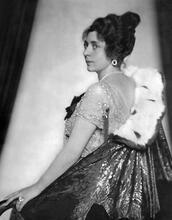
Actress, activist, and writer, Elisabeth Bergner (1897-1986) in 1935.
Image courtesy of the Library of Congress.
Elisabeth Bergner was a famed actress and former spy who helped other actors escape Nazi Germany. Born in Austrian Galicia, Bergner studied at the Academy for Music and the Performing Arts in Vienna from 1912 to 1915 and performed one of her first professional roles as Nora in A Doll’s House in 1915. She joined the Communist Party in 1918, serving as a courier during the 1919 Hungarian Revolution. In 1920 she moved to Berlin, performing in roles such as Rosalind in As You Like It and Tschang Haitang in Brecht’s Caucasian Chalk Circle. Bergner was performing in London when the Nazis came to power and remained in Britain, using her finances to help other actors escape. She continued to delight audiences on Broadway and the London stage until 1973 and in films until the 1980s.
Early Life and Career
field_section_text_value
Performance Career
field_section_text_value
World War Two
When the National Socialists came to power Bergner, who was in England working on a new film, did not return to Berlin. Rapidly learning English, she was soon able to resume her former stage and screen career. She particularly infuriated the Hitler regime by encouraging other famous actors to leave Germany, even sending them money to help them escape. When Catherine the Great was screened in Berlin, the Nazis staged a public riot, banned all her films and launched a general campaign against Jewish artists. Meanwhile, Bergner scored a triumphant success with Escape Me Never, both in London and in New York. In 1936 she starred with Laurence Olivier in a film version of As You Like It and in the same year appeared in James Barrie’s The Boy David. The playwright was so delighted that he left her a legacy of USD 10,000 for “the best performance ever given in any play of mine.”
In 1938 Bergner and Czinner became British citizens and the following year her mother and sister joined them in London before the German attack on Poland on September 1. In 1940 Bergner began work on 49th Parallel, which proved to be a powerful Allied propaganda film. But in the course of making the film she and Czinner unexpectedly moved to the United States, leaving the film to be completed with British actress Glynis Johns. Her defection caused an outrage; the British public, suffering from German air bombardment, resented what they perceived as a cowardly desertion, but which was more probably the result of pure fear engendered by the terrible fate meted out by the Nazi regime to so many of their Jewish colleagues who had not escaped from Germany.
Career in the United States
In the United States Bergner had to begin her career anew. While Czinner had no difficulty finding work in Hollywood, it was only at the end of 1941 that she herself received a major role in an anti-Nazi film entitled Paris Calling, which was not a success. She therefore returned to the stage, scoring a Broadway triumph in The Two Mrs. Carrolls, which was performed more than three hundred times in 1943–1944 and earned her the Delia Austrian Medal of the Drama League of New York.
Herself in exile, Bergner continued to help fellow émigré artists who reached the United States, among them Bertolt Brecht and his friend Ruth Berlau. She also helped many children to flee Germany and participated in anti-fascist activities such as the establishment of the Council for a Democratic Germany.
Yet for Bergner and her husband the post-war years proved difficult. She was cast infrequently and the Cold War tensions and McCarthyism of the late 1940s eventually led them to leave the United States. In 1949, following a religious crisis, she became a Christian Scientist. In the same year she toured Israel. In October 1950 the Czinners returned to their home in London, but it took some time for Bergner to reestablish herself. This she eventually did when she returned to the German stage in March 1954, in a production of Terence Rattigan’s The Deep Blue Sea in West Berlin. In October of that year she was “back home” as a guest artist at the Theater in der Josefstadt. From then on she again received numerous major roles in Germany, Austria and even Britain, where she appeared in television and on radio. A special triumph was her 1959 appearance in the German version of Dear Liar, a dramatization of the correspondence between the actress Stella Patrick Campbell and G. B. Shaw, in which she appeared opposite O. E. Hasse. She had a similar success in 1964, in Jean Giraudoux’s The Madwoman of Chaillot, directed in Düsseldorf by Karl Heinz Stroux. The child-woman had been transformed into a charming, though occasionally unfathomable, old lady. In 1973 she made her final stage appearance, in London in a production of Catsplay by Istvan Örkeny (1912–1979) but she continued to work in films for almost ten years.
Honors and Legacy
Bergner’s dramatic skills won her numerous prizes. In 1962 she became the first actress to be honored with the coveted Schiller Prize of the City of Mannheim. In 1979 she received the Ernst Lubitsch Prize. In 1980 Austria awarded her the Cross of Merit for Science and Art and in 1982 she won the Eleonora Duse Prize Asolo. In the Berlin district of Seglitz, a city park was named after her. In 1985, when she was already ill with cancer, she traveled to East Berlin, where she was made an honorary member in the Deutsches Theater and received the Hans Otto Medal of the German Democratic Republic, which was named after one of her good friends of former times. In April 1985 she broadcast a moving account of her life on Austrian national radio. Her memoirs, Bewundert viel und viel gescholten (Greatly admired and often cursed), subtitled Elisabeth Bergners unordentliche Erinnerungen (Elisabeth Bergner’s disorderly memoirs), published in 1978, had received favorable reviews.
Elisabeth Bergner died in her London home on May 12, 1986.
Filmography
Der Evangelimann (1923).
Nju (1924).
Liebe (1926).
Dona Juana (1927).
Konigin Luise (1927).
Fräulein Else (1929).
Ariane (1931).
Der träumende Mund (1932).
Catherine the Great/Rise of Catherine the Great (1934).
Escape Me Never (1935).
As You Like It (1936).
Dreaming Lips (1937).
Stolen Life (1939).
Paris Calling (1941).
Die Glückliche Jahre der Thorwalds (1962).
Strogoff (1968).
Cry of the Banshee (1970).
The Pedestrian/Der Fussganger (1974).
Der Pfingstausflug (1978).
The Pentecost Outing (1979).
Feine Gesellschaft (1982).
Work
Bergner, Elisabeth. Bewundert viel und viel gescholten. Unordentliche Erinnerungen. Munich: 1978.
Eloesser, Arthur. Elisabeth Bergner. Berlin: 1927.
Zweig, Arnold. “Aufstieg einer Schauspielerin. Elisabeth Bergner.” In Juden auf der deutschen Bühne. Berlin: 1928: 157–169.
Elisabeth Bergner. Mit Beiträgen von Eva Orbanz, Sybille Wirsing und Wolfgang Jacobsen. Berlin: 1983.
Völker, Klaus. Elisabeth Bergner. Das Leben einer Schauspielerin. Berlin: 1990.
Unsere schwarze Rose. Elisabeth Bergner. Ausstellung des Historischen Museums der Stadt Wien in Zusammenarbeit mit dem Jüdischen Museum der Stadt Wien, January 21–March 21, 1993. Wien: 1993.
Sources
Elisabeth-Bergner-Archiv bei der Akademie der Künste, Berlin.
Lexikon Jüdische Frauen. Edited by Jutta Dick and Marina Sassenberg.

Double your impact to amplify Jewish women’s stories—
All gifts matched up to $35,000
Before you close this article, please consider supporting the Jewish Women’s Archive and uplifting Jewish women’s voices.
At JWA, we preserve the voices of Jewish women and gender-expansive people past and present, share them freely with millions online, and empower a new generation of Jewish feminists to lead with courage, creativity, and conviction.
But none of this happens without you. JWA is an independent nonprofit— we rely on people, like you, who believe that history belongs to all of us and that the voices of Jewish women must remain powerful, and heard.
This month, a generous JWA board member will match every gift dollar for dollar—up to $35,000—through June 30. Your contribution goes twice as far right now.
Every contribution—no matter the size—helps us document, teach, and inspire through Jewish women’s stories.
It takes less than a minute to make a difference.
Thank you for being a part of the JWA community,

Judith Rosenbaum, CEO

