

American Birth Control Movement

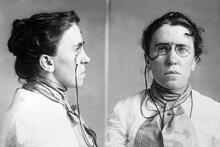
Long before the early twentieth century, Jewish women in western and central Europe and the United States showed commitment to reducing their fertility rates. Jewish women from all backgrounds contributed substantially to the growth of the U.S. birth control movement. Many participated through Jewish organizations like the National Council of Jewish Women, while others worked independently or with secular agencies. In the early twentieth century, prominent Jewish anarchist Emma Goldman featured contraception as a central topic during nationwide speaking tours. Later Jewish women educated the country through organizations like the American Birth Control League (precursor to Planned Parenthood) and books like Our Bodies, Ourselves. Today, Jewish women advocate to make birth control available and affordable, fight to protect the legal right to contraception, and mobilized to pass the Affordable Care Act that guaranteed access to birth control.
Introduction
Jewish women from a range of social and economic backgrounds found common political cause in the American birth control movement and profoundly impacted its successes in the early twentieth century. Radical and socialist Jewish women, in defiance of anti-obscenity laws, distributed information about birth control to working-class women, while middle-class women established clinics and lobbied to overturn the Comstock Laws, which restricted the publication, distribution, and even discussion of material the government deemed obscene. Professional women affiliated with the movement as gynecologists and social workers, and many women enthusiastically sought the financially accessible services of birth control clinics. Later, communal leaders helped start and grow educational efforts like Planned Parenthood and the Our Bodies, Ourselves book project, ultimately lobbying the government to include contraception as required coverage in 2010’s Affordable Care Act. This article charts the grassroots and organizational engagement of Jewish women as the American birth control movement grew from its formative years at the start of the twentieth century to today’s complex and interconnected network of education, activism, and healthcare.
Jewish Women Controlling Fertility
Jewish women in western and central Europe and in the United States attained widespread success reducing their fertility rates well before the start of the American birth control movement. Using available contraceptive methods and performing abortions at rates that far exceeded those of other religiously or ethnically defined groups, central and western European Jews attained rapidly declining fertility rates by the late nineteenth century and soon controlled their fertility more effectively than their non-Jewish peers.
The arrival in the United States of eastern European Jews, whose fertility rates had remained high, generated considerable interest among health care reformers. Although eastern European Jewish families were generally quite large upon arrival in the United States, a trend that continued in the following generation, 1930s studies of fertility rates by ethnic or religious affiliation found that American Jews, including those of the first or second generation, avidly sought birth control services to limit their relatively high fertility rates. Jewish women’s commitment to the birth control cause had dramatic consequences: In 1915, Jews in New York City had the highest number of children per marriage of any immigrant group, but by the early 1930s Jewish fertility rates generally matched the lower national average.
The Reproductive Choice Movement Begins

field_section_text_value

Rose Pastor Stokes began her involvement with the birth control cause at a rally to protest Goldman’s arrest, handing out leaflets describing the benefits of contraception. Pastor Stokes, an impoverished eastern European immigrant who began her career in a Cleveland cigar factory, eagerly worked to become a New York journalist, eventually making the front page herself when she married Socialist (and millionaire) J.G. Phelps Stokes. In 1915 Pastor Stokes became the financial secretary of the National Birth Control League, an organization attempting to legalize the distribution of birth control information by repealing anti-obscenity laws. Pastor Stokes disliked the limits of this legislative approach, however, and soon joined a variety of birth control organizations.
During the 1910s, 1920s, and 1930s, the American birth control movement shifted its focus to the rapidly growing number of clinics across the country, and the legal restrictions preventing women from accessing contraception. Immigrant Jewish women and their first-generation children educated themselves about birth control through the Jewish press. Sanger had several of her pamphlets about birth control translated into Yiddish and Polish, but she was not the only source of birth control-related information for Jewish immigrant readers in the United States. Ben-Zion Liber (1875-1958) wrote and published the magazine Undzer gezunt, “Our Health,” which had four thousand subscribers in its first year. “A Jewish monthly for enlightenment in health questions,” it provided news of the birth control movement and of Sanger’s legislative and court battles. He urged his readers to reject “die alte minhagim,” the old ways that might rule out birth control as an option for limiting family size. One issue included “The Truth About Sexuality,” an illustrated pamphlet. A book about sexuality, Dos geshlekhts lebn, went through four editions in 1914, 1918, 1919, and 1927.


field_section_text_value
National Council of Jewish Women
field_section_text_value
Activism Outside Jewish Agencies

field_section_text_value

field_section_text_value
Medical Revolution

Gloria Steinem, who exemplifies the Second Wave of American Feminism, began her career as a journalist writing under a man's name. She went on to co-found Ms., the first feminist periodical with a national readership. An advocacy journalist, she writes passionately about issues of women's empowerment and gender, racial and economic equality.
Courtesy of Sylvia Edwards, Longview Community College
field_section_text_value
A New Education: Women Take Charge

Founding Members of the Boston Women's Health Book Collective, 1976. Back (L-R) Ruth Bell, Judy Norsigian, Vilunya ("Wilma") Diskin, Jane Pincus, Middle (L-R) Pamela Berger, Esther Rome, Joan Ditzion, Norma Swenson, Paula Doress, Front (L-R) Wendy Sanford, Nancy Hawley. Courtesy of the Schlesinger Library on the History of Women in America at Harvard University.
field_section_text_value

Cover of the 1973 edition of Our Bodies, Ourselves.
Courtesy of www.ourbodiesourselves.org
field_section_text_value
Protecting and Preserving Access
field_section_text_value
A New Round of Challenges
field_section_text_value
Archival Sources
Chicago Women’s Aid Papers, University of Illinois Library.
Gertrude Weil Papers, North Carolina Department of Cultural Resources, Raleigh, North Carolina. Margaret Sanger Papers—LC, Reel 9.
National Council of Jewish Women, New York Section and Brooklyn Section, Papers, American Jewish Historical Society.
Printed and Secondary Sources
“A Brief History of Birth Control in the U.S.” Our Bodies, Ourselves. https://www.ourbodiesourselves.org/book-excerpts/health-article/a-brief-history-of-birth-control.
Antler, Joyce. Jewish Radical Feminism. New York: New York University Press, 2018.
“Betty Friedan and the Women’s Movement.” Bill of Rights Institute. https://billofrightsinstitute.org/essays/betty-friedan-and-the-womens-movement.
Boston Women’s Health Collective. Women and Their Bodies. Boston: self-published, 1970.
Chesler, Ellen. Woman of Valor: Margaret Sanger and the Birth Control Movement in America. New York: Simon & Schuster, 1992.
“Issue Focus: Contraceptive Access.” National Council of Jewish Women. https://www.ncjw.org/act/action-resources/issue-focus-contraceptive-access.
Friedan, Betty. The Feminine Mystique. United Kingdom: Gollancz, 1963.
Gibbs, Nancy. “The Pill at 50: Sex, Freedom and Paradox.” TIME Magazine: April 22, 2010. http://content.time.com/time/magazine/article/0,9171,1983884,00.html.
Goldman, Emma. Living My Life. New York, Alfred A. Knopf Inc, 1931.
Gordon, Linda. Woman’s Body, Woman’s Right: Birth Control in America. New York: Grossman Publishers, 1976.
Isaias-Day, Sofia. “‘Our Bodies, Ourselves’ in 2022.” Jewish Women’s Archive: March 16, 2022. https://jwa.org/blog/risingvoices/our-bodies-ourselves-2022.
“Jewish Groups Oppose Rollback of Contraception Coverage.” The Times of Israel, via Jewish Telegraphic Agency: October 8, 2017. https://www.timesofisrael.com/jewish-groups-oppose-rollback-of-contraception-coverage.
Klapper, Melissa R. “The Drama of 1916: The American Jewish Community, Birth Control, and Two Yiddish Plays.” The Journal of the Gilded Age and Progressive Era Vol. 12, No. 4 (2013): 502-534.
Klapper, Melissa. Ballots, Babies, and Banners of Peace. New York: New York University Press, 2014.
Koffman, Lori. “Jewish Perspectives on Reproductive Realities.” National Council of Jewish Women: 2018.
“Life Story: Betty Friedan – Women & the American Story.” New York Historical Society. https://wams.nyhistory.org/growth-and-turmoil/cold-war-beginnings/betty-friedan.
Oransky, Ivan. “Dr. Ruth Talks on Sex, Signs Condoms.” The Harvard Crimson: October 29, 1991. https://www.thecrimson.com/article/1991/10/29/dr-ruth-talks-on-sex-signs.
“Physician Statistics Summary (1970-1999).” Pinnacle Heath Group. https://www.phg.com/2000/01/physician-statistics-summary.
Rosner, Fred. “Contraception in Jewish Law.” Tradition: A Journal of Orthodox Jewish Thought Vol. 12, No. 2 (1971): 90-103.
Sanger, Margaret. An Autobiography. New York City: W. W. Norton, 1938.
Schwartz, Penny. “The Jewish Voices Behind ‘Our Bodies, Ourselves.’” The Jewish Journal: January 29, 2019. https://jewishjournal.org/2019/01/10/the-jewish-voices-behind-our-bodies-ourselves.
Tobin-Schlesinger, Kathleen. “Population and Power: The Religious Debate Over Contraception.” Ph.D. dissertation, University of Chicago, 1994.
Wells, Susan. “Our Bodies, Ourselves: Reading the Written Body.” Signs Vol. 22, No. 3 (2008): 697-723.
Westoff, Charles F. and Ryder, Norman B. “United States: Methods of Fertility Control, 1955, 1960, & 1965.” Studies in Family Planning Vol. 1, No. 17 (1967): 1-5.
Whole Women’s Health v. Hellerstedt. 15-274, 579 (U.S. 2016).
“Why Women’s Liberation – Women & the American Story.” New York Historical Society. https://wams.nyhistory.org/growth-and-turmoil/feminism-and-the-backlash/why-womens-liberation.
More Like This

Double your impact to amplify Jewish women’s stories—
All gifts matched up to $35,000
Before you close this article, please consider supporting the Jewish Women’s Archive and uplifting Jewish women’s voices.
At JWA, we preserve the voices of Jewish women and gender-expansive people past and present, share them freely with millions online, and empower a new generation of Jewish feminists to lead with courage, creativity, and conviction.
But none of this happens without you. JWA is an independent nonprofit— we rely on people, like you, who believe that history belongs to all of us and that the voices of Jewish women must remain powerful, and heard.
This month, a generous JWA board member will match every gift dollar for dollar—up to $35,000—through June 30. Your contribution goes twice as far right now.
Every contribution—no matter the size—helps us document, teach, and inspire through Jewish women’s stories.
It takes less than a minute to make a difference.
Thank you for being a part of the JWA community,

Judith Rosenbaum, CEO

