

Helen Goldmark Adler

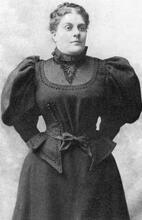
Helen Adler was an active philanthropist who dedicated her intelligence and compassion to improving turn-of-the-century New York. Adler helped her husband Felix establish the first model tenements at Cherry Street as well as the first free kindergarten in America, called the Working Man’s School, and later the Ethical Culture School at Fieldston. She took an active part in the visiting nurses’ service for the poor at the DeMilt Dispensary, the oldest clinic in the city, which Felix had initiated in 1877. With the assistance of a Dr. Koplik, she helped cut the infant death rate by having milk bottled safely at the Laboratory Department for Modified Milk for Tenement Babies, which Koplik and Adler founded in 1891.
Although as accomplished and intelligent as her well-known husband Felix, Helen Adler did not strive to forge an independent name for herself. Her hard work and accomplishments, however, benefited the many people with whom she came into contact throughout her life.
Early Life and Education
field_section_text_value
Philanthropic Career
After her marriage, Helen Adler involved herself in the Ethical Culture Movement and her husband’s work. She took notes on philosophical essays for her husband’s use; wrote articles for The Standard, the organ of the Ethical Culture Society; and took a prominent part in the Women’s Conference of the society. Helen Adler helped her husband establish the first model tenements at Cherry Street as well as the first free kindergarten in America, called the Working Man’s School, and later the Ethical Culture School at Fieldston. She took an active part in the visiting nurses’ service for the poor at the DeMilt Dispensary, the oldest clinic in the city, which Felix had initiated in 1877. With the assistance of a Dr. Koplik, she helped cut the infant death rate by having milk bottled safely at the Laboratory Department for Modified Milk for Tenement Babies, which Koplik and Adler founded in 1891. She accompanied her husband on numerous trips abroad, notably to Berlin in 1903 and to Oxford, where he was Hibbert lecturer in 1923, where she did independent research on the history of Hibbert and the lectureship. When her husband traveled without her, they exchanged loving and engaging letters, revealing a lifelong intimate partnership.
In favor of woman suffrage, but opposed to unlimited public roles for women, Helen Adler lent limited support to her feminist contemporaries. She bore five children—Waldo, Eleanor, Lawrence, Margaret, and Ruth—and believed a woman’s most important task was child rearing. Yet she worried that women were not rigorous or exacting enough to attend to this task adequately and set out to make child rearing a science. Perhaps at her husband’s suggestion, in 1888, Helen Adler and five other mothers founded the Society for the Study of Child Nature (later the Child Study Association), to educate parents. In 1891, the Teacher Company published her pamphlet “Hints for the Scientific Observation and Study of Children,” designed to teach mothers to monitor their children’s development.
Felix Adler died in 1933 at age eighty-two. In later years, Helen Adler’s interest in art led her to greater involvement with the Arts High School at Fieldston, and also to produce floral sketches, pottery, and textile designs, described by one admirer as “beautifully living” and the fruits of a “genuine artistic impulse.” Helen Adler died in March 1948, survived by her children and siblings.
Selected Works
“Dr. Adler’s Meeting with the Vienna Ethical Society.” The Standard 14 (1927-1928): 24–25.
“Felix Adler.” Manuscript Collection, Columbia University.
Hints for the Scientific Observation and Study of Children (1891).
“The Life and Writings of Dr. Arthur Pfungst.” The Standard 13 (1926–1927): 15–16.
American Reformers. Edited by Alden Whitman (1985).
Andress, Bart. “Fifty Years of Child Study.” The Standard 25, no. 2 (1938–1939): 29–30.
“Dr. Felix Adler Dies in 82nd Year.” NYTimes, April 26, 1933, 15:1.
Friess, Horace L. Felix Adler and Ethical Culture: Memories and Studies. Edited by Fannia Weingartner (1981).
Goldmark, Josephine. Pilgrims of ‘48 (1930); “Mrs. Felix Adler Dies at Age of 89.” NYTimes, March 21, 1948, 60:2.
NAW; Woman’s Who’s Who of America. Edited by John William Leonard (1914).
WWIAJ (1926, 1928).
Double your impact to amplify Jewish women’s stories—
All gifts matched up to $35,000
Before you close this article, please consider supporting the Jewish Women’s Archive and uplifting Jewish women’s voices.
At JWA, we preserve the voices of Jewish women and gender-expansive people past and present, share them freely with millions online, and empower a new generation of Jewish feminists to lead with courage, creativity, and conviction.
But none of this happens without you. JWA is an independent nonprofit— we rely on people, like you, who believe that history belongs to all of us and that the voices of Jewish women must remain powerful, and heard.
This month, a generous JWA board member will match every gift dollar for dollar—up to $35,000—through June 30. Your contribution goes twice as far right now.
Every contribution—no matter the size—helps us document, teach, and inspire through Jewish women’s stories.
It takes less than a minute to make a difference.
Thank you for being a part of the JWA community,


Judith Rosenbaum, CEO