
Writing Jewish Women Into America's Story


American Jewish families often share stories about how our mothers, grandmothers, and great-grandmothers were actively involved in key US sociopolitical developments. However, until recently, history books, documentary films, and pop culture have been mostly silent about Jewish women’s contributions. Dr. Melissa R. Klapper, Professor of History and Director of Women's & Gender Studies at Rowan University, has devoted much of her career to correcting this omission. Her books on American Jewish women's history paint vivid human profiles and perspectives on what it was like to be a Jewish woman or girl at various times.
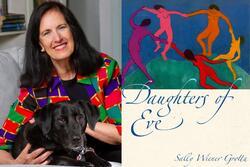
Sally Wiener Grotta sat down to chat with Melissa R. Klapper about her groundbreaking work on American Jewish women’s history. The following is an excerpt of that chat, edited for length and clarity. The full interview can be viewed here.
Sally Wiener Grotta: Melissa, you’ve devoted your career to telling stories about American Jewish women within the context of American history. What was the impetus behind that choice?
Melissa R. Klapper: Well, it goes back to when I was in graduate school getting my doctorate in American women's history. It ticked me off that there were basically no Jewish women showing up in the master narratives of American women’s history.
This is not an across-the-board truth, but it was often the case. We had research on American Jewish women in the labor movement; you can't write about women in the labor movement in the United States without Jewish women. There's also a fair amount of work on American Jewish women and Zionism, particularly through the history of Hadassah. Otherwise, you didn't see Jewish women showing up anywhere else. So, one of my prime motivations for my entire career has been to look at how American Jewish women were part of the master narratives of American women's history.
SWG: Your book Ballots, Babies, and Banners of Peace, tells the stories of American Jewish female activists in the late nineteenth and early twentieth centuries. When researching it, what correlations did you find between social activism and the nature of being a Jewish woman?
MRK: The Jewish women that I write about had different levels of attachment to—let's call it Jewishness. That could be religious, ethnic, cultural, heritage, or it could be just, “Oh, yes, I'm Jewish, and I'm not going to deny it.” But the bottom line is that, for most of them, Jewishness did have something to do with their activism. They wrote about their activism through a lens of “Because I am Jewish, I have an obligation to try to make the world a better place today.” We would use the term tikkun olam, repairing the world, though that's not a phrase that was in use in the period that I write about. But you do see references to tzedakah, which is often translated as charity. I would say it's better translated as a sense of righteous justice.
They also drew on biblical foremothers. For instance, some suffrage activists that I write about would give speeches in synagogues, and they would talk about Jewish women today needing to be more like the Deborahs and the Esthers of old. “They were judges, they were queens, they were public figures. We can be, too. We should be, too.” These were very effective arguments within and outside the Jewish community for why Jewish women should be playing an important role. “Look, we have this history and this set of ethics that we can bring to this movement.”
The movements that I write about—suffrage, birth control and peace—are different from each other. Jewish women were very heavily involved in suffrage on the ground, but they very rarely rose to the highest levels of leadership. There was quite a lot of antisemitism, racism, and xenophobia in the suffrage movement.
On the other hand, the way that Jewish women brought their Jewishness to their activism for birth control and peace had more of an impact, in part because they were more likely to achieve leadership positions in those two movements.
The tension around antisemitism and what we now would call progressive politics is not new. That's something I always deal with in my work. And it's distressing for me that it has this long history that pops up, but never seems to totally go away.
SWG: You paint such personal, and sometimes intimate, profiles of these women, as well as provide deep, rich textures about the world around them. What is your research process?
MRK: Something I absolutely love is the challenge of doing deep dives into archival research. I read huge amounts for all my books, especially diaries and personal letters that no one has looked at since they were written.
What you never find is a diary in which somebody wrote, “Today I'm going to write about X, because this is the way that I'm feeling about Y.” So you have to piece together narratives to make sense of people's lives.
I'm interested in recreating history from the bottom up, not just the top down. Some of the people I write about were leaders in the community. But I’m more interested in restoring individual voices, hearing what they said, getting better pictures of what their lives were like. You do that by piecing together a fragmented historical record and doing the best that you can to analyze what you have within larger frameworks.

Double your impact to amplify Jewish women’s stories—
All gifts matched up to $35,000
Before you close this article, please consider supporting the Jewish Women’s Archive and uplifting Jewish women’s voices.
At JWA, we preserve the voices of Jewish women and gender-expansive people past and present, share them freely with millions online, and empower a new generation of Jewish feminists to lead with courage, creativity, and conviction.
But none of this happens without you. JWA is an independent nonprofit— we rely on people, like you, who believe that history belongs to all of us and that the voices of Jewish women must remain powerful, and heard.
This month, a generous JWA board member will match every gift dollar for dollar—up to $35,000—through June 30. Your contribution goes twice as far right now.
Every contribution—no matter the size—helps us document, teach, and inspire through Jewish women’s stories.
It takes less than a minute to make a difference.
Thank you for being a part of the JWA community,
Judith Rosenbaum, CEO