The Wrong Place for the Right Fight


Growing up, the Western Wall was like Narnia: Far away, ancient, and a bit magical. I visited when I was little and still believed in the possibility of wishes going somewhere they were heard. I would scribble down dreams about becoming royalty and having blond hair, things so foreign to me that no one could believe it but God. The experience of faith captivated me so much that it didn't occur to me to internalize the inequality around me. To pan around, shorter than the shoulders surrounding me, and look at what I saw. To observe that on the women’s side of the Western Wall, the only side I was permitted on, we weren’t doing the same thing as men. We carried no Torah in our arms, and no uncovered skin on those empty arms could be exposed. But we were there regardless, praying and wishing.
But as I got older, I grew to eye level with the women around me and started to see what was actually around me:the unfair rules, the discrepancies with what the men can do and what I can do. I wasn’t the only one who had an issue with this segregation. Women of the Wall, is an organization of Jewish women advocating to “attain social and legal recognition.” Their mission statement criticizes the “status quo” that upholds a standard of "preventing women from being able to pray freely” as those on the other side of the barrier can.
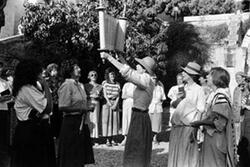
Founded in 1988 after a violent assault on women carrying a Torah, Women of the Wall was originally born as a religious approach to end sexism at the Kotel. Consolidated during the chagim, Jewish High Holidays, the protests were focused on enriching the women’s side, not demeaning the men’s. Neither police nor other conciliatory parties could prevent the “spitting, cursing and grabbing” that trampled the feminists’ efforts. But the women were determined. On the night of Taanit Ester, a celebration of the courage that the protagonist Esther showed in the famous Purim Story, the modern-day trailblazers made a deal. They would be permitted to pray in the section, mixed in among Ultra-Orthodox women. This was huge because previously, only the wives of husbands who were praying were permitted at the Wall. However, the integration of the two sects did not hold the same luck as Esther had. The Women of the Wall were met with violent hostility from men and women alike, with reports claiming that women were attacked with "chairs, bottles and diapers.” Still, their fight did not end.
In 1989, a devastating blow to the movement came in the form of a Supreme Court Order. Women were officially forbidden from reading Torah and donning a tallit, or a prayer shawl. And the punishment for the crime of “hurt[ing] the feelings of the worshippers towards the place” is six months. This decree is still in effect today.
Meanwhile, on the Upper West Side, I live an incredibly egalitarian life. I go to a co-ed school and have male friends. I was raised on a diet of confidence and intellectualism, the saying “you are better than no one and no one is better than you.” My brother was never taught that he was superior to me in any way because he is my brother and not my sister. And yet, I find myself struggling to relate to the Women of the Wall. The same women who fight for the equality I take for granted are the women who I fail to deeply resonate with
One of the reasons for my hesitation, I suspect, is my devotion to my own prayer space. I attend an Orthodox synagogue with a mechitza, a partition that separates women and men. The silky cloth that separates my father from me is physical, but I don’t see it as a fracture. It’s meaningful, a way of commanding myself to settle into the aroma of Shabbat. I have no distractions in synagogue; I have nobody but myself. While I could talk to the women around me, and occasionally I do, it feels like everybody is there on their own: A community of people trying to sit with themselves. I’ve never felt that I was unequal in that segregation. I’ve never felt like the hierarchy of Judaism placed God first, men second, women third.
What I’ve realized from defending that form of prayer is that I don’t believe modern-day activism always has a place in religion. Sometimes, what keeps things holy is that they are above the turmoil of moral squabbles and temporary elections. For me, God is above the three wings of government, just like the Western Wall is above the sexist interpretations of the Orthodox community. They are hundreds of years old, outliving our ancestors and our predecessors. They have survived through the darkest times in history, wars that felt infinite. These things are inherently holy; it is humans that taint them with mortal challenges. And while politics sometimes involves questions of all human lives and dignity, such as the issue of abortion, I believe there are appropriate and inappropriate times to address political issues. For me, the Kotel is not one of those appropriate spaces. It is sacred, like Narnia, and it deserves respect.
There is a fundamental issue with sexism in religious Judaism. It stems from internal beliefs, that is mentioned in the Torah, that women are to be dominated by men. Some Jews take this and apply it to everyday life, using God as an excuse for my sonify. But that is a man-made problem. Those believers should separate gender politics from our ancient script. And similar to the Western Wall, the Women of the Wall should be advocating for their equality in courtrooms and panels, not in front of the last remaining structure of the Second Temple. Judaism is ancient and eternal. It ascends past the grasp of our minds and our souls. The Kotel deserves to be left out of politics, no matter how righteous the issue, in today's day and age. And while I wish the best for the Women of the Wall, I wish to support them from a different protest site. Just not in front of the Western Wall, in front of all those sacred wishes.
This piece was written as part of JWA’s Rising Voices Fellowship.
Double your impact to amplify Jewish women’s stories—
All gifts matched up to $35,000
Before you close this article, please consider supporting the Jewish Women’s Archive and uplifting Jewish women’s voices.
At JWA, we preserve the voices of Jewish women and gender-expansive people past and present, share them freely with millions online, and empower a new generation of Jewish feminists to lead with courage, creativity, and conviction.
But none of this happens without you. JWA is an independent nonprofit— we rely on people, like you, who believe that history belongs to all of us and that the voices of Jewish women must remain powerful, and heard.
This month, a generous JWA board member will match every gift dollar for dollar—up to $35,000—through June 30. Your contribution goes twice as far right now.
Every contribution—no matter the size—helps us document, teach, and inspire through Jewish women’s stories.
It takes less than a minute to make a difference.
Thank you for being a part of the JWA community,
Judith Rosenbaum, CEO