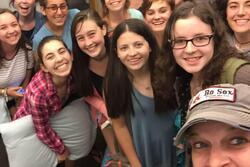
South Side Proud: Finding Pride and Place in Community


In Hebrew, darom simply means “south.” It is a directional marker, a point on a compass. But to me, darom is not just a coordinate; it is an identity. It is also Darom #5073, the Southside Chicago chapter of the B’nai B’rith Youth Organization (BBYO). When the heavy wooden gavel struck against the table in the synagogue social hall, ending our elections and swearing me in as the very first Morah, or Members in Training (MIT) Mom, the sound didn’t just signal the end of a meeting. It echoed a legacy I had previously struggled to access.
For much of my life, my connection to Jewish history has been fraught with a quiet, nagging sense of inadequacy. There is a specific type of suffocation that happens in third grade when you open your chumash, the five books of Moses, only knowing half of the Aleph-Bet. It is the same one that happens in a synagogue, sitting in the velvet-lined pews, surrounded by the rhythmic murmuring of liturgy I cannot translate. I choke on the Hebrew words that feel like foreign stones in my mouth. In those spaces, where Judaism is defined by fluency in ancient texts, I feel like an impostor. I find myself asking the same two questions: Am I Jewish enough? If I cannot decode the prayers of my ancestors, is their history even mine to claim?
This is the central complication of my identity: I am drawn to the intimate rituals of home, yet alienated by public worship. The lighting of the Shabbat candles on Friday night at my dinner table always feels different from the ones lit for me at synagogue. I yearn for belonging, but I remain separated by the barrier of language.
The B’nai B’rith Girls (BBG) and the Aleph Zadik Aleph (AZA) have existed as a youth movement since the mid-1940s and 1920s, respectively, the sister and brother constituents of BBYO as a whole. They have a massive, weighty history of their own. Yet, unlike a synagogue, BBYO didn’t ask me to memorize its history; it asked me to make it. When Darom #5073 was founded, we weren’t just joining a chapter; we were creating something more for Jewish teens on the Southside of Chicago, a geographic area where we are often the minority.
The etymology of darom is fittingly poetic. The linguist Ernest Klein notes that the root for the Hebrew word darom is actually of uncertain origin. It is a word whose meaning points one in a specific direction, yet linguistically, its beginnings are hard to find. That is our chapter. Like the word, our origin is uncertain. We didn’t inherit a thriving group with decades of tradition. We were the founders. We were the origin point.
As the chapter’s Morah, I was tasked with guiding the newest members, the future of the scrappy, vibrant group we were building. Standing in front of my chapter, being inducted into a position of leadership, the timeline of Jewish history seemed to fold over on itself. The gap between the original BBYO founders of 1944 closed. I realized that they, too, were just teenagers, forging a sense of belonging within their own worlds. We were separated by decades, but united by the same belief that we could build the community we wanted.
This realization changed my relationship with the suffocating feeling I felt in religious spaces. History became more than the static list of rabbis and prayers written in antiquity. History is also a group of teenagers on the Southside of Chicago, slamming a gavel onto a plastic folding table to open a BBYO chapter meeting, upholding a century-old tradition of Jewish connection, deciding they matter. Through BBYO, I earned my Judaism through something beyond study. However, while BBYO empowers me, I still feel disconnected elsewhere.
When surrounded by other Jewish teens, I feel an undeniable connection to the Jewish people. I feel powerful. But the weekend ends, and I return to my secular school, the power dissipates. I am brought back to a Judaism where the expectations feel rigid. I am returned to a place where my identity is defined by the limited, closed expectations of others: perfect Hebrew and a kosher lunch. It happened when I explained the convention to them, describing the energy of the Havdalah circle. My friends just stared back, offering a tentative “So it’s like Hanukkah?” In their blank expression, they could only imagine me praying the whole weekend, wondering why I couldn’t do my ‘Jewish stuff’ at home. Seeing that, to them, my community was reduced to a checklist of rituals, I am left with the realization that my “BBYO Judaism” may not always translate to the rest of the world.
This tension between my Judaism and what is expected of it is something that I am learning to live with, that it is acceptable for connection to be complicated. In BBYO, we are defining what it means to be Jewish in a space where the definition isn’t handed to us on a silver platter.
The gavel strike naming me chapter Morah didn’t solve my impostor syndrome completely. I still stumble over the Hebrew, I still worry about my place in the grand theology of my people. But when I look at Darom, I know one thing for sure: we are not waiting for history to accept us; we are writing the next page.
In Darom, we end every election speech with a specific sign-off, a ritual that reminds us that, whether we win or lose, we are grounded in gratitude. It is a way of acknowledging the people and places that built us. So, in the spirit of this home, I will end this the only way I know how.
Written with undying love for the chaos of Spring Convention, Darom Shabbat dinners, and my fellow founding members, for the Great Midwest Region #61, and the South Side siblinghood of Darom #5073: My origin may be uncertain, but my direction is true. I remain, forever Venice Czarnecki-Lichstein, a damn proud BBG.
This piece was written as part of JWA’s Rising Voices Fellowship.
Double your impact to amplify Jewish women’s stories—
All gifts matched up to $35,000
Before you close this article, please consider supporting the Jewish Women’s Archive and uplifting Jewish women’s voices.
At JWA, we preserve the voices of Jewish women and gender-expansive people past and present, share them freely with millions online, and empower a new generation of Jewish feminists to lead with courage, creativity, and conviction.
But none of this happens without you. JWA is an independent nonprofit— we rely on people, like you, who believe that history belongs to all of us and that the voices of Jewish women must remain powerful, and heard.
This month, a generous JWA board member will match every gift dollar for dollar—up to $35,000—through June 30. Your contribution goes twice as far right now.
Every contribution—no matter the size—helps us document, teach, and inspire through Jewish women’s stories.
It takes less than a minute to make a difference.
Thank you for being a part of the JWA community,
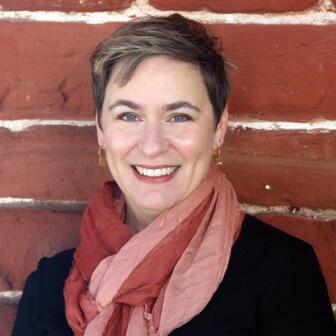
Judith Rosenbaum, CEO