She Who Wears The Star Chooses Her Burdens


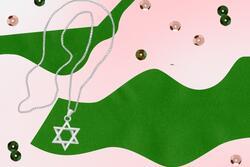
Link after link, the small, identical golden rings clasp onto each other, almost imperceptible to the human eye. The line of them is interrupted only by the small knot they tied around themselves when I wasn’t looking. Though they stretch and hang, when taut, they are stronger than I am. They don’t crack under any pressure or pull; they hold strong and fast in times when I would give in to weakness. They drape themselves over my shoulders, slithering down my collarbone, sagging by the small, matching golden charms that hang and tangle, weighing down the sliver of a chain. The two charms complement each other, never one without the other, whispering their secrets and history just out of my ears’ range. Though the Star of David pretends to be humble by hiding behind the larger cursive M charm (for Madeline), it shines brighter, the green stone encased within it glistening and catching the light at all the right times.
A common sight on many Jews, especially women, the necklace—whether carrying a Star of David, hamsa, chai (the letter, not the drink)—has become a staple of modern Jewish culture. The symbols have made their way around the world. More specifically, the Star of David historically can be traced from Buddhism, with the goddess Lakshmi to represent material fortune and abundance, to 18th-century alchemy texts. However, it is often argued that the symbol first appeared for Jews on the shields of King David’s army. For a long time, it was an image of prosperity and Jewish pride. However, in the 20th century, during the Holocaust, it was weaponized. Holocaust victims often had to have a yellow star sewn onto their clothes (many times along with the word “Jude” for Jew) and printed into their passports. It was used as an obvious segregation, labeling Jews as “other.” However, by wearing it now, I am embracing that “other” label, in separation from non-jews, and reclaiming the heritage that was stolen away.
My star comes from my mother. Last year, my mom joined a group of about 20 women who went to Israel and spoke with survivors of sexual assault and rape from the attacks on October 7th. Because this trip was so dangerous from the war, my mom and her group weren’t allowed to leave the hotel to do any shopping whatsoever. However, one jeweler came to them. When the jeweler visited, my mom found this charm for me. A golden Star of David with a small emerald (her birthstone) encased in the middle. She was hidden and in danger, but she still didn’t forget her Jewish identity. That is how I feel when I wear it, too, as though I am constantly remembering who I am and who came before me.
My mom is my role model. She embodies all that is strong and brave about being a feminist; she has taught that to my sisters and me. To be a feminist is to be someone not asking for a new world, not asking for women to control everything, but to be someone asking for respect, equality, and change. For me, being a Jew is very similar; it is simply asking for recognition and respect of existence. There is no real hierarchy between genders, nor between religions. The only hierarchy is the one that exists in our perceptions, which is what we must fight against.
The “M” on my necklace has only left my neck once since it was given to me for my bat mitzvah by my grandmother, and that was only to add on the star that my mom, her daughter, had picked out for me in Israel. The symbols of three generations hang around my neck: my grandmother, my mother, and me. The M charm, for Madeline, was given after my bat mitzvah to celebrate the fact that I was officially a Jewish woman and that I should “wear that fact with pride.” My name itself was a gift from my other side of the family, Madeline being my dad’s maternal grandmother (my great-grandmother), gone just before my birth, with only a name to leave me. I carry these women and their stories around with me everywhere I go, embracing the culture that follows me. I share the tenacity and joy of these women, traits I find reflected time and time again in my temple with the other Jews that are in my life. But it's not always easy.
One day, last year, I was touring colleges with my dad. We were at a school I had really loved when we overheard a guy shouting with a sign and a boombox. “F*** Jews!” he shouted as he watched us walk past. The tour guide carried on, explaining that “this happens sometimes” and that “there’s no real danger,” that it's better to simply move past it as though it weren’t there.
But he was there.
Although this was only one occurrence, it is a very true reality for so many Jews in the world right now. Situations such as that one drag along an unspoken promise of unpredictability and danger for anyone bold enough to wear the star around their neck. I am sometimes glad that my star hides behind the larger charm, out of sight, out of recognition. It is a bit smaller, and it makes all the difference for my safety. But just because it is small, it doesn’t mean it's not there. Although I am not always aware of its existence around my neck, nor are others, it is always there. You cannot escape yourself, cannot escape identity. This realization can be such a blessing, because it welcomes the possibility of community wherever you go. I love that I am a Jewish feminist, whether or not my charms hide, they are always with me, reminding me of who I am and the women who came before me.
This piece was written as part of JWA’s Rising Voices Fellowship.
Double your impact to amplify Jewish women’s stories—
All gifts matched up to $35,000
Before you close this article, please consider supporting the Jewish Women’s Archive and uplifting Jewish women’s voices.
At JWA, we preserve the voices of Jewish women and gender-expansive people past and present, share them freely with millions online, and empower a new generation of Jewish feminists to lead with courage, creativity, and conviction.
But none of this happens without you. JWA is an independent nonprofit— we rely on people, like you, who believe that history belongs to all of us and that the voices of Jewish women must remain powerful, and heard.
This month, a generous JWA board member will match every gift dollar for dollar—up to $35,000—through June 30. Your contribution goes twice as far right now.
Every contribution—no matter the size—helps us document, teach, and inspire through Jewish women’s stories.
It takes less than a minute to make a difference.
Thank you for being a part of the JWA community,
Judith Rosenbaum, CEO