
My Tallit: Sewing My Inheritance


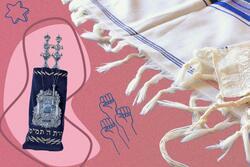
In my family, there weren’t really any heirlooms. There are no shelves of beloved objects carrying stories from the past. My home felt empty. So, with no heirlooms to be passed down, my mother created something new: my tallit, stitched with her love, just for me. For my bat mitzvah, she wove it herself, thread by thread, stitch by stitch; it was entirely ours. Into it she wove a story, one of my own, one of my family’s, and a new kind of legacy. At each corner of my tallit, my mother embroidered hot air balloons, just as I requested. At thirteen, I didn’t know why. But there was something freeing about them, something special in the way they fly, something in their steady ascent that hinted at the divine. The tallit echoed Jewish tradition, yet each corner featured my own voice. This transformed the tallit into something more than just a prayer shawl; it became a symbol of my connection to Judaism.
For centuries, the tallit has been a garment of male authority, a physical representation of a commandment reserved for men. To some Jews, the thought of a woman wearing one is still unthinkable. Yet, in my home, it became my most cherished heirloom, a symbol of a ritual that honors not only what was, but what can be.
Standing on the bimah for the first time at my bat mitzvah, draped in the tallit, its weight sank into my shoulders. For so long, women had been barred from wearing a tallit and reading Torah, yet here I was, doing both. The tallit, a reminder of G-d’s commandments, rooted me to a present where I belong, even as it pushed through a history that once excluded women from studying Torah and leading prayer.
But belonging is not a guarantee. In confirmation—a Reform practice in which a teenager confirms their commitment to Judaism at an older age than a Bat Mitzvah—I was pushed to explore a world of Judaism beyond ritual. I learned that wearing a tallit or reading from the Torah were not the only ways Jewish women claimed space once denied to them. Advocacy was an extension of that same struggle: the fight to be heard, counted, and to have a voice in shaping our future. In speaking up for issues such as reproductive rights or gender equality, my shoulders felt the same weight they did on the bimah, a heavy reminder of barriers and responsibility. Through my tallit, I understood that my Judaism and feminism were not separate, but woven tightly together in the pattern of who I was becoming.
On the Saturday of my confirmation, I neatly folded my tallit into its bag and carried it to shul. I read Torah again, though this time a little less nervously. And yet again, as I draped my tallit over my shoulders, its texture made the abstract idea of faith tangible.
Who I am now is also an echo of Jewish mothers and grandmothers who had long played quiet roles, nurturing faith when most were not given a place for their own. Building on their legacy, I am also a reflection of my own mother, who gave me something that was not hidden but visible. Something entirely mine. She not only passed on a ritual object to me, but a way that I could experience Judaism fully, claim my space, and reshape it for me.
I used to think that a change in tradition required a break, that one must abandon the past to make space for the new to emerge. But on high holidays, as I wrap myself in my tallit once again, surrounded by Jewish tradition, I am reminded that Jewish life is defined by adaptation, defined by breaking adherence to conceived social norms. I now understand tradition as something fluid, evolving with the people who live it. Women before me gently pressed at the edges of tradition, testing what would give way, forging paths in the margins. Their struggle and persistence open the space where I now stand, carrying their work into my own life.
In the same way that those women made their faith, my mother helped me make mine. Through her hands, her patience and care transformed a meaningless thread into a meaningful object, carrying the past forward while embracing the future in me. Its stitches are calls to change. Draped in it, I am both bound and unbound, cradled in heritage by arms that affirm a new voice. In wearing it, I not only remember what was but illuminate what can be. In wearing it, I carry the flame of Jewish feminism forward.
This piece was written as part of JWA’s Rising Voices Fellowship.
Double your impact to amplify Jewish women’s stories—
All gifts matched up to $35,000
Before you close this article, please consider supporting the Jewish Women’s Archive and uplifting Jewish women’s voices.
At JWA, we preserve the voices of Jewish women and gender-expansive people past and present, share them freely with millions online, and empower a new generation of Jewish feminists to lead with courage, creativity, and conviction.
But none of this happens without you. JWA is an independent nonprofit— we rely on people, like you, who believe that history belongs to all of us and that the voices of Jewish women must remain powerful, and heard.
This month, a generous JWA board member will match every gift dollar for dollar—up to $35,000—through June 30. Your contribution goes twice as far right now.
Every contribution—no matter the size—helps us document, teach, and inspire through Jewish women’s stories.
It takes less than a minute to make a difference.
Thank you for being a part of the JWA community,
Judith Rosenbaum, CEO