
How Rebecca the American Girl Doll Shaped My Perception of a Woman’s Role in Judaism


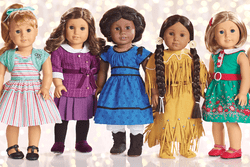
When I was little, I loved the Rebecca American Girl Doll books. I remember reading about how Rebecca and her sisters would sit and sew pieces for their wedding chests while their brothers practiced Torah.
I tore through the Rebecca books. I loved the way I could see my own family’s Shabbat traditions reflected in her stories, the way our shared theatrical ambitions shone through a character so much like me. It never bothered me that Rebecca didn’t have a bat mitzvah because I understood the historical context, but the ways in which her brothers’ bar mitzvahs and religious upbringings were portrayed made me wonder about deeper traditional biases and everything that stays unsaid and unwritten.
It is unfortunate to me that the “feminine” act of creating art and the “masculine” act of learning and studying Torah have been mutually exclusive for so long, because they feel so interconnected. Torah has never been straightforward— maybe the reading of it, but never the interpretation part. The creativity that works in tandem with sewing pieces for a wedding chest seems necessary to interpret Torah in new ways, because people who have never been given the opportunity to be creative will never achieve the full potential of their critical thinking and interpretation skills. Additionally, if only one group of people is given the opportunity to read and interpret such sacred text, the dialogues and conversations that are so integral to Judaism are going to be short-lived. Observing the words of the Torah through an artistic lens and offering the opportunity to read and question to all people, not just men, is crucial in leading the way towards more diverse viewpoints and more complex conversations.
In my house, we have a bowl full of kippot. It’s huge and wooden and has sat in the same spot since I was twelve, ready and waiting for my dad or brothers to grab a kippah and head out the door. They are embroidered with “Ben’s Bar Mitzvah,” or “Mazel Tov, Josh,” or “Singer Family Reunion, 1993”. Amongst the shiny blue, silver, and pink, three kippot are different. Bought in Israel and embroidered by hand, my dad and brothers know exactly which kippot they reach for when it comes time for services. However, there are only three – none for me or my mom, which, intentional or not, left me searching for a piece of my own.
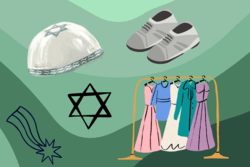
I bought my kippah at a vintage store. White knit with a silver Star of David in the middle, tucked behind handkerchiefs and candlesticks in the store’s minuscule Judaica section, it felt like something I could make my own. No matter how mass-produced it actually was, I could imagine my bubbe—or anyone’s bubbe—sitting, cup of tea in hand, meticulously knitting every stitch, with hopes that it would someday enter a synagogue, resting proudly on the head of her great-granddaughter. Being the first piece of Judaica I ever bought for myself, my kippah is so much more than a head covering. It’s a declaration of feminism in any Jewish space I enter, a way to gain autonomy over my own Jewish practice, and even a way to connect me to generations of women who never had the privilege of wearing one themselves.
Kippot are not a traditionally feminine garment. But at my reform synagogue, women walk around wearing kippot all the time, and I am grateful that it is nothing new to me.
One of the first times I wore my very own kippah to the synagogue for Friday night Shabbat services, I noticed my rabbi wearing the same one across the room. It was an odd moment of connection for me, seeing someone I so deeply respect sporting the same sacred head covering. Every time we would show up to services wearing matching kippot, I felt a part of something bigger than myself. I had become so integrated into this Jewish community that I was unintentionally twinning with the rabbi on multiple occasions!
I love wearing my kippah in any Jewish space because, no matter what volume I speak at, no matter what loud political declaration I make or don’t make, my kippah communicates something about me. Subtly breaking traditional gender roles by bobby-pinning my thrifted silver-and-white knit kippah to my frizzy curls might not mean anything to anyone else, but it really doesn’t need to. To me, it represents the intersection of my Judaism and feminism.
As I see it, women in Judaism have covered their hair for thousands of years—a form of submission to their husbands, maybe, or to God. While there’s nothing wrong with that, looking at a head covering as a form of empowerment rather than submission is important for me as I grow into an activist and young adult who has always been propelled forward by Jewish values. My kippah represents so much more than a head covering. It’s a way to carry my Judaism with me, a constant reminder to live by the values that shape me; to act with love and kindness, to build community, to always try to make the world a better place.
As I navigate life as a Jewish teenager, I hope to think of myself as something of a modern-day Rebecca, but one with the permission to read Torah and the drive to interpret it. My creativity does not primarily manifest through sewing, but through writing, just as Rebecca found her spark in acting.
As I wear my kippah, I have found that it makes me stand out. Not in a “pick-me” way, just a subtle she cares way that isn’t regularly seen in secular spaces. I hope that through wearing it, I can communicate that she cares about Judaism, she cares about feminism, she cares enough about both of those things to defy social norms and stab pins into her head, loud and proud. I love how my kippah connects me to Judaism and to the increasing complexity of what it means to be a woman in a Jewish space. Even just existing as a woman in Judaism has an air of resistance to it, but proudly wearing a traditionally male headpiece seems an ever-defiant act.
This piece was written as part of JWA’s Rising Voices Fellowship.
Double your impact to amplify Jewish women’s stories—
All gifts matched up to $35,000
Before you close this article, please consider supporting the Jewish Women’s Archive and uplifting Jewish women’s voices.
At JWA, we preserve the voices of Jewish women and gender-expansive people past and present, share them freely with millions online, and empower a new generation of Jewish feminists to lead with courage, creativity, and conviction.
But none of this happens without you. JWA is an independent nonprofit— we rely on people, like you, who believe that history belongs to all of us and that the voices of Jewish women must remain powerful, and heard.
This month, a generous JWA board member will match every gift dollar for dollar—up to $35,000—through June 30. Your contribution goes twice as far right now.
Every contribution—no matter the size—helps us document, teach, and inspire through Jewish women’s stories.
It takes less than a minute to make a difference.
Thank you for being a part of the JWA community,

Judith Rosenbaum, CEO