Holding Faith at Arm’s Length


Philosophy and theology. They’re supposed to be separate, right? But there’s this moment in Lucretius’ De Rerum Natura that shook my faith—and far more than I thought philosophy, with all its annoying questions and words ending with “ism,” was capable of.
Lucretius was a Roman poet-philosopher born two thousand years ago, and it's safe to say he would thoroughly disagree with the existence of the Jewish Women’s Archive. In addition to summarizing all women as “hateful and loud,” Lucretius was deeply suspicious of religion. He believed the Greco-Roman gods existed, but that they were distant, unconcerned with human suffering. The cruelty in the world, for him, didn’t come from divine will—which he considered powerless within itself—so much as from what humans will do once they think the divine has granted them permission.
To make that argument, he began with a story. And let me warn you, he granted his readers no gentle introduction:
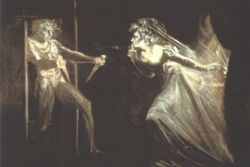
A girl is pinned down while her father watches. The men restraining her are not enemies, but attendants. They lift her carefully. They raise a knife. Her father, Agamemnon, does not look away. He believes a god has demanded this sacrifice. He believes that obedience will protect his people. He kills his daughter not in madness or hatred. He kills his daughter in faith.
I love my faith, so initially, facing a narrative so similar to the binding of Isaac, I expected to argue with Lucretius’s portrayal of a faithful person, to search for some misreading or error. I was ready to do what anyone would do when their worldview gets challenged: hit it with a highlighter and pretend that counts as refutation.
But that's not what happened. Because Lucretius made a fantastic argument. His ideas had the neatness of the textbook-perfect essay. He checked every box:
Plausible claim: check.
Effective evidence: check.
Careful, clear analysis: check.
I had no reason—besides, perhaps, my 17 years of Jewish education—to disagree with his claim that faith equals evil. And to make matters worse, he made me understand something I didn’t want to: the terrifying efficiency of belief.
Until that moment, I had considered Judaism to be a framework that would naturally bend towards good. And if someone wanted proof, I had it ready: “Shall the Judge of all the earth not deal justly?” I carried the line like a spiritual multipurpose tool—open a box, fix a bike, solve emotional chaos. Whenever something felt inexplicable or unfair, I could hold up the verse like a flashlight and tell myself, “See? Justice is here somewhere.”
I pictured G-d as some landscaper who trimmed all overgrowth, removed all weeds, and pruned all trees that might threaten the harmony of my garden. He would leave the scene orderly. I was comforted to see that even in chaos, there was a caretaker, a just one to repair the damage I could not prevent.
Then Lucretius hands me Agamemnon, and suddenly my metaphor begins to sweat. Because in Agamemnon’s equation, his faith doesn’t tell him the solution is to “be patient” or “trust the process.” The solution, of course, is “murder your own daughter.” Because, of course, that kind of work would fix things. And Agamemnon actually does exactly what is instructed. Faith succeeds. It efficiently supplies the answer. It removes uncertainty. It tells him what must be done.
I had used my faith for that type of forward motion before. Now, to be clear, not in a human-sacrifice context. But when faced with questions bigger than I thought I could handle, I let belief fill in the blank and kept going. That same habit—simply relocated in myth—led to disaster. Agamemnon’s devotion does not elevate him, but hollows him. His faith makes him certain, and when certainty arrived too early, it became lethal.
I didn’t lose my faith while reading Lucretius. But I did lose my willingness to let faith finish my sentences for me. My faith was not dangerous because it asked too much of me, but because I asked too much of it. When belief supplies an answer before critical thinking has done its work, it cannot elevate morality. Agamemnon fails because his devotion crowded out his discernment.
So no—philosophy and Judaism were never meant to be competing systems. One shouldn’t replace one with the other. Philosophy without faith can become sterile; faith without thinking can become reckless. And Judaism, at its core, never asked for that replacement from me. The problem wasn’t my tradition, but my use of it.
Take, for instance, my English course this past semester, where we spent months reading John Milton’s Paradise Lost. In the first weeks, I relentlessly attempted to insert my Jewish perspective into my analysis of a Christian epic. I found, though, that my faith wasn’t meant to rewrite Milton’s work, only to shape how thoughtfully and curiously I read it.
That is where my connection to Judaism now feels more honest: not in certainty, but in accountability. Faith no longer arrives to close the question. It stays in the room while the question is being asked—unless the question is a math problem, in which case faith seems to provide no help at all.
Still, the shift left a scar. What lingered for me was distance. After Lucretius, faith stopped feeling like a place I could rest inside and more like something I had to hold at an arm’s length, aware of what it could do if I let it speak unchecked. I didn’t lose G-d that day, and I didn’t lose my faith the day I read those sentences. But I did lose the ability to let that faith go unquestioned.
This piece was written as part of JWA’s Rising Voices Fellowship.
Double your impact to amplify Jewish women’s stories—
All gifts matched up to $35,000
Before you close this article, please consider supporting the Jewish Women’s Archive and uplifting Jewish women’s voices.
At JWA, we preserve the voices of Jewish women and gender-expansive people past and present, share them freely with millions online, and empower a new generation of Jewish feminists to lead with courage, creativity, and conviction.
But none of this happens without you. JWA is an independent nonprofit— we rely on people, like you, who believe that history belongs to all of us and that the voices of Jewish women must remain powerful, and heard.
This month, a generous JWA board member will match every gift dollar for dollar—up to $35,000—through June 30. Your contribution goes twice as far right now.
Every contribution—no matter the size—helps us document, teach, and inspire through Jewish women’s stories.
It takes less than a minute to make a difference.
Thank you for being a part of the JWA community,


Judith Rosenbaum, CEO