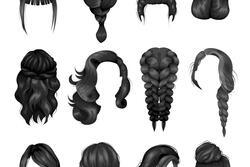
Embracing My Natural Curls


From the moment I was born, I had thick, black, curly hair. I was a tiny little girl with a ginormous head of coils. I didn’t mind this at first, but as I began to grow up, not only did my hair become harder to manage, but I started to hate how I looked with curls. I remember standing in front of my mirror the morning of sixth-grade picture day. I tugged at the ends of my hair, wishing it would just lie flat like everyone else's. Most of my friends are white and have straight hair, and mine felt “too ethnic.”
In middle school, the desire to conform led me to start straightening my hair every day. I dreaded walking through the halls with my frizzy hair taking up so much space. It was so loud and noticeable. It made me feel messy and dirty. Straight hair felt more neat and put-together, like the kind that didn't draw attention. I always thought that was the desired look, so I spent all my allowance on hair straighteners, heat protectant, and blow-dry brushes to change my appearance. People who knew me then had no idea about my natural curls. I looked exactly how I wanted: like every other girl in my school.
Entering high school, I began to reconnect with my Jewish roots. I wanted to become more involved in my Jewish community, so I joined the Rosh Chodesh group at my synagogue and influenced my family to observe Shabbat. Ashkenazi, Sephardi, and Mizrahi Jews often have naturally curly or textured hair, a connection I later learned more about in an article from New Voices titled "When Hair Means More Than Just Hair: A Deeper Take on Jewish Curls." Seeing Jewish women with hair like mine made me pause each morning before picking up my straightener.
I started to examine myself through a feminist lens. If I could look at a woman and think their curly hair is beautiful, then why couldn’t I think the same thing about mine?
Beauty standards have always been tools of control, reinforced by capitalism. The beauty industry profits from convincing women that something about them needs fixing, and standards create a constant demand for products that promise an unattainable “ideal.” Self-confidence becomes threatening in this system. If women believe they look good naturally, there's no purpose in purchasing products designed specifically to "correct” their appearance. For so long, we have been taught to resent our own features and assume we're only presentable after modifying our natural selves. In reality, women should have agency over their own bodies.
Still, with this in mind, I stood in front of my bathroom mirror two years ago with my blow dryer in hand. I remembered a girl at my synagogue complimenting my curls when I wore them to a Shabbat dinner the week before; she told me they looked "so fresh and alive!” I suddenly wondered why I was trying so hard to erase the one feature that connected me to my family and culture. That thought made me pause, and I put the blow dryer down. I realized that I don’t need to alter my natural hair to fit in and take up less space. My curls are big and voluminous, and they reflect my various identities: the thickness passed down from my Colombian relatives, who immigrated to the U.S. with stories braided into their hair, and the texture I share with generations of Jewish women before me, from my grandmother who wore her curls to synagogue in the '60s to my mom who spent her own middle school years fighting with mousse and heat.
At that moment, I reached into the back of my closet and pulled out the curl cream I hadn’t touched in years. This was the start of my curly hair journey.
My hair is now free of heat damage and falls down to my waist. There is no “taming” of my curls, because the “wild,” “messy,” and “unruly” appearance is exactly what makes it so unique and powerful. My hair is different; it stands out. Its texture, volume, and resistance to falling flat and being controlled reflect my refusal to accept beauty standards and conform.
Embracing my natural hair is more than just a style choice: It represents my identity as a Jewish woman of color. Wearing my natural curls unapologetically honors every part of who I am and who came before me.
This piece was written as part of JWA’s Rising Voices Fellowship.
Double your impact to amplify Jewish women’s stories—
All gifts matched up to $35,000
Before you close this article, please consider supporting the Jewish Women’s Archive and uplifting Jewish women’s voices.
At JWA, we preserve the voices of Jewish women and gender-expansive people past and present, share them freely with millions online, and empower a new generation of Jewish feminists to lead with courage, creativity, and conviction.
But none of this happens without you. JWA is an independent nonprofit— we rely on people, like you, who believe that history belongs to all of us and that the voices of Jewish women must remain powerful, and heard.
This month, a generous JWA board member will match every gift dollar for dollar—up to $35,000—through June 30. Your contribution goes twice as far right now.
Every contribution—no matter the size—helps us document, teach, and inspire through Jewish women’s stories.
It takes less than a minute to make a difference.
Thank you for being a part of the JWA community,

Judith Rosenbaum, CEO