
In Defense of the Wicked Child


Judaism was never a religion to me. For as long as I can remember, I viewed it as a system of values rather than a matter of faith. The idea of God was less appealing to me than the principles our teachings embodied, especially the Jewish value of questioning. I loved that my community encouraged me to interrogate tradition, to wrestle with big ideas instead of passively accepting them. Some may have thought my questioning was contrarian, but for me, it was a necessary step toward building the relationship with Judaism I sought.
I slipped easily into the role of the questioner. At seders, I defended the “wicked” child, insisting year after year that writing him off for saying לכם (you) instead of לנו (us) was counterproductive and a missed opportunity to welcome in someone who was struggling to belong. At school, I gained a reputation for relentlessly debating teachers and poring over texts until I was satisfied with the meaning I had found in them. It left me slightly adrift in services, uncomfortable with rote prayer, but it also gave me confidence that Judaism had room for me somewhere.
And then came my eighth-grade class trip to Israel.
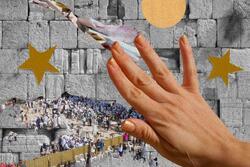
On the trip, we split up by gender for Kabbalat Shabbat. The boys headed to the men’s section of the Kotel, while we went down to the egalitarian plaza. Something about being there, with the sun setting behind us, as we stood in the same spot our ancestors did thousands of years prior, lit a spiritual spark in me I had never felt before. In that moment, the prayers I had mechanically recited for years finally felt like my own.
Then, I saw them. Or, rather, heard them. Three boys, no older than me, stood nearby, clad in matching Bob Marley sweatpants and kippahs slightly askew atop their heads. They screamed over our service, their taunts cutting through our songs. As we finished, flustered, and started up the stairs, they followed, throwing popcorn and spitting at us.
To them, we were intruders, and, as women praying aloud in a holy space, a violation of everything they stood for. To me, they were proof that the Judaism I thought I belonged to might not want me after all.
Back at the hostel we were staying at, a teacher noticed I was more shaken than others and pulled me aside for a conversation. Pleased to have someone to talk to, I explained my experience to her, how the boys had stamped out my budding spirituality before it had a chance to take root. I expected to receive at least comfort, if not solidarity. What I heard instead was a defense of the boys and a plea not to judge them too harshly. It felt as though my learning to accept the way things were was more important than teaching us that we should fight for equality, even if it makes others uncomfortable.
In that conversation, I realized questioning was only encouraged, only safe, if it stayed within the framework of compliance. When I criticized the interpretation of a text, I may have been slightly provocative at times, but I was still broadly accepting of the structure that had been set out for me. But when I began to examine the foundations of that structure—why women praying at the Kotel was a provocation, why my teacher’s instinct was to protect the boys instead of me—my questions were no longer welcome. Instead of probing into little details, they challenged the entire system, and that was a step too far.
After that night at the Kotel, my first instinct was to retreat. For the rest of the trip, I kept my siddur closed during services, if I even attended. I grew cynical; how could carving out my own little corner of the tradition ever be enough if others were still comfortable with a world in which my corner didn’t count?
When I got home, however, my mindset shifted. Watching my friends and family—especially those who had been at the Kotel with me—continue to embrace Jewish study and practice and find so much joy in it, I saw that by sitting quietly in the corner of the classroom or staying home from shul, I was wasting an opportunity to develop something meaningful. So, instead of focusing on the disappointing conversation, I returned to the brief moment at the Kotel, in the few minutes of song before the shouting began, when I finally felt like I had found my place.
Since then, I’ve held on stubbornly to that moment. That feeling, fleeting as it was, is the core of my Jewish identity today: The insistence that my experience matters, that my presence matters, and that my questions are not only valid but necessary.
To me, Jewish feminism means asking the questions others want silenced. It means refusing to accept that “don’t judge them” is an acceptable answer when what’s at stake is my belonging. It means defending the “wicked” child who dares to say “you” instead of “us,” pointing out a feeling of exclusion rather than stifling it to blend in. I know what it feels like to be told my questioning disqualifies me from the community I love.
This piece was written as part of JWA’s Rising Voices Fellowship.
Double your impact to amplify Jewish women’s stories—
All gifts matched up to $35,000
Before you close this article, please consider supporting the Jewish Women’s Archive and uplifting Jewish women’s voices.
At JWA, we preserve the voices of Jewish women and gender-expansive people past and present, share them freely with millions online, and empower a new generation of Jewish feminists to lead with courage, creativity, and conviction.
But none of this happens without you. JWA is an independent nonprofit— we rely on people, like you, who believe that history belongs to all of us and that the voices of Jewish women must remain powerful, and heard.
This month, a generous JWA board member will match every gift dollar for dollar—up to $35,000—through June 30. Your contribution goes twice as far right now.
Every contribution—no matter the size—helps us document, teach, and inspire through Jewish women’s stories.
It takes less than a minute to make a difference.
Thank you for being a part of the JWA community,
Judith Rosenbaum, CEO